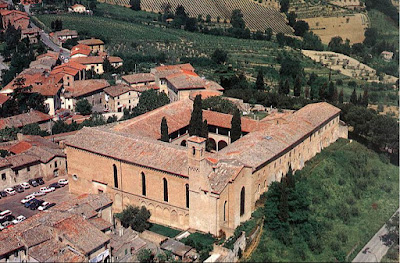
The first part of this, which was published on Sunday, the feast of St Augustine, ended with the scene of his conversion; here we pick up the story from his baptism. As in the first part, these public domain images are all taken from the Wikimedia Commons page on the choir chapel of the church of St Augustine in San Gimignano, Italy, where these frescoes were done by the Florentine painter Benozzo Gozzoli between 1463 and 1467.
Eleventh scene: St Augustine is baptized by St Ambrose. In accord with the tradition that the Te Deum was composed by them both on this occasion, the first words of it are painted on the wall behind them. Until 1913, the header “Hymnus Ss Ambrosii et Augustini” was printed in the breviary above it. In keeping with a common artistic convention of the period, after this, the Saint always appears anachronistically clothed in the habit of medieval Augustinian friars, which Gozzoli makes dark, but not black, which would clash too strongly with color scheme of the whole.
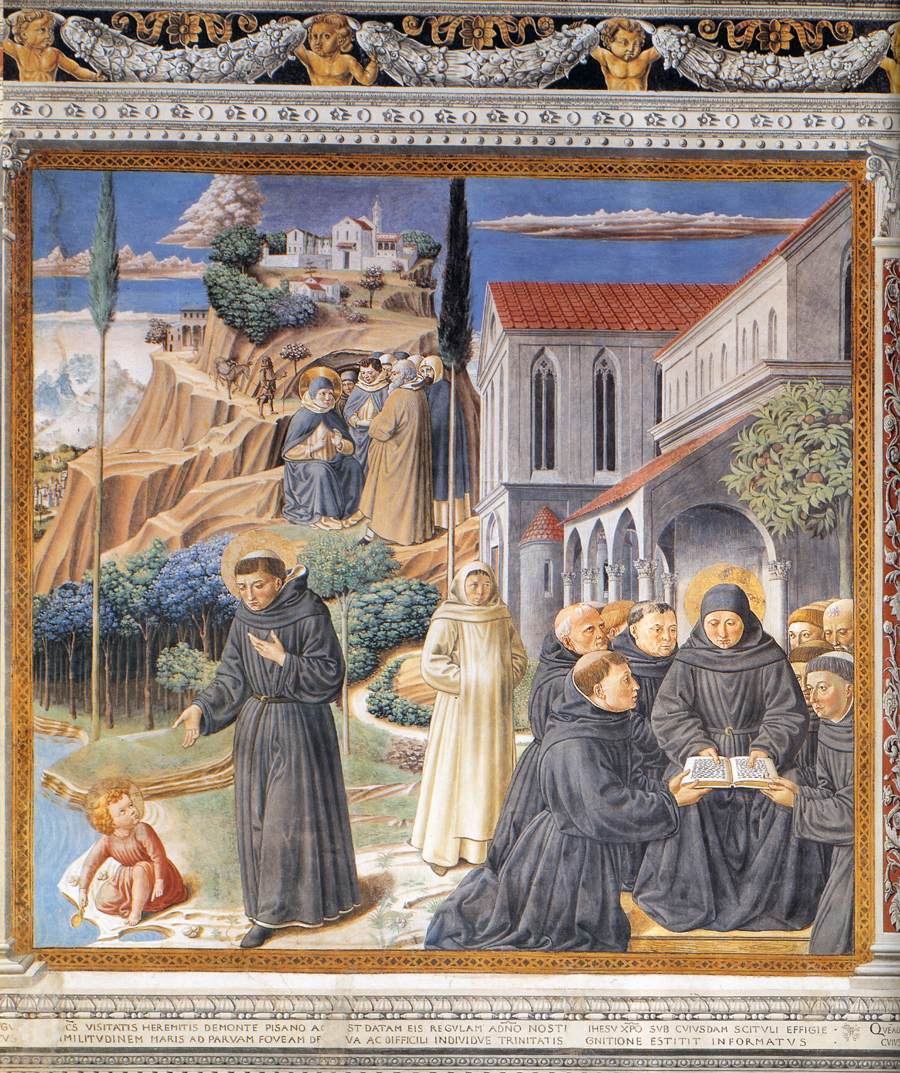
Twelfth scene: on the left, the famous (and apocryphal) story that Augustine, after finishing his book on the Trinity, went walking on the seashore, where he saw a boy trying to pour the ocean into a hole in the sand. When he told the boy that this was impossible, the boy replied that it was also impossible to fully explain the Trinity, and disappeared. In the background is represented a medieval tradition of Italian Augustinians that he once visited a group of hermits on Mt Pisano, about 40 miles to the north-west of San Gimignano. (The absence of any reference to a visit to Tuscany in his own writings was ingeniously explained as a lapse of memory, brought on by grief over the death of his mother, St Monica.) On the right, St Augustine is shown as a friar among friars, giving them the Augustinian Rule.
Thirteenth scene: the death of St Monica. This event, which is described in one of the most moving passages of the Confessions (book 9, 11-12), took place in the Roman port city of Ostia, well before Augustine returned to Africa and began to live in a monastic community. His departure is shown through the colonnade on the right. The Augustinian friar who commissioned these paintings, Fr Domenico Strambi, stands at the foot of the bed with an inscription underneath him to indicate who he is. St Monica was buried in Ostia, and her relics were kept there in the church of St Aurea until 1430, when they were transferred to the Roman basilica named for her son.
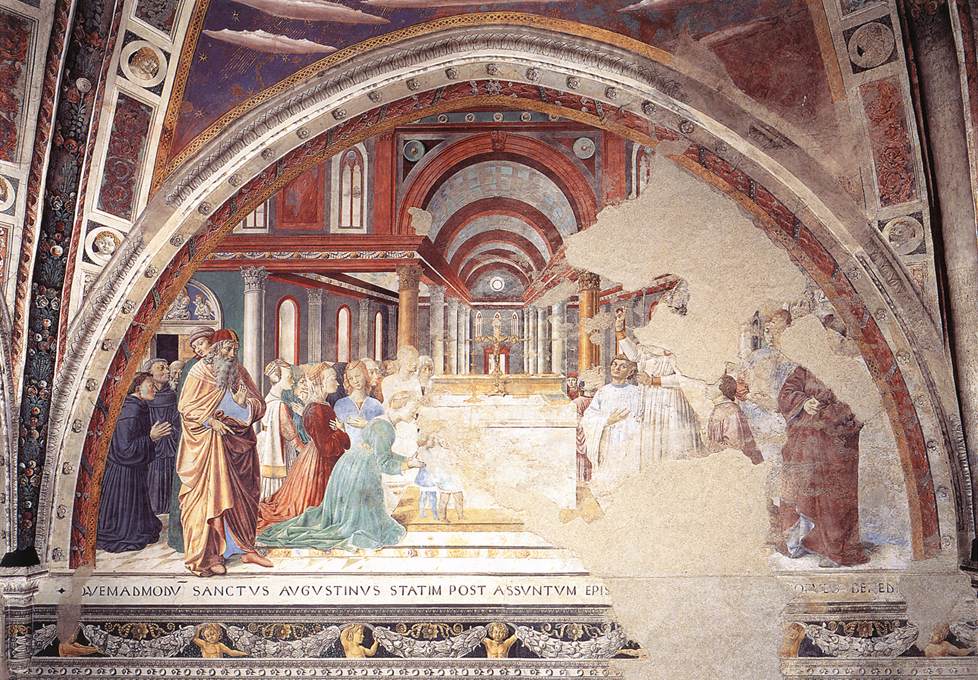
Fourteenth scene: St Augustine (barely visible on the right where the plaster has been damaged) blesses the people of Hippo after becoming their bishop.
Fifteenth scene: St Augustine converts a priest of the Manichean sect named Fortunatus. Note that he continues to wear his Augustinian habit under his cope.
Sixteenth scene: A representation of a legend that just as St Augustine was composing a letter to St Jerome, the latter appeared to him to inform him that he had just died, and was even then in the glory of heaven.
Seventeenth scene: the deceased St Augustine laid out on his funeral bier.
Gozzoli and his assistants also painted eight Saints on the pillars of the chapel’s chancel arch. On the left pillar, top left, St Monica,
and top right, St Geminianus, a bishop of Modena who died in the late 4th century, and was adopted as the patron of San Gimignano, of which he holds a model in his hands, with its famous medieval towers.
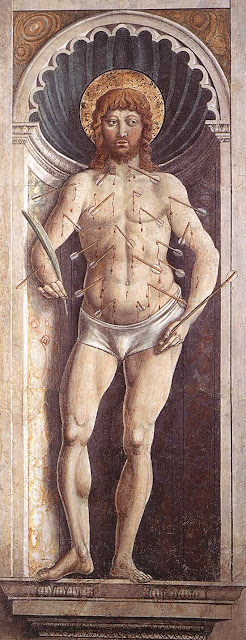
At the bottom left, St Sebastian, patron against plagues, undoubtedly included because of a serious plague that was afflicting Tuscany at the time, and which caused the artist to leave his native Florence.
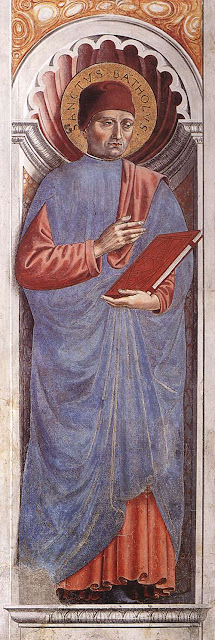
Bottom right, St Bartolo, a native of San Gimignano and priest of the Franciscan Order, who devoted his life to taking care of lepers after contracting the disease himself.
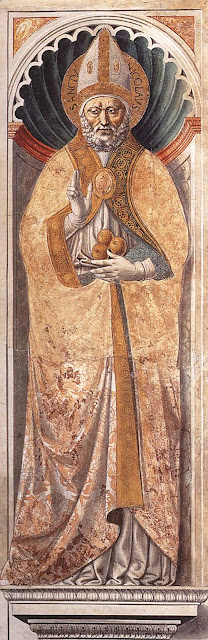
On the right pillar, top left, St Nicholas, one of the most popular and frequently depicted Saints in all of Italy.
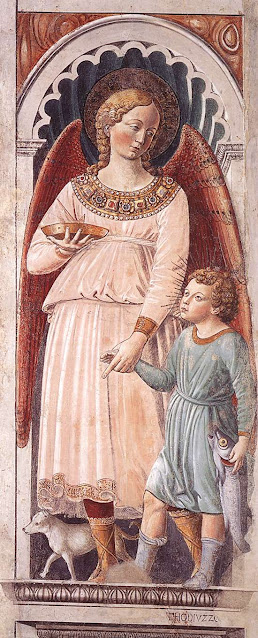
Bottom left, St Raphael, also frequently invoked against plagues; here he is shown holding the hand of the younger Tobias on his journey, improbably shown as very young boy.
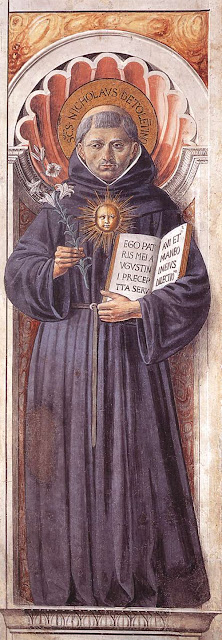
Bottom right, St Nicholas of Tolentino (1246-1305), the most famous among medieval Augustinian Saints.
We continue with the fourth part of this guest essay by a Nigerian Catholic on the problems of liturgical inculturation. The first two parts were published earlier this month (part 1; part 2; part 3).
Returning to the Zaire Usage and drawing from our discussions above, we are compelled to admit that the excited singing and dancing at the Vatican on the First Sunday of Advent in 2019 that made such glowing headlines in the global media were neither a unique African religious/cultural expression nor were they the most dignified actions at the Sacrifice of the Holy Mass. Dancing as a liturgical or devotional exercise has existed in many societies, African and non-African, and in several of these communities, including traditional Jewish and Christian communities, reverence for the divine has meant that such expression of excitement was kept away from the most sacred action of religion or the principal cultus. Many traditional African religions extensively employ the emotion of fear to elicit and maintain religious fervor. [74] Practitioners are strictly obliged to offer sacrifice and libation or suffer grave consequences. [75] Such stringent obligation requires for compliance, and confers on the associated religious service, a stern and terrifying outlook. Hence, the attitude of “respectful distance” in dealing with the sacred that is practiced in traditional African societies. [76]
This fact was graphically related by Chinua Achebe in his novel Things Fall Apart [77], from which it is evident that nothing could be more out-of-place, even downright “sacrilegious”, than a smiling and swaying worshipper, dancing to the tune of rhythmic joyful music, at a sacrifice or divination service in the shrine of Agbala or Amadioha or any of the other Alusi or deity of traditional Igbo religion.
But how then did the notion of lively singing and joyous dancing become so intimately connected with the religious expressions of Africans in modern times if such behaviors, in that context, are alien to the indigenous religion? We must look for the root of the rhythmic dance music not in the cultus of the African people but in their secular cultures or social tradition. In marked contrast to the petrifying scene of divination painted by Achebe, his description of a village wrestling contest showcase the delightful and lively atmosphere we have come to associate with African religious sentiments. [78]
Thus, rhythm, excitement, and frenzy, those supposed iconic marks of African religious expressions, are in fact “the unmistakable wrestling dance – quick, light and gay [79], ” or the overriding sentiments of other social functions that are only tangentially related to the traditional religion rather than typifying it. Interpreting Achebe in Things Fall Apart, one readily comes to the conclusion that while Africans may be extravagant in their joy when at play, they have the tendency, or rather intuition, of assuming a more or less severe and somber air when they pray. Africans understand that prayer is not, and should not be a joke. Furthermore, Achebe contrasted the gravity of the pre-colonial Igbo people in religious matters with the jovial mood of evangelical Protestantism as follows:
“Then the missionaries burst into song. It was one of those gay and rollicking tunes of evangelism which had the power of plucking at silent and dusty chords in the heart of an l[g]bo man.” [80]
Protestantism is an attempt to demystify and popularize the Catholic Faith. It is the removal of elements which offend contemporary sensibility, and the injection of accessible and “respectable” notions. Such popularization amounts to secularization, the turning away from the divine to the human. This is why the Protestantization of Europe was only a step away from its secularization. Similarly, the identification of native African cultus with secular African cultures in the popular psyche, the identification of how indigenous Africans pray with how they play, and the transfer of these playful ethos (rather than the prayerful) into Catholic liturgy as inculturation constitute genuine liturgical popularization and secularization. It is the direct parallel of introducing rock music or operatic singing into the liturgy in the United States or in Italy in the name of inculturation. Such actions merely trivialize and secularize the liturgy, stripping it of its mystery and solemnity.
The world-acclaimed Missa Luba, “an African setting of the Mass sung in Latin,” [81] originally performed by a Congolese choir under the direction and inspiration of Belgian priest Guido Haazen, was developed entirely from tunes drawn from the Congolese repertoire of traditional folk music rather than from the stock of religious music. Why? Maybe this is because the religious music is largely unpopular or largely undeveloped. These two possibilities are derivatives, I think, of the extreme austerity of native African religious disposition. We do not thereby inculturate the Mass in the Congo when we ask the Congolese to pray as they would play. We merely trivialize and secularize the sacred function. Missa Luba was a huge success in several concert halls in Europe and across the world, and rightly so, because it was an innovative composition for concerts, a novel exhibition of African rich secular music tradition. It was not intended, nor was it suitable, for use as prayer at Mass, just as operatic settings of the Mass are unsuitable in Italy or in any part of the Catholic world. This thought was more fully developed in St. Pius X’s Tra Le Sollecitudini, which declared:
“Among the different kinds of modern music, that which appears less suitable for accompanying the functions of public worship is the theatrical style, which was in the greatest vogue, especially in Italy, during the last century. This of its very nature is diametrically opposed to Gregorian Chant and classic polyphony, and therefore to the most important law of all good sacred music.” [82]
To maintain the effective and necessary demarcation between the playground and the sacred ground, St. Pius X insisted that musical compositions “which are admitted in the Church may contain nothing profane, be free from reminiscences of motifs adopted in the theaters, and be not fashioned even in their external forms after the manner of profane pieces.” [83]
There is hardly any doubt that Missa Luba and other African musical compositions of the Mass contributed to the development of the Zaire Usage. [84] Today, whether in a Mass celebrated according to the Zaire Usage or any other inculturated forms of the Roman Rite celebrated in Africa, music in the Missa Luba style, or forms much more unrestrained and theatrical, have become normative. While it is true that in some instances such inculturated liturgical services do afford some opportunity for prayer and union with the Sacrifice, I have many experiences in several parishes across Nigeria in which the sacred function was reduced to almost a mere jamboree, especially during fundraisers such as Uka bia nara Ngozi, Harvest Thanksgiving or Seed Sowing, etc. Unfortunately, such fundraisers within the Mass are increasing in frequency and excesses in many parts of Nigeria.
The disturbing secularization of the liturgy that goes with inculturation bridges the gap Achebe noted in Things Fall Apart between native African stern approach to religion and the happy-clappy mood of Protestantism, especially the Pentecostal camp. It should be noted that the popularization introduced into the Mass under the guise of inculturation is often behind the latest trends in Pentecostalism, whose raison d’être is religious secularization or rapprochement with the zeitgeist. One result of this state of things is that Catholics unsatisfied with half-measure popularization in their parishes stream into one of the up-to-date Protestant congregation. Hence, inculturation is arguably the main reason why Catholics in Nigeria defect to Pentecostal or Evangelical groups.
NOTES (numeration continued from previous article):
[74] Wielzen, D. R., 2009, p. 43
[75] Onyewuenyi, I. C., 1982, 123, p. 63-78; Okwu, A. S. O., 1979, 9, 3, p. 19-24
[76] Ekwunife, A. N. O. “African Traditional Values and Formation in Catholic Seminaries of Nigeria,” Bulletin of Ecumenical Theology, Vol. 8, Issue 2, 1996, p. 49-65
[77] “The Oracle was called Agbala, and people came from far and near to consult it. They came when misfortune dogged their steps or when they had a dispute with their neighbors. They came to discover what the future held for them or to consult the spirits of their departed fathers. The way into the shrine was a round hole at the side of a hill, just a little bigger than the round opening into a henhouse. Worshippers and those who came to seek knowledge from the god crawled on their belly through the hole and found themselves in a dark, endless space in the presence of Agbala. No one had ever beheld Agbala, except his priestess. But no one who had ever crawled into his awful shrine had come out without the fear of his power. His priestess stood by the sacred fire which she built in the heart of the cave and proclaimed the will of the god. The fire did not burn with a flame. The glowing logs only served to light up vaguely the dark figure of the priestess.” Achebe, C., 1994, p. 16-17
[78] “The drums were still beating, persistent and unchanging. Their sound was no longer a separate thing from the living village. It was like the pulsation of its heart. It throbbed in the air, in the sunshine, and even in the trees, and filled the village with excitement…There were seven drums and they were arranged according to their sizes in a long wooden basket. Three men beat them with sticks, working feverishly from one drum to another. They were possessed by the spirit of the drums… Old men nodded to the beat of the drums and remembered the days when they wrestled to its intoxicating rhythm.” Achebe, C., 1994, p. 44, 46, 47
[79] Ibid., p. 42
[80] Ibid., p. 146
[81] McDaniel, D. A., “Analysis of the Missa Luba,” Master’s Thesis, University of Rochester, 1973, p. ii
We never let August 30th pass without remembering the Blessed Cardinal Alfredo Ildefonso Schuster, who went to his eternal reward on this day in 1954, after serving as Archbishop of Milan for just over a quarter of a century. We have written about him many times on NLM, partly in connection with our interest in the Ambrosian liturgy, of which he was a great promoter, but also as one of the most important scholars of the original Liturgical Movement.
In 2018, we published a brief meditation of his on the value of praying the Office, which, to judge from viewing numbers and several requests for permission to reprint, was very much appreciated. This was taken from the account of Schuster’s final days included in the book Novissima Verba by Abp Giovanni Colombo, the cardinal’s successor-but-one in the see of St Ambrose. At the time of Schuster’s death, the latter was a simple priest, serving as both rector and professor of Italian literature at Venegono, the archdiocesan seminary which the cardinal had founded; it was he who who administered the last rites to Schuster. My translation of this incredibly moving piece certainly does not do justice to Abp Colombo’s magnificent Italian. Thanks to Nicola de’ Grandi for some of the pictures.
Had it been possible to foresee that these were his last words, that each one was almost like a will, they would certainly have been noted down one by one with diligence, to be kept in a notebook with the veneration due to a father. But there was no way any one could have seen ahead of time how close and how swift his final departure would be, not even the doctors who hoped to get him back his strength with a few weeks’ rest and care. So now, after five years, the heart alone remains, with no written aid, to remember his final holy words, and record them faithfully as it finds them in memory.
The call by which his secretary, Mons. Ecclesio Terraneo, informed us that His Eminence would come to Venegono for a period of rest was received in the seminary with a sense of joy, and also amazement. Joy, because it hardly seemed real that we could have time to enjoy the presence of the archbishop, whose visits were frequent, to be sure, but always accompanied by his eagerness to run off to other places and persons; amazement, and almost dismay, because the suspicion had arisen in us all that only a serious illness could have brought such a tireless shepherd to yield at last to the idea of taking a vacation, the first in 25 years of his episcopacy, and as it would prove, the last. …
… although nature and vocation had made him for the peace of prayer and study, more than for the turmoil of action, he never deceived himself (as to his duty), not even when old age and poor health would have urged greater moderation (in his activities). He had no wish to spare his energies, even when he was close to the end. He used to say “To be archbishop of Milan is a difficult job, and the archbishop of Milan absolutely cannot allow himself the luxury of being ill. If he becomes ill, it is better that he go at once to Paradise, or renounce his see.”
Cardinal Schuster’s episcopal consecration, celebrated in the Sistine Chapel by Pope Pius XI, himself previously archbishop of Milan, on July 21, 1929.
The archbishop’s car stopped outside the entrance to the seminary around 6 p.m. on August 14, 1954. It was no longer raining, but a low cloud cover filled the sky, … Exhausted, wan, in pain, walking towards the elevator with difficulty, he said, “I would like to read some of the recent publications on archeology, liturgy, church history while I am here.” He had always taught that studies are an essential component of the priest’s spiritual life; all his life had borne witness to this teaching, and he remained faithful to it even in the face of a deadly illness.
On the feast of the Assumption, the radio broadcast the noon Angelus recited by Pope Pius XII. Standing in the room where he took his meals privately, because he did not have the strength to reach the common dining room, while awaiting the Pope’s prayer, the archbishop heard along with us the joyful tolling of the bells of St Peter’s. At the sound, he looked at us with eyes full of emotion, and repeated twice, “The bells of my town, the bells of my town!” His voice was trembling; was it the sweet nostalgia of other occasions that called back to him to the long-ago solemnities of his childhood, or was it rather the sad understanding that he would never hear them again?
On the afternoon of August 18th, the high school seminarians and those of the theologate, who had come back to the seminary the day before… gathered on the tree-lined slope under the window of his apartment to see and greet the archbishop. Called by their youthful song, he appeared smiling on the balcony, and spoke to them with these words. “Here I am among you, on a forced rest; because I did not wish to pay the interest year by year, now I am forced to pay both interest and capital at once. You have asked for a memento from me. I have no memento (to give you), other than an invitation to holiness. It seems that people do not any longer let themselves be convinced by our preaching, but in the presence of holiness, they still believe, they still kneel and pray. It seems that people live in ignorance of supernatural realities, indifferent to the problems of salvation, but if a true Saint, living or dead, passes by, everyone runs to see him. Do you remember the crowds around the caskets of Don Orione or of Don Calabria? Do not forget that the devil has no fear of our playing fields and our movie theatres [1], but he does fear our holiness.” …
His days, which should have been passed in complete rest, were full of prayer, reading, decisions on the affairs of the diocese, and discussions. Someone said to him, “Your Eminence allows himself no rest. Do you want to die on your feet like St Benedict?” Smiling, he answered, “Yes.” This was truly his wish, but this was a matter of Grace, and thus it was God’s to grant.
It was only a few days before the 25th anniversary of his entry into the diocese. In the quiet sunsets of Venegono, he was beset by memories. How many labors and events, some of them tragic, did he have to confront after that serene morning of September 7th (1929), when, on the journey from Vigevano to Rho, he stopped the car half-way over the bridge on the Ticino river, got out, and kissed the land of St Ambrose on its threshold? That land had become his portion of the Church, the sacred vineyard of his prayerful vigils, of his austere penances, of his labor and his love, of his griefs both hidden and known, of all his life, and now of his death. From the end of the road he had traveled, looking back, he saw that he had passed through dangers of every sort, but felt that the hand of God had drawn him safely through fire and storm; above all, he was comforted by the thought that he had always had the affection and loyalty of his people. …
(Unedited footage of Cardinal Schuster’s installation as archbishop in Milan cathedral, unfortunately without soundtrack. Particularly noteworthy is the Latin plaque shown at the beginning, which set over the door of the cathedral, and starts with the words “Enter (‘Ingredere’, in the imperative,) Alfred Ildephonse Schuster.” Starting at 1:20, one sees the extraordinarily large crowd in the famous Piazza del Duomo, far too large for them all to enter the cathedral for the ceremony itself, many of whom have climbed up onto the large equestrian statue of King Victor Emmanuel II. From the YouTube archive of the Italian film company Istituto Luce.)
The archbishop spoke of the recent canonization of St Pius X, saying among other things, “Not every act of his governance proved to be completely opportune and fruitful. The outcome of one’s rule in the Church, as a fact of history, is one thing, whether for good or ill; the holiness that drives it is another. And it is certain that every act of St Pius X’s pontificate was driven solely by a great and pure love of God. In the end, what counts for the true greatness of the Church and Her sons is love.”
He spoke of St Pius X, but he was certainly thinking also of himself, in answer to his own private questions. Looking back upon his long episcopacy, the results could perhaps have made him doubt the correctness of some of his decisions, or the justice of some of his measures; he might perhaps have thought that he had put his trust in both institutions and men that later revealed themselves unworthy of it. But on one point, his conscience had no doubts: in every thought and deed, he had always sought the Lord alone, had always taken His rights with the utmost seriousness, and preferred them above everything and every man, and even above himself. As his spiritual father, Bl. Placido Riccardi, had taught him when he was a young monk, the Saint is set apart from other men because he takes seriously the duties which fall to him in regard to God. …
One morning, the door of his room was left half-opened; from without, one could see the cardinal sitting at the table in the middle of the room in the full light of the window. His joined hands rested on the edge of the desk, with the breviary open before them; his face, lit by the sun, was turned towards heaven, his eyes closed, and his lips trembled as he murmured in prayer. A Saint was seen, speaking with the invisible presence of God; one could not look at him without a shiver of awe. I remembered then what he had confided to me some time before concerning his personal recitation of the Breviary, in the days when he found himself so worn out that he had no strength to follow the sense of the individual prayers.
“I close my eyes, and while my lips murmur the words of the Breviary which I know by heart, I leave behind their literal meaning, and feel that I am in that endless land where the Church, militant and pilgrim, passes, walking towards the promised fatherland. I breathe with the Church in the same light by day, the same darkness by night; I see on every side of me the forces of evil that beset and assail Her; I find myself in the midst of Her battles and victories, Her prayers of anguish and Her songs of triumph, in the midst of the oppression of prisoners, the groans of the dying, the rejoicing of the armies and captains victorious. I find myself in their midst, but not as a passive spectator; nay rather, as one whose vigilance and skill, whose strength and courage can bear a decisive weight on the outcome of the struggle between good and evil, and upon the eternal destinies of individual men and of the multitude.” …
He had decided to end his stay and continue on his way. In vain did the doctors and all his close friends ask him to stay longer – he was set to depart from Venegono on August 30. “Neither rest nor the treatments have helped me: I might as well return to Milan. If death comes, it will find me on my feet, at my place and working.” And he would indeed depart that Monday, but on a different voyage.
Giovanni Cardinal Colombo, 1902-92; archbishop of Milan 1963-79.
In the middle of the night, shortly after 1 o’clock in the morning of the 30th, the brother in charge of the infirmary called me to his sickbed. I found him alone, sitting on the bed, with his hands joined, in deep recollection. Just a moment before he had received the Holy Eucharist from his secretary, Mons. Terraneo.
“I wish for Extreme Unction. At once, at once.”
“Yes, Your Eminence; the doctor will be here in a few moments, and if necessary, I will give you Extreme Unction.”
With a voice full of anguish, he replied, “To die, I do not need the doctor, I need Extreme Unction. … be quick, death does not wait.”
Meanwhile, Agostino Castiglioni, the seminary doctor, had arrived, and after seeing his illustrious patient, told us that his condition was very serious, but did not seem to be such that we should fear his imminent death.
Assisted by Mons. Luigi Oldani, by Fr Giuseppe Mauri, and Mons. Ecclesio Terraneo, I began the sad, holy rite. He spoke first, with a clear and strong voice: “In nomine Patris et Filii et Spiritus Sancti. Amen. Confiteor Deo omnipotenti...”
He followed every word with great devotion, answering every prayer clearly; at the right moment, he closed his eyes, and without being asked, offered the back of his hands for the holy oils.
When the sacrament has been given, sitting on the bed, he said with great simplicity, “I bless the whole diocese. I ask pardon for what I have done and what I have not done. In the name of the Father, and of the Son, and of the Holy Spirit.” He traced a wide Sign of the Cross before himself; then he lay down on the bed. The doctor at the moment realized that his heart was giving out.
“I am dying. Help me to die well.”
The signs of his impending death became more evident.
He groaned: “I cannot go on. I am dying.” …
He was told that in every chapel of the seminary, the various groups, the students of the theologate, the high school, the adult vocations, the oblate brothers, the sisters, were gathered in prayer and celebrating Masses for him. “Thank you! Thank you!”
He looked steadily upon each person who entered the room, as if he were trying to recognize someone for whom he was waiting. With his innate gentility, which did not fail even in his final agony, he invited those present to sit. “Please, have a seat!”
Again and again he repeated the prayers suggested to him, but at a certain point he said, “Now I can’t any more. Pray for me.” …
At 4:35, he let his head fall on the pillow, and groaned. His face became very red, then slowly lost its color. From the other side of the bed, the expression of the doctor, who was holding his wrist, told us that he no longer lived upon the earth. The heart of a Saint had ceased to beat. …
None of those present felt that they had attended three hours of agony, but rather, at a liturgy of three hours’ length. Three hours of darkness, but a darkness filled with the hope of the dawn that would rise in the eternal East. Three hours of suffering, but a suffering permeated by waves of infinite joy coming rapidly on. He spoke no uncontrolled words; his suffering, which was great, (he said “I cannot go on! I cannot go on!” several times), was indicated by quiet laments, as if in dying he were not living through the sufferings of his own flesh and spirit, but rather reading those of the Servant of the Lord in the rites of Holy Week. [2] He made no uncontrolled movements; his translucent hands, his arms, his head, all his slender body, held to the hieratic gestures of a pontifical service.
The archbishop’s death was in no way different from those of the ancient giants of holiness on whose writings he had long meditated, with such fervor as to become familiar with their very thoughts, their feelings and their deeds. A year before he died, describing their death in the Carmen Nuptiale [3], without knowing it, he prefigured his own death. “The death of the ancient Fathers was so dignified and serene! Many holy bishops of the Middle Ages wished to breathe their last in their cathedral, after the celebration of the Eucharist, and after exchanging the kiss of peace with the Christian community. Thus does St Gregory the Great describe the death of Cassius, bishop of Narni, of St Benedict, of St Equitius, etc. In the Ambrosian Missal, the death of St Martin is commemorated as follows: Whom the Lord and Master so loved, that he knew the hour in which he would leave the world. He gave the peace to all those present, and passed without fear to heavenly glory. [4] But what was it that made the death of these Saints so precious in the sight of God (Psalm 115, 6) and of the Church? In the fervor of their Faith, they rested solidly on the divine promise, and so set their feet on the threshold of eternity. ‘Rejoicing in the sure of the hope of divine reward….’ These are the words of St Benedict.” [5]
The Carmen Nuptiale was a truly prophetic swan song. Speaking of St Benedict, Schuster had written, “After the Holy Patriarch’s death, some of his disciples saw him ascend to the heavenly City by a way decorated with tapestries, and illuminated with candlesticks. This was the triumphal way by which the author of the Rule for Monks and the Ladder of Humility passed.”
The street which descends from the hill of the seminary, passing through Tradate, Lonate Ceppino, Fagnano Olona, Busto Arsizio, Saronno, and comes to Milan, was the triumphal way decorated with tapestries, illuminated by the blazing sun, on which not just a few disciples, but crowds without number, watched him pass, one who out of humility had refused all celebration of his 25th year of his episcopacy.
Who drove all those people, on that August 31st, to line the streets? Who drew the workers to come out of their factories, along the city walls? Who brought those men and women together, waiting for hours for the fleeting passage of his casket? Who drove the mothers to push their little ones towards that lifeless body? Why did they all make the Sign of the Cross, if his motionless hand could not lift itself to bless them? What did those countless lips murmur, what was it that they wished to confide to a dead man, or ask of him?
He himself gave the answer fifteen days before to the seminarians, speaking from the balcony of his rooms. “When a Saint passes by, everyone runs to see him.”
* * *
[1] “our playing fields and our movie theatres.” In the post-war period, Italian parishes built countless playing fields for various sports and movie theaters, to provide healthy activities for young people, while keeping them away from similar facilities run by the communists. This was especially common in the urban centers of the north, Milan most prominent among them, which were taking in large numbers of new residents from the poorer regions of the South.
[2] Isaiah 53, known as the Song of the Suffering Servant, is read at the Ambrosian Good Friday service ‘post Tertiam’, before the day’s principal account of the Lord’s Passion.
[3] “Carmen Nuptiale – Wedding Song” is the title of a poem on the monastic life written by the Bl. Schuster in the year before he died.
[4] The Transitorium (the equivalent of the Roman Communio) of the Ambrosian Mass of St Martin. “Quem sic amavit Magister et Dominus, ut horam sciret qua mundum relinqueret. Pacem dedit omnibus adstantibus: et securus pergit ad caelestem gloriam.”
[5] The Rule of St Benedict, chapter 7. “Securi de spe retributionis divinae... gaudentes.”
Lessons for Today: Why critical race theory and gender theory destroy education, and why even many classical education, liberal arts, and Great Books curricula are not Catholic enough.
In his encyclical on Catholic education, Divini illius magistri, published in 1929, Pope Pius XI told us what Catholic education should aim to do, and what it should not be.
First what it ought to be:
95. Christian education takes in the whole aggregate of human life, physical and spiritual, intellectual and moral, individual, domestic and social, not with a view of reducing it in any way, but in order to elevate, regulate and perfect it, in accordance with the example and teaching of Christ.
96. Hence the true Christian, product of Christian education, is the supernatural man who thinks, judges and acts constantly and consistently in accordance with right reason illumined by the supernatural light of the example and teaching of Christ; in other words, to use the current term, the true and finished man of character.
This means that whatever else appears in the curriculum, what makes the education Catholic is the formation that equips the student to be a good Christian. The goal is to equip the student to be free to seek union with God, and so be supernaturally transformed and informed by divine wisdom. Aside from knowledge of the content of the Faith, this means giving all that the student needs to actively participate in the sacramental life of the Church, and most especially the worship of God in the sacred liturgy. This would mean adequate catechesis prior to receiving the first sacraments, and continued mystagogical catechesis afterward. The deep study of Scripture would be an essential part of this, although it is often missing, even at Catholic schools.
What it is not:
60. Hence every form of pedagogic naturalism which in any way excludes or weakens supernatural Christian formation in the teaching of youth, is false. Every method of education founded, wholly or in part, on the denial or forgetfulness of original sin and of grace, and relying on the sole powers of human nature, is unsound. Such, generally speaking, are those modern systems bearing various names which appeal to a pretended self-government and unrestrained freedom on the part of the child, and which diminish or even suppress the teacher's authority and action, attributing to the child an exclusive primacy of initiative, and an activity independent of any higher law, natural or divine, in the work of his education.
Catholic and non-Catholic classical schools:
Pius XI does not tell us that there is any requirement for a classical curriculum, a Great Books program, or a Liberal Arts program. These can be complementary to the Faith, but do not teach the Faith directly.
I am an advocate of such traditional curricula, but only if they are taught in such a way that students understand in clear simple terms how what they are learning relates to their participation in the sacramental life of the Church.
If the direct connection to the Faith is not made in such programs, or if they are taught at the expense of more essential subjects that impart a deepening knowledge and understanding of the content of the Faith, then they become, quite simply, alternative forms of pedagogical naturalism, to use Pius XI’s words. Their main value is that at least they are not directly undermining the Faith as public education generally does now.
Good public education?
Until very recently, most public education was based upon the ideas of the American educational reformer John Dewey (1859-1952). He denied the supernatural, so his theories also represent pedagogical naturalism. The main thrust of his thought is that students should be trained for work, and that the only verifiable truth is scientifically proven. This is a diminished understanding of truth and of the role of education, but not necessarily anti-Catholic. Catholic education, as Pius XI stated, can include giving people the skills to earn a living too, and I would argue that it should do so.
However, what Dewey didn’t appreciate is that the supernatural can, to use Pius XI’s words, elevate, regulate, and perfect our activities at work by ordering them to our ultimate end. So a Dewey curriculum will teach life skills, without equipping the student with the wisdom to develop them beyond what is taught and to do so well.
Nevertheless, provided the student is not indoctrinated with Dewey’s worldview and is allowed in addition to study and participate in the necessary aspects of the Faith, then in principle, an excellent Catholic education is still open to him. In many ways, one might argue, a Dewey-plus-Catholicism education would be preferable to a classical education that does not incorporate the Faith. The Catholic elements that are added to a Dewey curriculum might be provided by additional classes at school, through the words and examples of other members of the family, or through a formation at the local parish. This will not always be easy, but at least it is possible.
Jaques Maritain, who critiqued Dewey in his day, thought so. Where this older form of public education prevails within the context of a firm Christian or Catholic culture then a good public education is still available.
In principle.
In practice, however, this is rarely possible for long, given another contradiction inherent with the scientism of Dewey. The scientific method relies on fundamental assumptions, which will only withstand philosophical inquiry if bound to the principle of objective truth, which in turn is only preserved when anchored to the Christian faith. The scientific method grew directly out of the Christian understanding of reality and is inextricably tied to the Faith. When science is separated from Christianity philosophically, it is susceptible to distortion.
I am not referring here to the immoral application of the truths of science. This runs deeper. I am saying that the very capacity of natural science to discern truth, even within the materialistic parameters of the natural scientist, is diminished when the axiomatic truths that form the basis of the scientific method are cast adrift from Truth.
Science imparts an understanding of the natural world; it does not, and cannot, make us masters of it, despite what some might think, for no scientist can alter the natural order that he observes and turn it into the pattern of truth that he or his political masters would like it to be.
However, when separated from the Christian understanding of reality, which is the only one that is consistent with Truth, the scientist is free to assert anything he likes and alter the scientific theories to say what is required, regardless of objective truth. He does this by altering the premises of the scientific method, in accordance with his own, subjective worldview. This is the science of the bureaucrat, the leftist politician, the public health professional and the atheist materialist of any description.
Dewey was guilty of the heresy of scientism, which asserts that the only truths we can know are those that are scientifically verifiable. But this heresy, which is bad enough, leads inevitably to an even greater and more destructive one, that of what I will call, Scientist-ism.
Scientistism is the heresy that says that the truth is what the scientist says it is, regardless of what the science says. It is a form of argument from authority, that rests on a weak authority. Frustrated by the fact that science won’t behave as the Marxist theorists want, they strive to get science to tell them what they want to hear. Corrupt scientists who are controlled largely by government funding (for there is so much of it) assert that the false is true on behalf of their paymasters and call it science, in order to convince us of the truth of their assertion that black is white. Sound familiar?
This brings me to the worst form of education I have seen. This is worse than no formal education at all:
Bad public education
In the most recent iteration of public education, the curricula have been handed over to neo-Marxist theorists, and their ideas dominate public education today from K through to the university level. In the United States it is only relatively recently, as I understand it (I am not American and so I might be wrong), with the Supreme Court decision of Everson v. Board of Education (1947), that Christian prayer was removed from public schools. Regardless, as long as there is no Christian prayer in public schools, and Christianity is not taught by believers to believers or potential believers, then there is nothing to stop the vacuum being filled by any quasi-religious ideologies, provided it is not defined in law as a religion. This is precisely what Marxist ideology is. The goal of the modern manifestations of Marxist ideas, those that have developed since 1947 and are pushed by teachers’ unions, such as Critical Race Theory and Gender Theory, is to form people to be revolutionaries who will destroy every institution they participate in. It is remarkably good at doing this. The theories themselves are not studied directly in classes in public schools; this generally only happens in degree programs such as Gender Studies. Rather, they are assumed to be true, without this being stated explicitly, and then the whole curriculum is built upon its premises at all levels of education, so that each subject is distorted and reflects the Marxist narrative.
No subject, whether it is natural science, fine art, or humanities, is safe from being tainted by this evil. For example, good science that contradicts the Marxist narrative is ignored or condemned, while false science that confirms it is lauded as objective truth.
The moment any of this woke nonsense is tolerated in any form, it steadily works its way into every aspect of the curriculum like an ideological parasite eating away at its host. Teachers and students alike see themselves as victims who endlessly complain and compete with each other for greater victim status, demanding ever-greater concessions to what they demand, which inevitably promotes the Marxist narrative. The teachers are then, in turn, regarded as oppressors by the students. Eventually, all who dissent from their woke worldview will be hectored and chastised as oppressors and haters until they either conform or are removed.
Above: the familiar credo of the progressive left. On the face of it, few would disagree with the sentiments, but the words love, rights, science, kindness, women, and human are not used as a Christian would use them, so in fact, most of these slogans actually mean, in Marxist theory, the opposite of the common use of the word and run against common sense.
The Marxist theorists who developed these ideas and the methods by which they are applied in our schools were very clever. What is presented as the search for justice, and so appears relatively benign and hard to object to, is, in fact, an anti-Christian ideology. It is designed to create angry conflict, by encouraging in its adherents a false perception of oppression, injustice, and deep resentment about every aspect of society, and in every personal relationship in which they participate.
The end game here is not justice, but the creation of conflict, initially with the threat of violence, but ultimately leading to violence. The greater aim is the total destruction of Western values and the world order founded on them. Razing institutions of authentic justice and order to the ground is, they believe, necessary for a new, better order to come in. They never say exactly how the new society will be built or what it will look like. Never, has such an order been observed when they implement their methods, only the destruction and misery that this evil ideology asserts is the means by which the mythical utopia is achieved.
Its power to persuade derives from the fact that it provides a quasi-religious narrative about our lives and our destinies, indulging us in our grievances and resentments and allowing us to blame others for our woes. The false premises of this Marxist narrative are accepted on faith, at the same deep level that we accept the truths of the Faith in our hearts.
Once the desired conflict within an educational institution has been created, the goal is to destroy the capacity of the institution to offer any decent education, as we would understand the word. Instead, students are formed as miserable, bitter, and angry leftist political agitators on a mission to destroy Western society. They go on to cause trouble in every aspect of society in which they participate to an end: greater misery for themselves and those they engage with.
The only way to stop this spread is to stand up to it at first sight and not tolerate it in any form. Otherwise, once it gets a toehold, it will spread like cancer in any institution. This is why Christians must be clear that at every level of life, they refuse the various manifestations of these modern Marxist ideas and the organizations that promote them, whether it is modern Democratic Socialists, teachers’ unions, or the progressives in the Democrat Party who espouse such theories, Black Lives Matter, Jane’s Revenge, or Antifa.
If educational institutions try to accommodate or work with these ideas, they will eventually be destroyed, and being a classical, Great Books, or liberal arts school, or even a Catholic school, is no protection against this effect once these ideas are present.
It takes courage to stand up to it. Verbal abuse, threats of violence, and ultimately the use of it are part of the armory of the left. I pray for God’s grace daily that I will have the courage if needed.
Those who want to be involved in authentic Catholic education might consider taking the Master of Education in Catholic School Administration at Pontifex University - www.Pontifex.University, which has been designed by Fr Peter Stravinskas of the Catholic Education Foundation
Truly it is fitting and just, right and profitable to salvation, that we should give Thee thanks, o Lord almighty, and bless Thee at every time, and praise Thee especially on this day’s festivity, on which the blessed John the Baptist acquired the crown of martyrdom, even he than whom there hath been none greater among those born of woman. By prohibiting an illicit marriage, he obtained the glorious triumph of martyrdom when he was beheaded; in his bodily presence, he showed that Our Lord Jesus Christ, the Savior of the world, had come, and, going before Him, also proclaimed His descent to those below (i.e., in the limbo of the Fathers). And therefore... (The Ambrosian Preface for the Beheading of St John the Baptist.)
The Head of St John the Baptist Presented to Salome, by the Dutch painter Carel Fabritius, ca. 1640; now in the Rijksmuseum in Amsterdam. – Fabritius, born in 1622, studied with Rembrandt, and was considered one of his best pupils. In about 1650, he moved to Delft, where he was killed on Oct. 12, 1654, in the incident known as the ‘Delft Thunderclap’, the explosion of a gunpowder magazine which leveled about a quarter of the city. Fabritius’ studio was destroyed, along with most of his paintings; this is perhaps the earliest of his surviving works, which number only about a dozen.
Vere quia dignum et iustum est, aequum et salutare, nos tibi, omnipotens Domine, gratias agere: teque omni tempore benedicere, et in hujus
praecipue festivitate diei laudare. In quo beatus Ioannes Baptista martyrii coronam est adeptus: quo inter natos maior nemo exstitit mulierum. Nuptias prohibendo illicitas, gloriosum martyrii triumphum capite truncatus obtinuit: et Dominum nostrum Iesum Christum mundi Salvatorem venisse corporali præsentia demonstravit, eius quoque descensionem praecurrens inferis nunciavit. Et ideo...
We are pleased to announce Church Latin Publishing Co.’s facsimile edition of a 121-year-old Latin Vulgate Bible (Clementine Edition). An excerpt from the “Editor to the Reader” of this bible perfectly summarizes both the reasons it was originally published and why we have labored to bring it back into print:
“May, finally, this edition of the Sacred Bible be published, and may it bear exceedingly rich fruits of knowledge and piety; we humbly pray that St. John the Evangelist, our great patron, who drew his stream of divine eloquence from the sacred font itself of the Lord’s breast and, inebriated with the grace of the Holy Ghost, more deeply revealed to others the hidden things of Divinity, might obtain these results for us through his kind intercession with the most sacred Heart of Jesus.”
In our present day, traditional Catholic worship and devotion are under attack. This reprint of the Latin Vulgate Bible is both a testimony to Catholic Tradition and a living archive of Catholic scriptural literacy. It also pays homage to the authority of the Clementine text and is a tribute to the lost art of more elegant religious and liturgical typesetting and printing. This Vulgate bible is a true icon of Catholic history; the interior text and images were described by a reviewer as “a modern adaptation of a medieval manuscript.”
It is presented in a case wrap hardcover format with a few added features such as enhanced images of the original color maps and two ribbon markers (one can see lots more images at the publisher’s website). At 6” x 9”, the size is neither too large for easy transport nor too small for easy reading. It can be ordered from www.churchlatin.com for $59.99. A full write-up explaining all of the contents and features can be found there as well.
I recommend a visit to the website, which is full of fascinating and informative things about Desclée the publisher, the Vulgate edition, and this particular project, which was years in the making.
In 1463, the Florentine painter Benozzo Gozzoli (1421-97) left his native city, then suffering from an outbreak of plague, and settled in the little town of San Gimignano about 30 miles to the south and west. During his stay, which lasted for four years, he was commissioned to decorate the choir of the local Augustinian church with a fresco cycle of the life of St Augustine, whose feast is today. Gozzoli had been a student of Fra Angelico, but unites to the typically Florentine style of his teacher, which tends towards the use of relatively simple backgrounds, the richly decorative style known as the International Gothic. The result is justly considered one of the best narrative cycles in fresco of its era. We begin with some overview photos, and then closer images of each individual panel of the narration. There are also several portraits of Saints on the pillars of the chancel arch, with Christ and the Twelve Apostles, and Ss John the Baptist and Elijah on the arch itself. (All public domain images from the Wikimedia Commons page about this chapel.)
A frontal view of the chapel; Augustinian religious communities tended to be quite small, as we can see from the size of the choir.
The left wall; the stories run around the chapel from left to right, first through the whole bottom band, then the middle, then the top.
The middle and top bands on the back wall.
This photograph gives a more complete view of the back wall, although it does no justice to Benozzo’s brilliant colors. I include it because it shows the whole arrangement more clearly, and includes the panel under the window, of which no other image seems to be available, St Augustine’s voyage from Carthage to Rome.
The right wall.
The vault, with the Four Evangelists (clockwise from the top, Luke, Mark, John and Matthew), and Christ and the Twelve Apostles in medallions on the chancel arch.
First scene: Augustine’s parents, Patricius and St Monica, bring him to his first day of school in his native town of Tagaste in north Africa. The kindness of his teacher is emphasized by the way he pats the boy’s cheek; note that Monica is dressed as a wealthy matron in a beautiful white dress, where below, after she is widowed, she appears more like a nun. On the right side, Augustine studies his letters, while another boy is beaten; the Latin inscription at the bottom notes that he quickly made remarkable progress in his studies. (Tagaste is now a town called Souk Ahras in eastern Algeria, about 55 miles from the Mediterranean coast. It has been a see in partibus since the later 15th century, and is currently held by the nuncio to Portugal.)
Second scene: Augustine studies the liberal arts at the university of Carthage, the capital and largest city of Roman Africa. As so often happens with frescoes that are close to the external wall of a building, the right side is badly damaged by water infiltration.
Third scene: Augustine leaves his mother and goes to Rome. Monica, by now a widow, is typically shown dressed as a nun, rather than as the well-to-do matron she was in the first scene. Next to this is shown the voyage of St Augustine to Rome, of which there seems to be no photograph available.
Fifth scene: Augustine disembarks at Ostia.
Sixth scene: Augustine as a successful teacher of rhetoric in Rome.
Seventh scene: Augustine leaves Rome for Milan, to take up the post of official teacher of rhetoric for that city, an extremely prestigious job. Gozzoli’s International Gothic leanings are especially evident in the elaborate buildings that make up the city of Rome, and the variety of trees in the countryside. The inscription at the top (in two elegiac couplets) states that a member of the Augustinian community, Fr Domenico Strambi, commissioned the work; he is described as a “Doctor Parisinus - a Parisian doctor”, since he had studied at the Sorbonne, the most important theological school of Medieval and Renaissance Europe.
“Eloquii sacri doctor Parisinus et ingens Gemignaniaci fama decusque soli, Hoc proprio sumptu Dominicus ille sacellum Insignem jussit pingere Benotium. MCCCCLXV
A Parisian doctor of the Sacred Word, and the great fame and glory of the country of Gimignano, the renowned Dominic, at his own expense had the famous Benozzo paint this chapel. 1465.” The man in red standing at the right is believed to be a self-portrait of the artist. Fr Dominico’s boasting may seem a little inappropriate for a friar, but San Gemignano was a very small town long past its heyday by the mid-15th century; a native son with a doctorate from the Sorbonne would certainly have been quite the boast for it.
Eighth scene: Augustine arrives in Milan. In the foreground, a servant helps him to take off his riding clothes (a bit of Benozzo’s showing off his mastery of perspective); in the middle, within the loggia, he kneels before a man dressed as a Muslim of the 15th century (or what a Tuscan of the 15th century would imagine as such), representing a teacher of the Manichean sect with which Augustine had fallen in; at the right, he meets St Ambrose. (Italian artists long struggled with finding material that made good and lasting blue pigments for fresco; in the clothes of Augustine in the center and Ambrose at the right, we see the result of a not-wholly-successful experiment with a material that has partly corrupted over time.)
Ninth scene: various episodes with St Ambrose in Milan. At the left, Augustine has an interview with him; in the middle, Ambrose and St Monica; at the right, Augustine sits among the crowd that has gathered to hear his preaching. (This scene is above the second one shown above, and is also obviously rather badly damaged by water infiltration.)
Tenth scene: the “Tolle, lege” episode recounted in the Confessions (8, 12), the moment of St Augustine’s conversion. The man to the right is his boyhood friend St Alypius, who ended his days as bishop of their native place.
For a fairly brief period, today was kept by the Franciscans as the feast of the Seven Joys of the Virgin Mary. As an expression of the Seraphic Order’s devotional life, it corresponds to the feast of the Holy Rosary, which began among the Dominicans, and the observance on September 15th of the Seven Sorrows of the Virgin, which was originally the Patronal feast of the Servites. The principal contribution of the Franciscans to the Church’s cycle of Marian feasts is, of course, the Immaculate Conception, whereas the liturgical celebration of the Seven Joys is very late, and short-lived. It was granted to them in 1906, and at first fixed to the Sunday after the Octave of the Assumption; when the reform of St Pius X abolished the practice of fixing feasts to Sundays, it was permanently assigned to August 27th. In the Calendar reform promulgated in 1961, which aimed at reducing the number of feasts, and especially the so-called “feasts of devotion” (as opposed to those of Our Lord and the Saints), it was suppressed.
The Altarpiece of the Seven Joys, by the anonymous painter known as the Master of the Holy Family, ca. 1480; now in the Louvre.
The devotion to the Seven Joys in and of itself, however, is much older; the story of its origin is told thus in the Manual for Franciscan Tertiaries.
About the year 1420, a young man, deeply devoted to Our Lady, took the habit of St Francis. Before joining the Order, he had, among other practices, been accustomed daily to make a chaplet of flowers, and with it to crown a statue of the Blessed Virgin. Having in his novitiate no longer an opportunity of making this crown for his Most Beloved Queen, he, in his simplicity, thought that she would withdraw her affection from him; this temptation of the devil disturbed his vocation, and he resolved to abandon the cloister. The merciful mother appeared to him, and gently rebuking him, strengthened him in his vocation by telling him to offer her instead of the chaplet of flowers, a crown much more pleasing to her, composed of seventy-two Ave Marias and a Pater after each decade of Ave Marias, and to meditate at each decade upon the seven joys she had experienced during the seventy-two years of her exile upon the earth. The novice immediately commenced reciting the new crown or rosary, and derived therefrom many spiritual and temporal graces. This pious practice spread quickly through the whole Order, and even throughout the world… St Bernardin of Siena used to say that it was by the Crown of the Seven Joys that he had obtained all the graces which Heaven has heaped upon him.
A traditional Franciscan Rosary of the Seven Joys, still worn as part of the Order’s habit.
The Seven Joys listed in the Manual are the Annunciation, the Visitation, the Birth of Christ, the Adoration of the Magi, the Finding of the Christ Child in the Temple, the Resurrection and the Assumption, but other version of the list may be found. Two more Aves are added to make the number seventy-two mentioned above, and another Pater and Ave for the intentions of the Pope. The recitation concludes with a versicle and response, and the Collect of the Immaculate Conception.
V. In thy Conception, o Virgin, thou wast immaculate. R. Pray for us to the Father, whose Son thou didst bear.
Let us pray. O God, Who by the Immaculate Conception of the Virgin, prepared a worthy dwelling place for thy Son; we beseech thee, that, as by the foreseen death of Thy same Son, Thou preserved Her from every stain, so Thou may grant us also, through Her intercession, to come to thee with pure hearts. Through the same Christ our Lord. R. Amen.
V. In Conceptione tua, Virgo, immaculata fuisti. R. Ora pro nobis Patrem, cujus Filium peperisti.
Oremus. Deus, qui per immaculátam Vírginis Conceptiónem dignum Filio tuo habitáculum praeparasti: quaesumus; ut qui ex morte ejusdem Filii tui praevisa, eam ab omni labe praeservasti, nos quoque mundos ejus intercessióne ad te perveníre concedas. Per eundem Christum, Dominum nostrum. R. Amen.

 Twelfth scene: on the left, the famous (and apocryphal) story that Augustine, after finishing his book on the Trinity, went walking on the seashore, where he saw a boy trying to pour the ocean into a hole in the sand. When he told the boy that this was impossible, the boy replied that it was also impossible to fully explain the Trinity, and disappeared. In the background is represented a medieval tradition of Italian Augustinians that he once visited a group of hermits on Mt Pisano, about 40 miles to the north-west of San Gimignano. (The absence of any reference to a visit to Tuscany in his own writings was ingeniously explained as a lapse of memory, brought on by grief over the death of his mother, St Monica.) On the right, St Augustine is shown as a friar among friars, giving them the Augustinian Rule.
 Thirteenth scene: the death of St Monica. This event, which is described in one of the most moving passages of the Confessions (book 9, 11-12), took place in the Roman port city of Ostia, well before Augustine returned to Africa and began to live in a monastic community. His departure is shown through the colonnade on the right. The Augustinian friar who commissioned these paintings, Fr Domenico Strambi, stands at the foot of the bed with an inscription underneath him to indicate who he is. St Monica was buried in Ostia, and her relics were kept there in the church of St Aurea until 1430, when they were transferred to the Roman basilica named for her son.
  Fourteenth scene: St Augustine (barely visible on the right where the plaster has been damaged) blesses the people of Hippo after becoming their bishop.
  Fifteenth scene: St Augustine converts a priest of the Manichean sect named Fortunatus. Note that he continues to wear his Augustinian habit under his cope.
 Gozzoli and his assistants also painted eight Saints on the pillars of the chapel’s chancel arch. On the left pillar, top left, St Monica,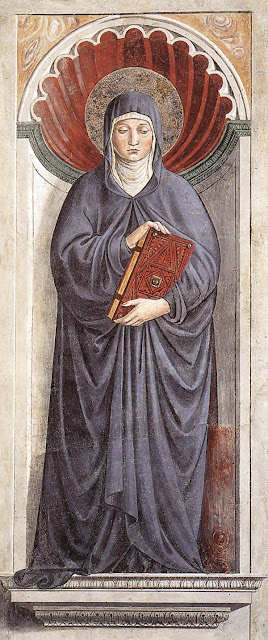
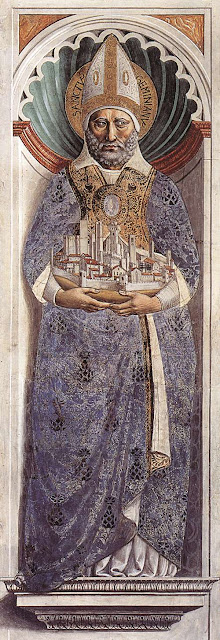 At the bottom left, St Sebastian, patron against plagues, undoubtedly included because of a serious plague that was afflicting Tuscany at the time, and which caused the artist to leave his native Florence.
 Bottom right, St Bartolo, a native of San Gimignano and priest of the Franciscan Order, who devoted his life to taking care of lepers after contracting the disease himself.
  On the right pillar, top left, St Nicholas, one of the most popular and frequently depicted Saints in all of Italy.
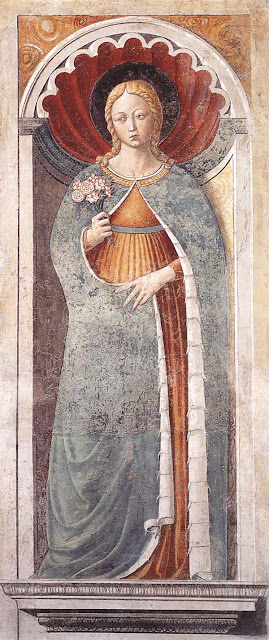
 Top right, St Serafina, generally known as Fina, the primary patron of San Gimignano.
 Bottom left, St Raphael, also frequently invoked against plagues; here he is shown holding the hand of the younger Tobias on his journey, improbably shown as very young boy.
 Bottom right, St Nicholas of Tolentino (1246-1305), the most famous among medieval Augustinian Saints.