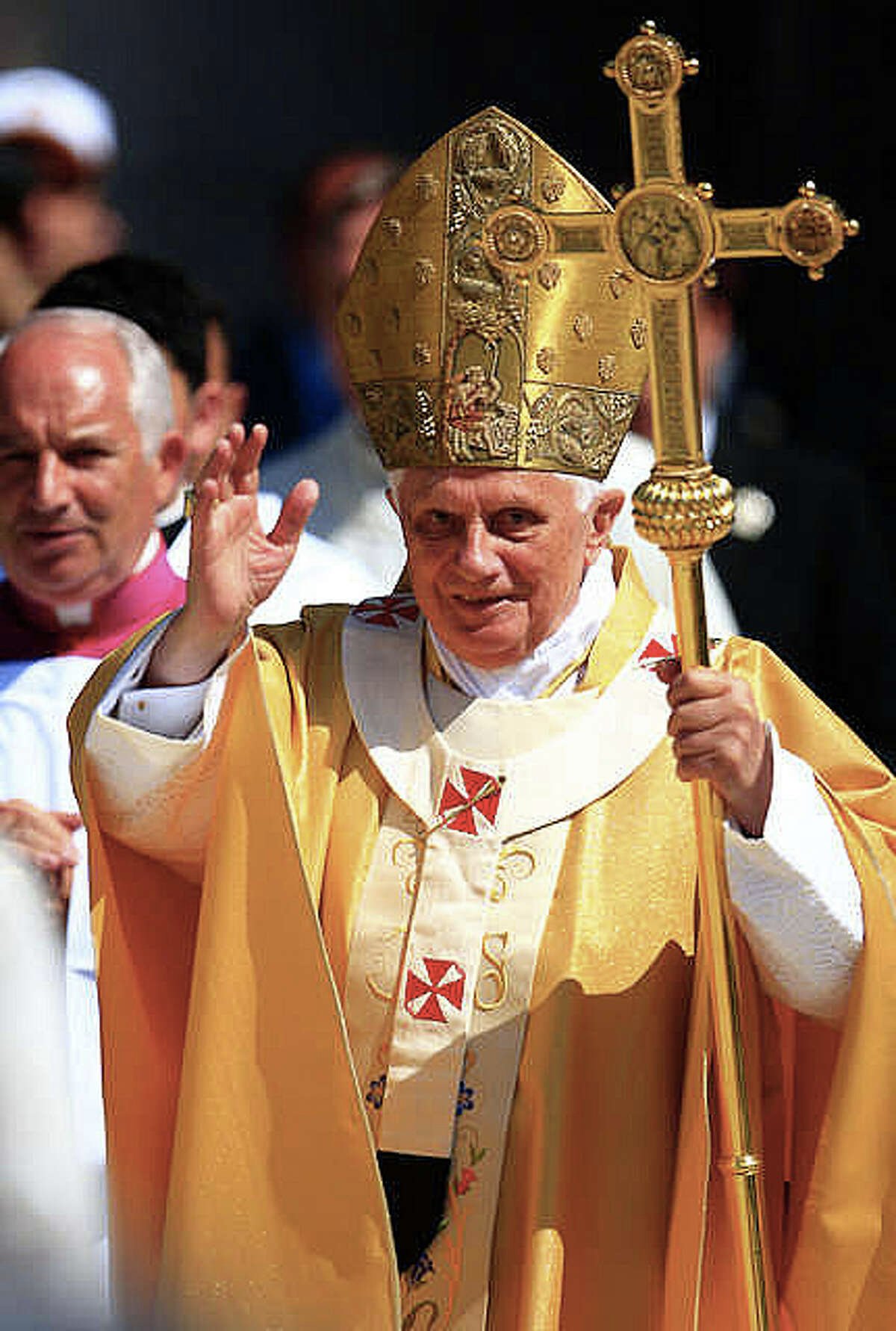
Deus, qui inter summos sacerdótes fámulum tuum Benedictum ineffábili tua dispositióne connumerári voluisti: praesta, quáesumus; ut, qui Unigéniti Filii tui vices in terris gerébat, sanctórum tuórum Pontíficum consortio perpétuo aggregétur. Per eundem Christum, Dóminum nostrum. Amen.
God, Who in Thy ineffable providence, did will that Thy servant Benedict should be numbered among the high priests, grant, we beseech Thee, that he, who on earth held the place of Thine Only-begotten Son, may be joined forevermore to the fellowship of Thy holy pontiffs. Through the same Christ, Our Lord. Amen.
As we pray for the eternal repose of the deceased Pope Emeritus, let us also remember with gratitude the gift of his papacy, his graciousness and good humor, his many wise and well-considered writings, his paternal love especially for priests and religious, but of course above all, his restoration to the Church of the incomparable treasure of the traditional Roman Rite, an act which will continue to bear great spiritual fruit and lead the way for much-needed reform. “What earlier generations held as sacred, remains sacred and great for us too, and it cannot be all of a sudden entirely forbidden or even considered harmful.”
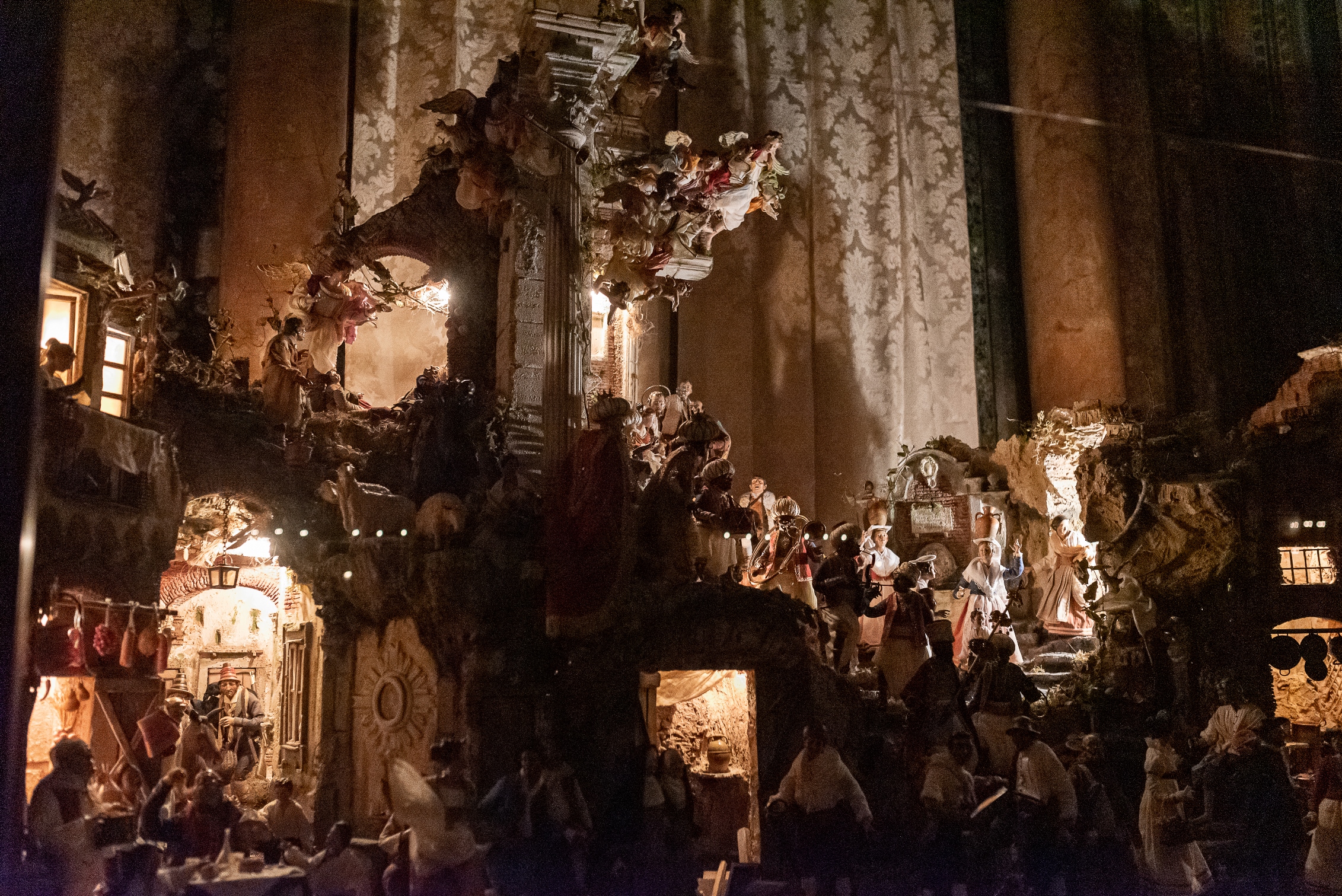
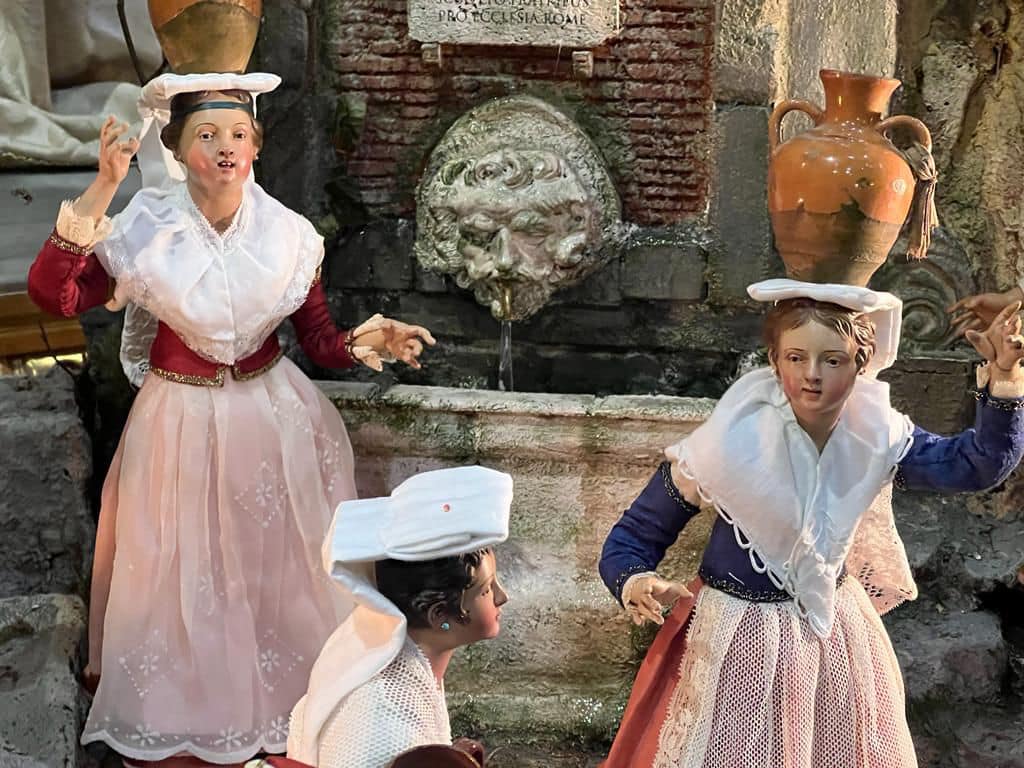
Although the invention of the creche is attributed to an Umbrian, St Francis of Assisi, the city of Naples can truly boast of having developed it into a particular art form, with the creation of a highly theatrical Baroque style admired and imitated up and down the peninsula. The Neapolitan tradition began with St Cajetan, the founder of the Theatine Order. One of his favorite places to pray in Rome was the basilica of St Mary Major, specifically, the chapel where the relics of Christ’s crib were kept. At the end of the 13th century, the sculptor Arnolfo di Cambio had carved for this chapel a large Nativity set, several pieces of which survive to this day. While praying there one year on Christmas Eve, St Cajetan had a vision of the Virgin Mary, who handed him the Baby Jesus to hold. When he came to Naples in 1534, he set up a Nativity scene in the church of a major public hospital, in imitation of the Roman one; this was then picked up by many other churches, as well as private families. It was also in Naples that the tradition began of dismantling the creche after the Christmas season ended, so that it could be reassembled, perhaps in a different way, the following year; previous ones like di Cambio’s, the figures of which were all stone, were permanent fixtures.
As the tradition developed and spread throughout Italy and elsewhere, it became a kind of competition (a friendly one, we hope) to enrich the scene with an ever larger number of human figures, and make them continually bigger with the addition of whole buildings, streets, piazzas etc. The persons and scenes shown are for the most part ordinary folks going about their ordinary lives, a theological declaration that the sanctifying grace of Christ, which begins to come to us in the Incarnation, is available to all in whatever station of life they find themselves. Very frequently, the Holy Family are shown within a ruined temple, or some other ancient Roman building, representing the world which suffers from the ruin of sin, and longs for renewal in the coming of the Savior.
This year, Santissima Trinità dei Pellegrini, the Fraternity of St Peter’s parish in Rome, set up a new Nativity scene in the finest Neapolitan tradition, with many of the sections made to look like the streets of the neighborhood, and as you can see below, even includes a scene with the church’s founder, St Philip Neri. The figures are clothed in a manner more in keeping with the traditions of Rome and environs, as seen, for example, in the flat headdresses of the women, and the costumes of the shepherds. The first twelve photos were taken on Christmas night before the Midnight Mass; some photos with brighter light are seen below.
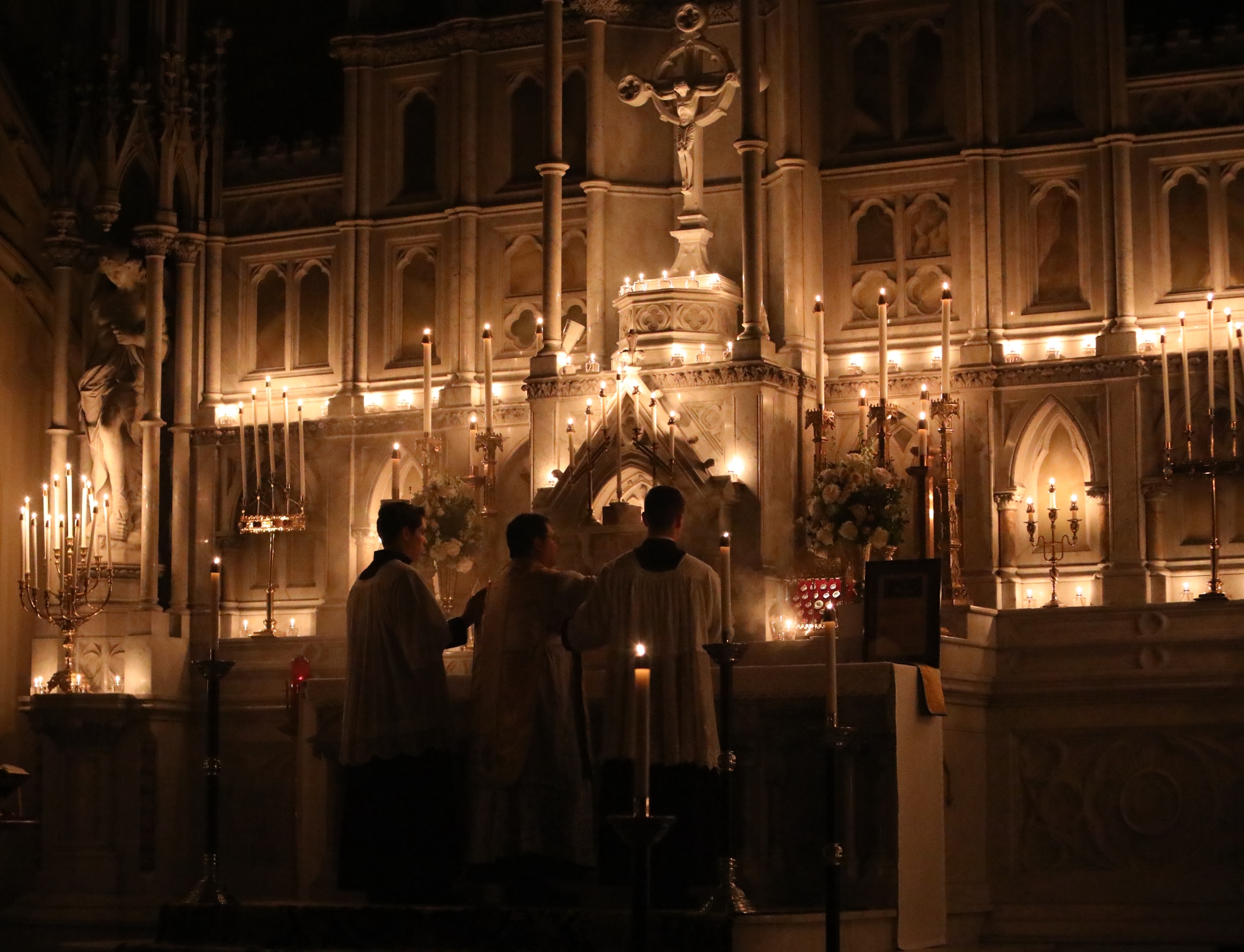
Since Christmas fell on a Sunday this year, the Mass and Office of the Sunday within the octave of Christmas are transferred to December 30th. Here is William Durandus’ commentary on the Mass, the 14th chapter of book six book of his Rationale Divinorum Officium.
On the Sunday which falls within the octave of the Lord’s birth, the Mass is sung of the Nativity; whence the Introit is “Dum medium silentium tenerent omnia.”
Introitus (Sap. 18) Dum medium silentium tenérent omnia, et nox in suo cursu medium iter habéret, omnípotens Sermo tuus, Dómine, de caelis a regálibus sédibus venit. Ps 92 Dóminus regnávit, decórem indútus est: indútus est Dóminus fortitúdinem, et præcinxit se. Gloria Patri ... Sicut erat... Dum médium siléntium...
Introit (Wisdom 18) When a profound stillness compassed all things, and the night in its swift course was half-spent, Thy almighty Word, o Lord, came down from heaven’s royal throne. Ps. 92 The Lord hath reigned, he is clothed in splendor; robed is the Lord with strength, and hath girt himself. Glory be... As it was in the beginning... When a profound stillness...
The silence is threefold, namely, of ignorance, of despair, and of glory. The silence of ignorance was before the Law, because they knew not their sins, and therefore they did not cry out to the Lord; for death reigned from Adam until Moses (Rom. 5, 14). But after the Law was given for the knowledge of sin, for a long time they kept the Law, but at the last, they despaired, namely, when “all (had) gone aside (and) become unprofitable together.” (Ps. 13, 3). Then was the silence of despair. But after Christ came, the silence was broken, whence all cry out the praises of God. The silence of glory will come, when all our desire is fulfilled. In the silence of despair the Lord will come, so that the salvation of the human race may be attributed to Him who is the true healer. …
There follows “the night”, that is, the devil, “in his course had the middle way”, i.e. the common way, for all were going down into hell together; “Thy almighty word”, that is, Thy son, “Lord” and Father, who is called the Word of the Father, because He was born through Him, came from the royal seats to seek (men) and make them kings. Or literally, “When all things had the middle, that is common silence, from the night, namely, when all things are silent, and the night was in the midst of its course, Thy almighty Word (came) form the royal seats” because the Lord was born in the night. …
The Graduale is “Thou art beautiful (above the sons of men; Ps. 44)” because He is immune from all sin, and full of all virtues; for as the Apostle says, “in him dwelleth all the fulness of the Godhead corporeally” (Col. 2, 9), … according to grace (divinity) is in the Saints, but by way of union it is in Christ, and therefore, “grace is poured forth upon thy lips (Ps. 44, 3).” Grace, since never did a man speak thus (Jo, 7, 46) is poured forth, I say, because the law of clemency is on his tongue (Prov. 31, 26), as when he said, “Woman … doth none condemn thee? … neither do I condemn thee. Go and sin no more.” (Jo. 8, 1-11). The Gospel (Luke 2, 33-40) likewise pertains to His Birth… “His father, putative, of course, and Mother were wondering at the things which were being said about him, namely, by the shepherds.
There follows in the Gospel the prophecy of Simeon “ Behold (this child) is set for the fall”, that is, of unbelievers, “and for the resurrection of many”, that is, of the faithful, “and for a sign which shall be contradicted…”
Again, the introit Dum medium is the voice of the primitive Church, in which it recalls the birth of the Lord, the fruit of which it preaches in the Epistle, because we have passed from servitude to adoption … but in the Postcommunion, “Take up the boy”, the time of the flight is invoked, when the Lord went down into Egypt, and mystically, this looks to the adoption of the gentile nations, because the Lord passed from Judea to the nations, that he might adopt them as heirs.
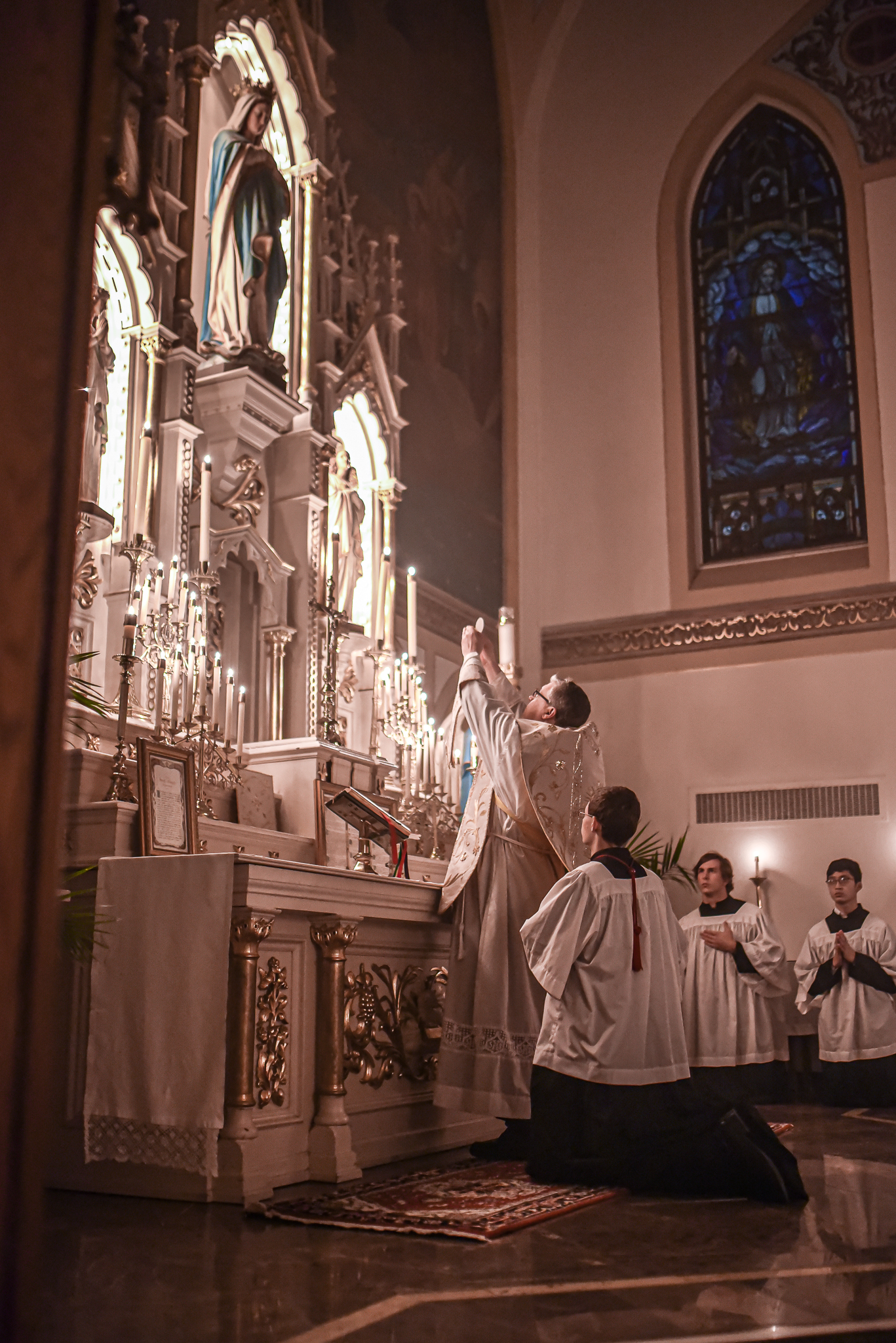
Before we move on to photos of your Christmas liturgies, here is one last set of Rorate Masses, a record-breaking sixth post in this annual series. This brings us to over 270 photos, from churches in 19 American states and 11 other countries, with several duplicates (three Canadian provinces, three locations in England etc.) We can all add to our other reasons for Christmas cheer the knowledge that the slow but steady work of recovering our Catholic liturgical tradition continues!
We must also remember to pray for our beloved Pope Emeritus Benedictus XVI, to whose incomparable pastoral wisdom and good example this recovery is due in no small measure.
St Patrick Oratory – Waterbury, Connecticut (ICRSP)
Courtesy of the Society of St Hugh of Cluny
Oratory of Ss Gregory and Augustine – St Louis, Missouri
Photos by Kiera Petrick
Church of the Immaculate Conception – São João del Rei, Mias Gerais, Brazil
Celebrations of the church’s patronal feast, presided over by His Excellency Edney Gouvêa Matoso, Bishop Emeritus of Nova Friburgo.









.jpg)
.jpg)
.jpg)
.jpg)
.jpg)
.jpg)
.jpg)
.jpg)
.jpg)
.jpg)
.jpg)
.jpg)
.jpg)
.jpg)
.jpg)
.jpg)
.jpg)
.jpg)
.jpg)
.jpg)
.jpg)



.jpg)
.jpg)
.jpg)
.jpeg)
.jpeg)
.jpeg)




