Thursday, November 30, 2023

Medieval Books of Hours in the Public Library of Bruges

Another win for the YouTube suggestion algorithm, which usually has such bizarrely counter-intuitive ideas about what I might be interested in watching. In the 15th century, the Low Countries were an important center of production of beautifully illuminated books and manuscripts, including Books of Hours. A public library in Bruges which holds a collection of 21 very fine examples of them, produced this video several years, which gives an excellent explanation of their contents and illustrations, demonstrated with some period reenacting.

There are just a couple of quibbles I would make with this video. One is the explanation of the Hours of the Divine Office as taking place every 3 hours on the clock, with Matins at midnight, Lauds at 3am etc. Before the invention of precise time-keeping devices, these hours were always an approximation, and in practice, the even spacing-out of the 8 canonical Hours was always more of an ideal than a reality. By the period this video is discussing, the 15th century, the liturgical duties of cathedral chapters, monasteries etc. had expanded considerably, relative to the customs of very early Middle Ages, and the Hours were generally said in choir in two blocks: Prime through None in the morning, with Mass after the apposite Hour, and Vespers, Compline, Matins and Lauds in the evening, with various other things (e.g. the Litany of the Saints) added to one block or the other, according to occasion and custom.

The other would be the reference to the prayers of the Office of the Dead as “sinister texts”, which is simply untrue, and would have been met with derision from those who created and used these books. The reality of death was of course far more present to medieval people than it is to us, and so also the urgent importance of praying for the dead. But the traditional Office of the Dead strikes a very healthy balance between contemplation of the reality of sin and death on the one hand, and God’s infinite mercy on the other. Vespers of the Dead was often called the “Placebo”, from the words of its first antiphon, “Placebo Domino in terra viventium. - I will please the Lord in the land of the living”, and Matins was called the “Dirge” in English, likewise from the first antiphon, “Dirige, Domine Deus, in conspectu tuo viam meam. - Guide, o Lord God, my way in Thy sight.” Surely there is nothing sinister about either of these, or texts such as “In a place a place of pasture, there He hath set me”, or “I believe I shall see the Lord in the land of the living”, etc.
The suggestion came, by the way, from my watching this video posted two days ago by Peter’s son Julian of his visit to a private library collection, in which he inspects inter alia two Roman Breviaries, one of the 14th century, and another of 15th.

The Feast of St Andrew the Apostle 2023

The hymns sung at the litia, the blessing of bread, wine and oil which is celebrated at Vespers on major feasts in the Byzantine Rite, for the feast of St Andrew the Apostle.

The first-called among the disciples, and, as an imitator of Thy Passion, likened unto Thee, O Lord, Andrew the Apostle, with the hook of Thy Cross, drew up those who once had wandered in the depths of ignorance, and brought them to you. By his prayers, o Thou that are good above all, grant peace to our lives, and save our souls.

The Calling of Ss Peter and Andrew, one of the panels from the reverse of the large altarpiece of the Cathedral of Siena known as the Maestà, by Duccio di Buoninsegna, 1308-11.
Let us sing, o ye faithful, of the brother of Peter, Andrew, the disciple of Christ; for once he once sought to catch fish by casting nets into the sea, but now, with the rod of the Cross, he casts his net over the world, and turns the nations back from error through Baptism; and standing before Christ, he asks for peace for the world, and great mercy for our souls.

 Having received within his heart the mystic flame that enlighteneth the mind and burneth away sins, the Apostle and disciple of Christ shineth forth with the mystical rays of his teachings in the unenlightened hearts of the nations, and likewise, burns the fables of the impious like twigs; for the fire of the Spirit hath such. O strange and fearful wonder! The tongue of clay, the body of mud, the nature of mud, the body of dust receiveth knowledge mystical and immaterial. But do thou, o teacher of matters ineffable, witness of things in heaven, intercede that our souls may be enlightened!

Statue of St Andrew with his Cross in the Lateran Basilica in Rome, by Camillo Rusconi, 1715 (Photo by Marie-Lan Nguyen from Wikimedia Commons)
Having seen the God for whom thou longed walking in the flesh upon the earth, o First-Called of His witnesses, thou didst shout with joy to thy brother: o Simon, we have found the One for whom we long! And to the Savior did Thou cry out like David: As the deer yearneth for streams of water, so doth my soul long for Thee, o Christ our God! Wherefore, adding love to love, by the Cross did Thou pass over to Him that thou loved, as a true disciple, becoming a wise imitator of Him through the suffering of thy Cross. Wherefore, since thou sharest now in His glory pray to him unceasingly for our souls.

Let us acclaim Andrew, the herald of the Faith and servant of the Word; for he fishes men from the depths (of error), holding in his hands the Cross in place of a rod, and letting down its power like a fishing-line, draweth up souls from the errors of the enemy, and bringeth as a gift most welcome to God. O ye faithful, let us ever acclaim him ceaselessly sing to him with the choir of Christ’s disciples, that he may pray Him to be merciful to us on the day of judgment.

Ss Nicholas and Andrew with the icon of the Virgin ‘Hodegetria’ (She Who Leads the Way)

Wednesday, November 29, 2023

The Vigil of St Andrew

In the Roman Rite, the term “vigilia – vigil” traditionally means a penitential day of preparation for a major feast. The Mass of a Saint’s vigil is celebrated after None, as are the Masses of the ferias of Lent or the Ember Days, and in violet vestments; however, the deacon and subdeacon do not wear folded chasubles, as they do in Lent, but the dalmatic and tunicle. The Mass has neither the Gloria nor the Creed, the Alleluja is simply omitted before the Gospel, not replaced with a Tract, and Benedicamus Domino is said at the end in place of Ite, missa est.

Folio 122r of the Gellone Sacramentary, a sacramentary of the Gelasian type written in 780-800 AD. The Mass of the vigil of St Andrew begins with the large Q, decorated with two fish in honor of his calling as a “fisher of men”; the same device is used with the Collect of the feast day towards the bottom of the page. The preface “Reverentiae tuae” cited below begins with the decorated VD about the middle of the page. (Bibliothèque nationale de France, Département des Manuscrits, Latin 12048)
Before the Tridentine reform, the vigil of a Saint consisted solely of the Mass, and had no presence in either the Roman version of the Divine Office, or in that of most other Uses. A minority custom, which seems to have been predominantly German, gave an Office to the vigils of Saints, which consisted of a homily at Matins, and the use of the collect of the vigil as the principal collect of the day; the rest of the Office was that of the feria. The Breviary of St Pius V adopted this latter custom for the vigils of Saints, a rare example of change in an otherwise extremely conservative reform; but even for the Roman Rite, this was not an absolute novelty. Historically, the vigils of the major feasts of the Lord (Christmas, Epiphany etc.) did include the Office, and the change in 1568 simply extended the scope of a well-established custom.

Writing in the mid-12th century, the liturgical commentator John Beleth states that the feast of St Andrew the Apostle “has no vigil, because it occurs in a time of fasting, (i.e. Advent), wherefore it was not necessary that a vigil be instituted for it.” (Summa de Ecclesiasticis Officiis 164). At the end of the 13th century, William Durandus repeats this statement word for word (Rationale 7,38). It may safely be assumed that this is not said merely in error, and does reflect a custom which they both knew to be in use at the time. [1] Nevertheless, the vigil of St Andrew is a very ancient observance of the Roman Rite, attested in the oldest sacramentaries and lectionaries with its own proper Mass, alongside those of the Assumption, the Birth of St John the Baptist, Ss Peter and Paul, and St Lawrence.

The church of Rome is particularly concerned to honor St Andrew as the brother of its first bishop, whom he brought to Christ, as recounted in the Gospel of the vigil. The Introit of the vigil Mass is therefore taken from the Gospel of the feast, Matthew 4, 18-22. “Dóminus secus mare Galiláeae vidit duos fratres, Petrum et Andréam, et vocávit eos: Veníte post me: faciam vos fíeri piscatóres hóminum. – By the sea of Galilee, the Lord saw two brothers, Peter and Andrew, and called them: “Come ye after me, and I will make you to be fishers of men.”


The epistle is a selection of verses from chapters 44 and 45 of the book of Sirach, with the first verse taken from the book of Proverbs. Several words differ from the version of Sirach found in the Vulgate, an indication of the reading’s extreme antiquity. In the lectionary of Wurzburg, the oldest of the Roman Rite (ca. 650 AD), it is assigned to the feast, but about a century later, in the lectionary of Murbach, it has been moved to the vigil. From this position, it became the common Epistle for vigils of the Apostles, as we find in the Missal of St Pius V. The words “divided him his portion among the twelve tribes” refer to the words spoken by the Lord to St Andrew’s brother, “You, who have followed me, in the regeneration, when the Son of man shall sit on the seat of his majesty, shall also sit on twelve seats, judging the twelve tribes of Israel.” (Matthew 19, 28)

Prov. 10, 6a The blessing of the Lord is upon the head of the just, Sir. 44, 26 therefore he gave him an inheritance, and divided him his portion among the twelve tribes, 27 and he found grace in the sight of all flesh, 45, 2 and magnified him in the fear of his enemies, and with his words he made prodigies to cease. 3 He glorified him in the sight of kings, and gave him commandments before his people, and showed him his glory. 4 He sanctified him in his faith, and meekness, and chose him out of all flesh. 6 And he gave him commandments before his face, and a law of life and instruction, and 7 exalted him. 8 He made an everlasting covenant with him, and he girded him about with a robe of justice, and the Lord put on him a crown of glory.

In the Gospel, John 1, 35-51, St Andrew is named as one of two disciples of St John the Baptist who follow the Lord after John points to Him and says “Behold, the Lamb of God.” Andrew finds and brings to the Lord his brother Simon, who is then first given the name “Cephas”, the Hellenized form of the Aramaic “kepha – the rock.” The passage continues to include the Lord’s meeting with Philip, who was of Bethsaida, the city of Andrew and Peter; Philip then brings to Him Nathanael, whom the other Evangelists call Bartholomew. This passage also provides the Communion antiphon of the Mass, which is unique to it. “Dicit Andréas Simóni fratri suo: Invénimus Messíam, qui dícitur Christus: et adduxit eum ad Jesum. – Andrew sayeth to his brother Simon, ‘We have found the Messiah, who is called Christ’, and brought him to Jesus.”


The Gelasian and Gregorian Sacramentaries each have a proper preface for the vigil of St Andrew. The former speaks of the importance of the ancient discipline of fasting in preparation for a major feast. “VD. Reverentiae tuae dicato jejunio gratulantes, quo apostolica beati Andreae merita desideratis praevenimus officiis, ut ad eadem celebranda solemniter preparemur. – Truly it is worthy and just, meet and profitable to salvation, that we give Thee thanks always and everywhere, o Lord, Holy Father, almighty and everlasting God, rejoicing in the fast dedicated to Thy veneration, by which we anticipate the merits of the blessed Apostle Andrew, our glad duty, that we may be prepared to solemnly celebrate the same. And therefore…”

In the Gregorian Sacramentary, this preface is displaced by that of the feast day, which lays greater emphasize on St Andrew’s role as a member of the Apostolic college. “VD. Qui Ecclesiam tuam in apostolicis tribuisti consistere fundamentis, de quorum collegio beati Andreæ solemnia celebrantes, tua, Domine, preconia non tacemus. Et ideo. – Truly it is worthy… who granted to Thy Church to stand firmly upon the foundation of the Apostles; and among their company, as we celebrate the solemnity of the blessed Andrew, we proclaim also Thy praises, o Lord. And therefore…”

Surprisingly, it is the Ambrosian Preface, not the ancient Roman one, that speaks particularly of St Andrew’s relationship to his brother Peter, and the fact that they both shared the Lord’s death by crucifixion. “VD. Per Christum, Dominum nostrum. Per quem beatus Apostolus Andreas tantum caelesti gratia eminet praecipuus, quantum etiam beati Petri Apostoli germanitate demonstratur esse præclarus: ut, quos una genitrix edidit mundo, una regeneratione per Crucis patibulum collocarentur in caelo. Et ideo… – Truly it is worthy… through Christ, our Lord. Through Whom the blessed Apostle Andrew stands forth as preeminent in heavenly grace, as he is also shown glorious as the brother of the blessed Apostle Peter; so that those whom one mother brought forth unto the world, might be reborn through the gibbet of the Cross, and placed in heaven. And therefore…” The final words “be placed in heaven” refer to a verse of Psalm 112 which is often referred to the Apostles, “That he may place (collocet) him with princes, with the princes of his people.”

The Crucifixion of St Andrew, by Mattia Preti, from the choir of the basilica of Sant’Andrea della Valle in Rome.
In the year 1955, as part of a simplification of the rubrics of both Missal and Breviary (which was in reality anything but a simplification), the vigil of St Andrew was suppressed, although the similarly ancient vigils listed above were not. Since the Gospel passage occurs nowhere else in the Missal, in 1960, it was rescued, along with the Introit, as part of a newly created votive Mass “to ask for ecclesiastical vocations”; the Epistle and the Communion, however, have disappeared. In the post-Conciliar rite, in which vigils in the traditional sense do not exist, both the Introit and Communion from the vigil of St Andrew have been moved to his feast.

[1] According to the rubrics of the Breviary and Missal of St Pius V, if the vigil occurs in Advent, the Office is that of the ferial day of Advent, with no mention of the vigil. However, the Mass of the vigil remains the principle Mass of the day, with commemorations of the feria and the martyr St Saturninus.

Treats for Andrewmas

The Crucifixion of St Andrew the Apostle

Andrew (d. 60) was a disciple of Saint John the Baptist and the first disciple of our Lord, the younger brother of Saint Peter who introduced his older sibling to Jesus, and the apostle who introduced the boy with the fishes and loaves to Jesus for one of His Eucharist-foreshadowing miracles (John 6, 8). According to tradition, he preached the Gospel in Byzantium and other areas south of the Black Sea before being crucified in Greece on an X-shaped cross. He is the patron saint of several countries including Scotland, where his feast day is the national day, and his cross is the saltire on Scotland’s flag. The traditional Scottish meal for “Andermas” or “Andrewmas,” as Saint Andrew’s Day was once called, is sheep’s head, although you can also enjoy haggis.

St. Andrew Cross, the flag of Scotland
Appropriately, Andrew’s name means “manly,” for these foods are not for the faint of heart. We suspect that most readers will prefer their mutton in the form of a gyro, a delicious lamb wrap from Greece that is easier to buy than make. This, too, is appropriate: Saint Andrew was martyred in Patras, Greece, and he is the patron saint of that city. Still, we can’t resist following a suggestion made in the old Feast Day Cookbook and testing your intestinal fortitude with a Brunswick stew, which is traditionally made with squirrel meat. It was customary in England to hunt squirrel on Saint Andrew’s Eve (November 29), leaving plenty of time to prepare the critters for dinner the next day. But if you are feeling squirrely about this choice (sorry, we couldn’t resist), you can substitute rabbit or chicken.
Dinner
Whatever the meat, Brunswick stew is excellent. There is a reason why the states of Virginia, North Carolina, and Georgia vie for the honor of being the home of this early American contribution to world cuisine.
Brunswick Stew
Serves: 8
Cooking time: 1 hour

2 lbs. precooked squirrel meat (or substitute cooked and shredded chicken breasts)
6 Tbsps. unsalted butter
1½ cups onions, chopped
3–4 garlic cloves
2 large potatoes, peeled and cut into cubes (yielding approximately 3 cups)
1 cup lima beans
2 cups frozen corn kernels
1 cup frozen okra, diced
3 cups chicken stock
2 cups diced tomatoes
½ cup ketchup
1 Tbsp. Worcestershire sauce
2 Tbsps. brown sugar, tightly packed
1 tsp. salt
1 tsp. black pepper
1 tsp. cayenne pepper

1. To a Dutch oven or heavy-bottomed pot, add the butter and melt over medium heat.
2. Add the onions and garlic and sauté until the onions become translucent.
3. Add the corn, okra, potatoes, lima beans, tomatoes, and chicken stock, cover the pot, and cook approximately 10 minutes, until the potatoes are tender.
4. Add all the other ingredients and spices and mix well.
5. Simmer the stew, uncovered, for 30 minutes, or until the liquids are evaporated and the stew is thickened.
6. Serve with rolls and coleslaw.

Beverages
And as for what to serve for drink, there is an embarrassment of riches for today’s Saint, and it is fitting that this manly Saint should be the patron of some of the world’s hardest drinking countries, chief among them Scotland, Greece, and Russia. It’s therefore time to savor some quality scotch, oúzo and metaxa, or vodka.
On the other hand, you can cut to the chase with a St. Andrew’s Martini, which honors his several patronages: the vodka for Russia, the Scotch for Scotland, the Kalamata olive for Greek Byzantium, and the Amalfi lemon for where he is currently interred.
St. Andrew’s Martini
1½ oz. vodka
¾ oz. dry vermouth
2 tsps. Raasay While We Wait single malt Scotch
Kalamata olive for garnish
Amalfi lemon for garnish
Pour ingredients into a mixing glass with ice and stir forty times. Strain into a cocktail glass. Garnish with a Kalamata Olive and a twist of Amalfi lemon.
Last Call
Saint Andrew is mentioned in the old Mass after the Our Father. Here is an amended version that can be used as a toast: “By the intercession of St. Andrew may the good Lord grant us peace in our days so that, helped by the riches of His mercy, we may always be delivered from sin and safe from every disturbance.”

Immaculate Conception Novena in Bridgeport, Connecticut

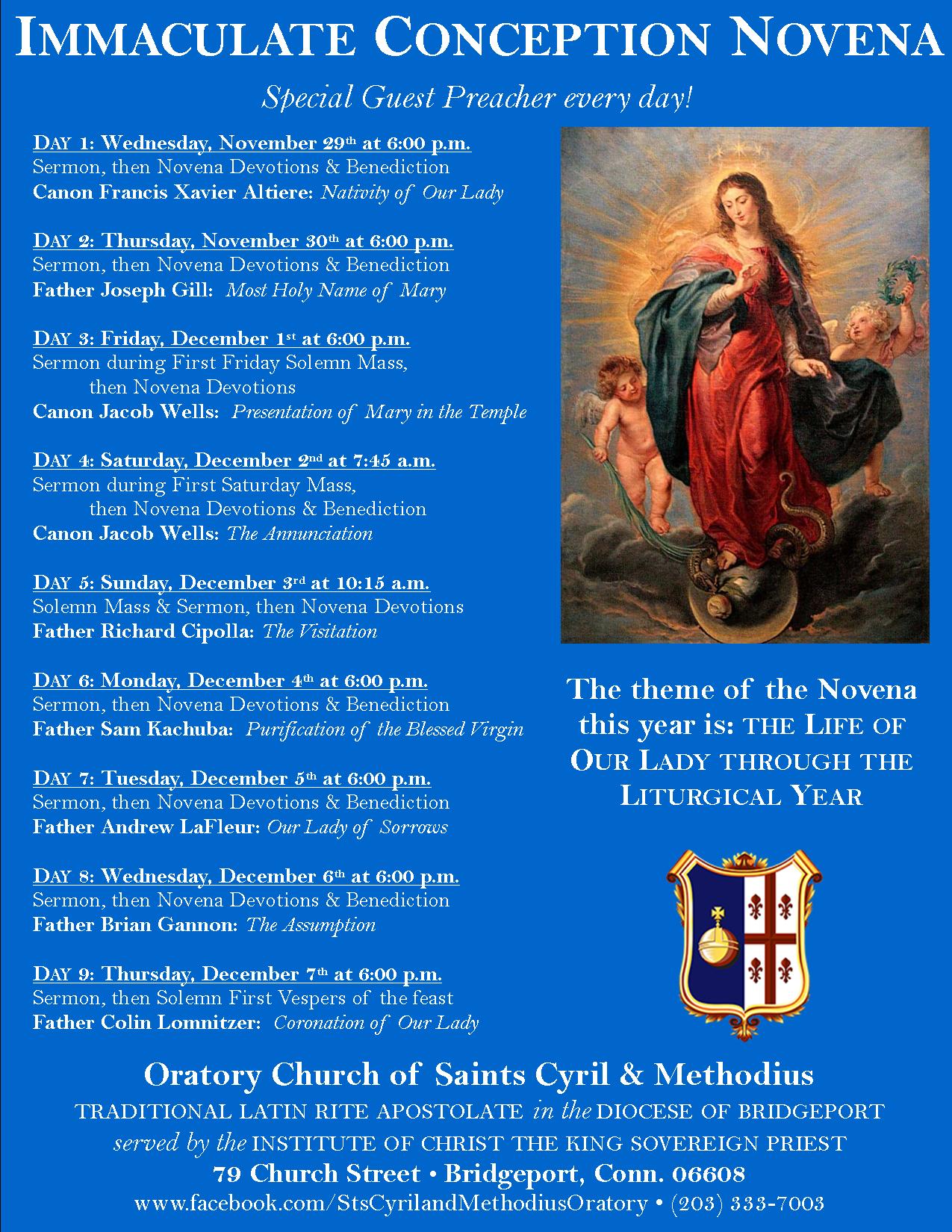
The Oratory of Ss Cyril and Methodius, the ICRSP’s Apostolate in Bridgeport, Connecticut, is holding a novena of preparation for the feast of the Immaculate Conception, starting this evening. Each day, a guest preacher will give a sermon on the theme of “The Life of Our Lady through the Liturgical Year”, which will be followed by novena devotions and benediction. (Note exceptions on the schedule for the coming weekend.) The church is located at 79 Church St.

DAY 1: Wednesday, November 29th at 6:00 p.m.
Sermon, then Novena Devotions & Benediction
Canon Francis Xavier Altiere: Nativity of Our Lady
DAY 2: Thursday, November 30th at 6:00 p.m
Sermon, then Novena Devotions & Benediction
Father Joseph Gill: Most Holy Name of Mary

DAY 3: Friday, December 1st at 6:00 p.m
Sermon during First Friday Solemn Mass, then Novena Devotions
Canon Jacob Wells: Presentation of Mary in the Temple

DAY 4: Saturday, December 2nd at 7:45 a.m.
Sermon during First Saturday Mass, then Novena Devotions & Benediction
Canon Jacob Wells: The Annunciation

DAY 5: Sunday, December 3rd at 10:15 a.m.
Solemn Mass & Sermon, then Novena Devotions
Father Richard Cipolla: The Visitation

DAY 6: Monday, December 4th at 6:00 p.m.
Sermon, then Novena Devotions & Benediction
Father Sam Kachuba: Purification of the Blessed Virgin

DAY 7: Tuesday, December 5th at 6:00 p.m.
Sermon, then Novena Devotions & Benediction
Father Andrew LaFleur: Our Lady of Sorrows

DAY 8: Wednesday, December 6th at 6:00 p.m.
Sermon, then Novena Devotions & Benediction
Father Brian Gannon: The Assumption

DAY 9: Thursday, December 7th at 6:00 p.m.
Sermon, then Solemn First Vespers of the feast
Father Colin Lomnitzer: Coronation of Our Lady

Tuesday, November 28, 2023

The Byzantine Golden Legend

Today is the older feast day of a Byzantine Saint called Simeon the Metaphrast, who is believed to have died on November 28th sometime towards the end of the tenth century, or within roughly the first decade of the eleventh. (He is now commemorated in most places on the ninth of this month.) Very little is known of his life, apart from the fact that he flourished in the days of the emperor Basil II, who reigned from 976-1025, and the patriarch Nicholas II (984-91). He has often been identified with a writer of the same name, Simeon the Logothete (the title of a class of high-level officials of the Byzantine court), who composed an important chronicle of world history, but this identification is now very much disputed. (Seventy years ago, it was more generally accepted, as noted in the revised edition of Butler’s Lives of the Saints.)

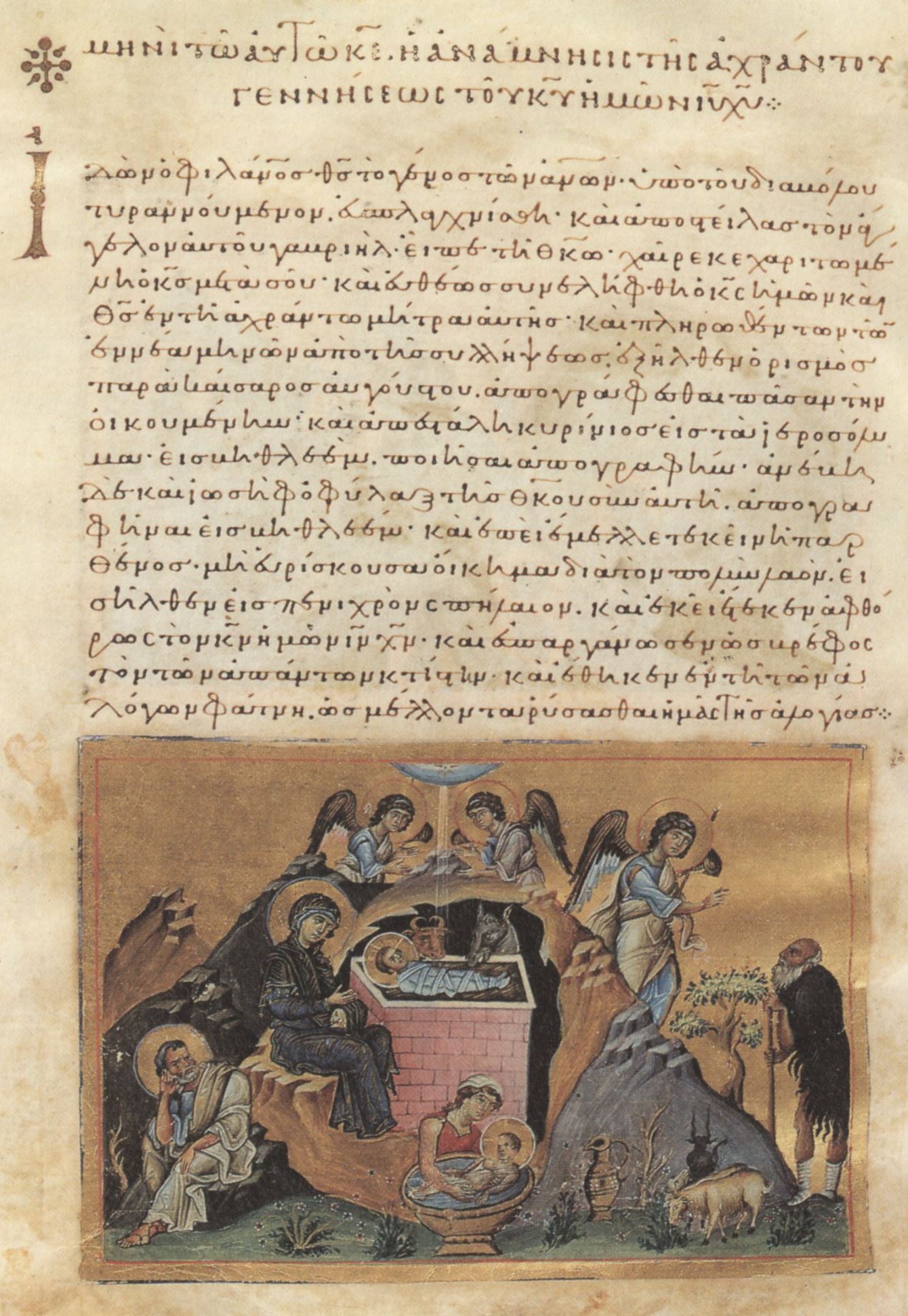
The entry in the Menologion of Basil II for Christmas Day. (Public domain image from Wikimedia Commons.) “Simeon” was a very popular name in the period of Byzantine history known as the Macedonian Renaissance, roughly the mid-9th to mid-11th centuries; the Metaphrast and the Logothete (if they are not the same person) count among their namesakes of that era two of the illustrators of this manuscript, a famous monastic poet and writer known as “the New Theologian”, plus his spiritual father, “the Studite”, and the first emperor of Bulgaria.
Simeon was the author of many liturgical texts in the various Byzantine liturgical genres (of which there are very many indeed), and he compiled an anthology of patristic writings, but he is most famous for his Menologion, a ten-volume compilation of the lives of the Saints, put together to be read in the Divine Office. The Greek verb “metaphrazein” from which his epithet derives means “to paraphrase”, because he would update and improve his sources stylistically, and supplement them with new material. This compilation met with such tremendous success that in many cases, the older versions of the texts were completely displaced, and no version of a Saint’s life older than Simeon’s now survives. Over time, however, the Menologion itself has mostly fallen into disuse as a formal liturgical text, since the Hour at which it is read, Orthros, is already spectacularly long and complex. In monasteries, it is now often read in the refectory instead.

Medieval Christians of the Byzantine world believed in the omnipresence of God, and His constant, benevolent and miraculous intervention, especially in the lives of the Saints, no less than their Latin counterparts did. Simeon’s Menologion is often spoken of as an Eastern Golden Legend, the highly influential collection of Saints’ lives by the Dominican bishop of Genua, Bl. Jacopo da Voragine (1230 ca. – 1298). Like the Golden Legend, it is full of stories of miracles and wonders, many of them very astonishing, many of them stretching credulity to or well past the breaking point. And like Jacopo, Simon has very often, and for the most part very unjustly, been impugned for his uncritical acceptance of such legends. Better and more dispassionate scholarship has in more recent times had the good sense to realize that they looked at the world very differently than modern men do (and that does not always mean for the worse), but also that much of what they recorded was simply received tradition, accepted and loved without skepticism or cynicism.
However, in the Byzantine liturgy as we have it nowadays, today is dedicated to the most prominent martyr of the iconoclast persecution, Stephen, who is given the epithet “the New” to distinguish him from the Protomartyr. He was born in Constantinople in either 713 or 715, and as a teenager, placed by his parents in a monastery on Mt Auxentius, on the eastern outskirts of the city’s Asian side. At the age of thirty, he became abbot, but left this position to live as a recluse in a remote cell twelve years later.
A mosaic of St Stephen in the monastery of St Luke (Hosios Loukas) on the Greek island of Boeotia. (Public domain image from Wikimedia Commons.)
Not long before Stephen entered the monastery, Leo the Isaurian (717-41) had become the latest Byzantine emperor to invent a heresy and try to force it on the Church, the heresy of iconoclasm. And not long before Stephen became abbot, Leo was succeeded by his son Constantine V (741-75), an enthusiastic promoter of his father’s heresy. His traditional epithet, “Copronymus”, means “dung-named” in Greek, a reference to a diaper accident that occurred at his baptism; this was taken by those who honored the sacred images as a presage of his impiety. It occurs several times in the Roman Martyrology, in reference to the many Saints killed or otherwise persecuted by him for the sake of the holy images.
In 754, the emperor held a synod in the imperial palace at Chalcedon, across the strait from the capital, to confirm the iconoclast position, and formally condemn the cult of the sacred images; it is known from the name of the palace as the Synod in Hieria. As long as iconoclasm held sway as an official policy of the Byzantine government, this synod was legally recognized as a legitimate council. With its conclusion, there began a fierce persecution of the iconodules; in The Church in Crisis: A History of the General Councils, Mons. Philip Hughes describes the 22 years from Hieria to Constantine’s death as a “reign of terror.” The stories of the treatment meted out to the orthodox rival those of the English reformation for shame and horror.
Throughout the iconoclast period, monks were the leaders of the opposition to it, and after some years, the emperor was very anxious to have Stephen approve Hieria, thinking, perhaps, that its acceptance by such a prestigious figure would go far towards persuading others of his order. Stephen refused absolutely to comply, and was persecuted in various ways for four long years. Among other things, he was accused of improper relations with a woman named Anna (variously reported as his own mother, or a widow under his spiritual direction, or a nun), who was whipped almost to death for proclaiming his innocence. He was banished for two years, then brought back to the city, where he had an interview with the emperor at which he successfully defended the veneration of images, and was therefore brutally scourged. The emperor, on hearing that he had survived the scourging, cried out (much like a later king would famously do in England), “Will no one rid me of this monk?” Stephen was then dragged out of his prison by a mob, and half-clubbed, half-stoned to death. In the Roman Martyrology, he is commemorated on this day along with three others named specifically, Basil, Peter and Andrew, and a company of 339 other monks.
The martyrdom of Ss Stephen the New, Peter and Andrew, also from the Menologion of Basil II. (Public domain image from Wikimedia Commons.)
The troparion of St Stephen Having struggled aforetime in asceticism upon the mountain, thou didst destroy the spiritual hosts of the enemies with all the arms of the Cross, o all-blessed one; but again, thou didst manfully strip thyself of them for martyrdom, and slayed Copronymus with the sword of the Faith; and for both hast thou been crowned by God, o holy renowned martyr Stephen.

The kontakion From a barren woman didst thou grow forth, the offshoot of a root, o venerable father, namesake of the Protomartyr; and thou wast shown to be a great instructor of monks, unafraid of the wrath of the emperor who did not wish to venerate the image of Christ. Wherefore, in dying thou didst receive the crown of martyrdom, o Stephen.

St Birinus Church, Dorchester-on-Thames, Oxfordshire

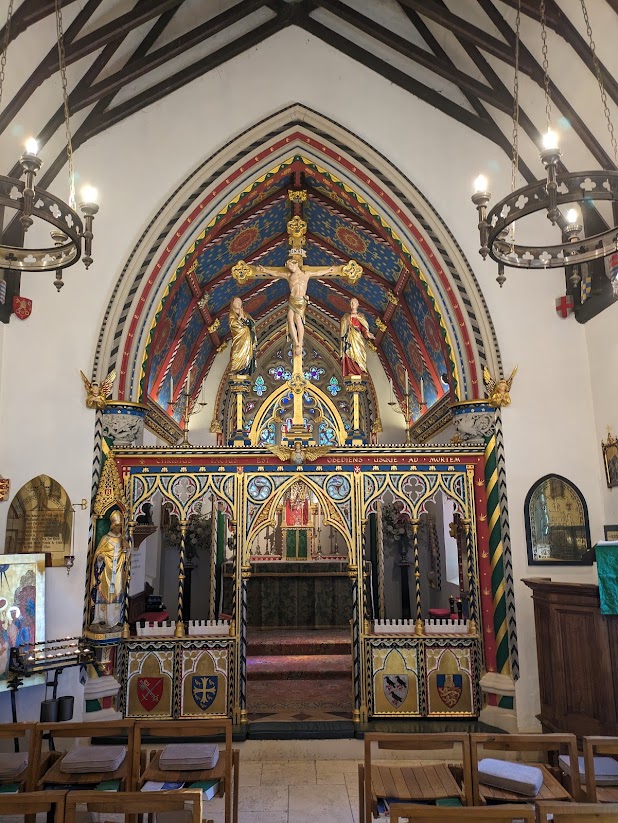
St Birinus Catholic Church is a tiny architectural jewel set in beautiful English countryside, 15 miles from Oxford, on the banks of the River Thame. The Traditional Latin Mass is celebrated there every Sunday. The choir is exceptional, the art is spectacular, and all works in harmony in a Victorian-era church that was so obviously created to house beautiful liturgy. It is a glimpse of what England might still have been if it hadn’t been for Henry VIII, and an indication of what, despite everything, it might again.

The wall painting was done by a parishioner. Under the guidance of the parish priest, Fr John Osman, this church and parish have become a beacon of light - beautiful art, architecture, and music. It shows what can be done with good taste and conviction.

Press your parish priest to commission work from the artists at the Chichester Workshop of Liturgical Art. Martin Earle, for example, could paint, mosaic, fresco the church and do all the carpentry to build the rood screen. 
St Birinus, by the way, is a little known early saint responsible for the conversion of England in the 7th century. 
Also, it is not a spelling mistake, the confluence of the rivers Thame and Isis occurs just a quarter of a mile away to form the river 'Thame-Isis' otherwise known as the River Thames.

Monday, November 27, 2023

Years of Invalid “Honeycake” Masses

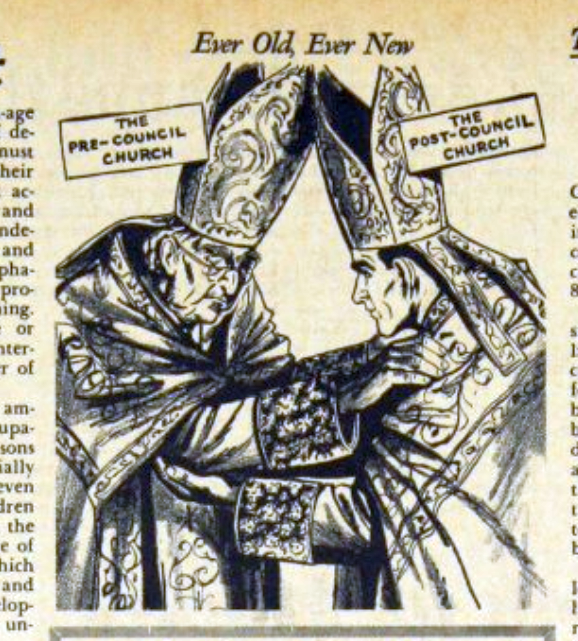
Cartoon from Catholic newspaper ca. 1965. Things didn’t quite turn out this way.
As I noted in an article published in October (“ The ‘Unique Expression of the Roman Rite’ in the Wild: New Zealand Priest Ad-libbing Eucharistic Prayer”), the primordial defect of the Novus Ordo is its huge range of possible realizations and adaptations, a dizzying number of them lacking in all good sense, good taste, connection with tradition, etc., and yet well within the bounds of what is legally permissible, not to say universally tolerated. In other words, it is a template for community prayer-action, not a liturgical rite as such, which is always characterized by unspontaneous and determinate givenness.

The “Big Bang” moment for the deritualization of rite was the very act of calling a global liturgical reform where everything was going to be evaluated through the filters of modern liturgical scholars. After that point, it hardly mattered what was said or done; the cord with tradition as normative, venerable, and essentially right had been severed, and Humpty-Dumpty’s situation looked quite favorable in comparison. “All the pope’s horses (i.e., curial officials) and all the pope’s men (i.e., local bishops) couldn’t put ritual back together again.” This helps explain why it seems dramatically easier to mount a full-scale solemn Tridentine liturgy than to reform the reform: the one thing is already a rite, the other is a workshop in search of an identity. 

I was thinking about all this recently when a reader sent me a recipe that was used in the ’90s at his wife’s childhood parish for “baking the Mass bread.” One glance at this recipe makes it apparent that the parish in question did not, in fact, offer Mass for years due to invalid matter. [UPDATE: See the comments section for some clarifications on this point. To be more precise, the matter here is of doubtful validity and is classified as a grave abuse by the Church.] The reader’s wife was, needless to say, very upset to find out, years after the fact, that her “First Communion” wasn’t actually her first, because there might have been no Communion there.

Fast forward to the present. Good news: today, that same parish hosts two TLMs per week. The days of honeycakes are long gone, and the Roman Rite is back in place. Thanks be to God!

Visit Dr. Kwasniewski’s Substack “Tradition & Sanity”; personal site; composer site; publishing house Os Justi Press and YouTube, SoundCloud, and Spotify pages.

Sunday, November 26, 2023

The Last Sunday after Pentecost 2023

At that time, Jesus said to his disciples: When you shall see the abomination of desolation, which was spoken of by Daniel the prophet, standing in the holy place, let him understand who readeth. Then they that are in Judea, let them flee to the mountains, and he that is on the housetop, let him not come down to take any thing out of his house, and he that is in the field, let him not go back to take his coat. And woe to them that are with child, and that give suck in those days. But pray that your flight be not in the winter, or on the sabbath. For there shall be then great tribulation, such as hath not been from the beginning of the world until now, neither shall be. And unless those days had been shortened, no flesh should be saved: but for the sake of the elect those days shall be shortened. Then if any man shall say to you: Lo here is Christ, or there, do not believe him. For there shall arise false Christs and false prophets, and shall shew great signs and wonders, insomuch as to deceive (if possible) even the elect. Behold I have told it to you, beforehand. If therefore they shall say to you: Behold he is in the desert, go ye not out: Behold he is in the secret chambers, believe it not. For as lightning cometh out of the east, and appeareth even into the west: so shall the coming of the Son of man be. Wheresoever the body shall be, there shall the eagles also be gathered together.

The central panel of the Last Judgment, ca. 1435, by the German painter Stephan Lochner (ca. 1410-51). Image from Wikimedia Commons by José Luiz Bernardes Ribeiro, CC BY-SA 4.0.
And immediately after the tribulation of those days, the sun shall be darkened and the moon shall not give her light, and the stars shall fall from heaven, and the powers of heaven shall be moved. And then shall appear the sign of the Son of man in heaven: and then shall all tribes of the earth mourn: and they shall see the Son of man coming in the clouds of heaven with much power and majesty. And he shall send his angels with a trumpet, and a great voice, and they shall gather together his elect from the four winds, from the farthest parts of the heavens to the utmost bounds of them. And from the fig tree learn a parable: When the branch thereof is now tender, and the leaves come forth, you know that summer is nigh. So you also, when you shall see all these things, know ye that it is nigh, even at the doors. Amen I say to you, that this generation shall not pass, till all these things be done. Heaven and earth shall pass, but my words shall not pass. (Matthew 24, 15-35, the Gospel of the Last Sunday after Pentecost.)

Saturday, November 25, 2023

St Catherine of Alexandria in the Counter-Reformation

The acts of St Catherine of Alexandria tell us that she was a noblewoman of immense learning in all the sciences, who at the age of eighteen went to the emperor Maximin Daia (305-312) to reprove him for his persecution of the Church, denouncing the worship of the false gods of the pagans. Unable to respond to her himself, Maximin had her imprisoned, and then brought a group of fifty philosophers to explain to her the folly of Christianity; all of these she converted to the Faith, for which they were put to death. Catherine was returned to prison, where she was visited by the empress and a captain of the emperor’s troops named Porphyry, both of whom were also converted, and soon after martyred. Catherine was then condemned to die by the famous spiked wheel which has long been known as her emblem, but which broke apart on touching her; like so many Saints whom Nature itself and the persecutors’ devices refused to harm, she was then beheaded. As the traditional Collect of her feast states, her body was carried by Angels to Mount Sinai, where first a church, and later the famous monastery were built in her honor.

An icon of the Presentation of Mary, with St Catherine on the far left. (Greek, 18th century). In the Byzantine Rite, the Entrance of the Virgin in the Temple is one of the twelve Great Feasts, most of which are kept with both a Forefeast and Afterfeast, broadly the equivalent of a vigil and octave in the traditional Roman Rite. Afterfeasts vary in length, and those of the Virgin’s Presentation and Nativity are the shortest, only four days, the final day being known as the Leave-taking; the Leavetaking of the Presentation therefore coincides with St Catherine’s feast day. (Photo from Wikimedia Commons by shakko.) 
She became one of the most popular Saints of the High Middle Ages beginning in the 11th century, when some of her relics were brought to the French city of Rouen. Innumerable churches and chapels were dedicated to her, she appears in an extraordinary number of paintings and statues, and her feast day was kept in many places as a holy day of obligation. She has long been honored as a Patron Saint of philosophers and theologians, orators and preachers, (and hence especially by the Dominicans, who kept her feast with an octave until the early 20th century,) but also of women in religious life, students of every sort, millers and wheelwrights. In France, her prestige was very much enhanced by the fact that she was one of the Saints who spoke to St Joan of Arc. She is honored in the Byzantine Rite with the title “Great Martyr”, and named in the preparation rite of the Divine Liturgy; in the Ambrosian Rite, her name was even added to the Canon of the Mass in the later 15th century.

It is painful to relate that no aspect of the life of St Catherine as given in her acts can be considered historically trustworthy. Just to give one of many possible examples, she is named as the “daughter of a king named Costus”, even though Egypt in the early fourth century was a province of the Roman Empire, and had had no king for over three-hundred years. There is no mention of her in the wealth of Egyptian Christian literature for several centuries after her death, or in the various accounts of pilgrims to the monastery on Mt Sinai, which was not originally named for her.

By the time the Roman Breviary was revised after the Council of Trent, scholars had long known that many of the well-known and loved stories of the Saints were not historically reliable. Thus we find several of the Virgin Martyrs who were very popular in the Middle Ages, such as Ss Barbara, Margaret of Antioch and Ss Ursula and Companions, reduced from full offices of nine readings in the Roman Breviary of 1529 to a mere commemoration in the Breviary of St Pius V. Even Ss Cecilia and Agatha, who are named in the Canon of the Mass, were originally kept at the second of three grades; only Ss Agnes, the Roman martyr par excellence among women, Lucy (a rather random choice), and Catherine of Alexandria were kept at the highest grade.

Virgo inter Virgines (The Virgin Mary among the other holy virgins) by the anonymous Netherlandish painter known as the Master of the St Lucy Legend, ca. 1490. The holy Virgins are Ss Apollonia, Ursula, Lucy, Dorothy, Catherine (receiving a ring from the baby Jesus; her red cloak is covered with her symbol, the wheel), Mary Magdalene, Barbara, Agnes, Margaret, Agatha and Cunera, patron of the Rhenen area near Utrecht, said be one of the 11,000 companions of St Ursula. (Click image to enlarge; click here for a complete explanation of the icongraphy.)
The Breviary of St Pius V, first published in 1568, was revised in the last decade of the same century, and a new edition published in 1602. Pope Clement VIII had entrusted the task of correcting the Saints’ lives to the great Cardinal Cesare Baronius, also the principal editor of the first Tridentine edition of the Martyrology. Among Baronius’ collaborators was St Robert Bellarmine, one of the most learned men of his age, who is supposed to have said in regard to St Catherine, “I wish I could believe that she existed.” In his History of the Roman Breviary, Mons. Pierre Batiffol notes (p. 216) that Baronius often refused, against St Robert’s advice, to alter some of the popular legends, despite the historical problems associated with them; and that he noted of St Catherine specifically, “Her history contains many things which are repugnant to the truth.” Nevertheless, her Office was left unaltered, and remained in the same form until the Breviary revision of 1960.

It was certainly a goal of the Tridentine reform of the Breviary to remove from the Church’s public prayer anything that might offer the Protestants a pretext for attack or ridicule. (Baronius was well aware of this problem, and also produced a massive history of the Church, covering the first 12 centuries, in response to Protestant controversialists.) The question therefore arises as to why a Saint whose life was subject to serious doubts, even on the part of the very revisers of the Breviary, was not merely included in it, but celebrated in one of its most prominent feasts.

In part, we may simply say that scholars must at times take their lesson from the devotion of the people, and accept what they may perhaps not understand. (It is interesting to note in this regard that St Catherine was abolished in the Novus Ordo, but restored to the general calendar by Pope St John Paul II.) But there are three aspects of the story of St Catherine that are particularly significant to the Counter-Reformation, which certainly contributed to the preservation of devotion to her.

The first is her role as the Patron Saint of philosophers, which comes, of course, from the story told above of her converting the fifty men sent to dissuade her of her Christian faith.

The second is her role as patron of women in religious life. This arises from the story that Maximin offered to take her on as a second wife or mistress, and even honor her as a goddess, if she would renounce the Faith. To this Catherine replied, “It is a crime even to think of such things. Christ has taken me to Himself as a bride; I have joined myself to Him as a bride in an indissoluble bond.” Other virgin martyrs like Ss Agnes and Agatha also speak of themselves in similar terms, but for whatever reason, it was seen as especially important in Catherine’s case. Therefore, she is very often represented, both before and after the Counter-Reformation, receiving a wedding ring from the infant Christ as He is held by His Mother, joined to him in a mystical marriage, although this is not specifically said in the text of her acts commonly read in medieval breviaries, nor in the Golden Legend.

The Mystical Marriage of St Catherine, by Guercino, 1620
The third reason has to do with her place among the Fourteen Holy Helpers. In the 1499 Missal of Bamberg, the Collect of a Votive Mass in their honor reads as follows:
Almighty and merciful God, who didst adorn Thy Saints George, Blase, Erasmus, Pantaleon, Vitus, Christopher, Denis, Cyriacus, Acacius, Eustace, Giles, Margaret, Barbara and Catherine with special privileges above all others, so that all who in their necessities implore their help, according to the grace of Thy promise, may attain the salutary effect of their pleading: grant us, we beseech Thee, forgiveness of our sins, and with their merits interceding, deliver us from all adversities, and kindly hear our prayers.
The words “according to the grace of Thy promise” refer to the tradition that during their passion, each of these Saints received a promise from God that their intercession would be exceptionally effective on behalf of those who honored them. Thus, the third antiphon of Lauds in the proper office of St Catherine reads “I await the sword for Thee, o Jesus, good king; set Thou my spirit in Paradise, and show mercy to those who keep my memory.” To this Christ answers in the fourth antiphon: “A voice sounded from heaven: ‘Come, my chosen one, come, enter the chamber of Thy spouse; thou hast obtained what thou asked; those that praise thee shall be saved.” And the fifth concludes, “Because we keep the memory of thee, o virgin, with devout praises, pray for us, we ask, o blessed Catherine.”

In these three roles, as Patron Saint of philosophers, as a bride of Christ, and as a Holy Helper, St Catherine stands out as a perfect response to the novelties of the Protestant reformers.

After serving for many centuries as the “handmaid of theology,” from the Fathers to Boethius to St Thomas, and particularly after the great scholastic conquest of Aristotle, philosophy, and indeed reason itself, were cast out by Martin Luther as “the Devil’s greatest whore… who ought to be trodden under foot and destroyed, she and her wisdom…” And likewise, “Aristotle is the godless bulwark of the papists. He is to theology what darkness is to light. His ethics is the worst enemy of grace. He is a rank philosopher, … the most artful corrupter of minds. If he had not lived in flesh and bones, I should not scruple to take him for a devil.” As for St. Thomas, “he never understood a chapter of the Gospel or Aristotle … In short, it is impossible to reform the Church if Scholastic theology and philosophy are not torn out by the roots with Canon Law.” St Catherine therefore serves as an example of the Church’s true tradition, one who successfully used philosophy in the preaching and teaching of the Faith.

St Catherine and the Philosophers, from the Castiglione chapel in the Basilica of St Clement in Rome, by Masolino da Panicale, 1425-31. Note how she calmly counts off her reasons for believing the Christian faith, as the philosophers look in confusion in different directions. “We firmly confess this to thee, o emperor, that unless thou shall show us a more likely sect than these which we have followed hitherto; behold, we all convert to Christ, because we confess Him to be true God and the son of God.” (from the Sarum Breviary). At this the emperor orders them to be burnt alive, as seen on the right.
The Protestants also completely rejected any kind of monastic or canonical religious life, leaving no formal place at all for women in the institutional life of the Church. (Luther himself, like so many disaffected religious, married a former nun, whose name, ironically, was Catherine.) The tradition of Christ accepting her in a mystical marriage would therefore validate the institution of consecrated life in general, but particularly for women.

Finally, as a Saint renowned for her powerful intercession on behalf of many classes of people, St Catherine stands with countless others in the “cloud of witnesses” against the early Protestant rejection of devotion to the Saints, and their power to intercede for us in this world.

Even within Luther’s lifetime, it was hardly possible to get two Protestant reformers together to agree on any point; hence, the famous dispute at which he carved “EST – it is” into the table, in reply to Zwingli, who was quite certain that the Lord was only kidding when He said “This IS my body.” Broadly speaking, however, they generally accepted that things had really gone wrong in the Church with the coming of the mendicants, (especially the Franciscans), and the flourishing of their teachings in the universities. Although the life of St Catherine may no longer be regarded as historical, it still bears witness to the Church’s historical belief, before the emergence of the mendicants, in the goodness of reason and philosophy, in the value of consecrated life, and the intercession of the Saints on our behalf.

Friday, November 24, 2023

The Apocalypse Tapestries (Part 3)

This is the last of three posts about one of the most remarkable artistic representations of the book of the Apocalypse, a series of six enormous tapestries created in Paris between 1377 and 1382. (See part one and part two.) They were commissioned by Louis I (1339-84), the second son of King Jean II of France, and first Duke of Anjou; his grandson and third successor to his title, René, donated them to the cathedral of Angers, the capital of the duchy, in 1480. Each of them begins on the left with a man sitting under a Gothic baldachin, reading the Apocalypse from a book on a stand in front of him. There follow 14 scenes of St John’s visions arranged in the order of the book, running from left to right, first above and then below, making for 15 panels per tapestry, an original total of 90 scenes between the six.

After being plundered and cut into pieces during the Revolution, the surviving parts were recovered in 1848. The fifth and sixth tapestries, the most badly damaged, are shown in this post; the former lost three full scenes and parts of two others, while the latter lost five, as well as its reader, and its last two scenes survive in fragments. The images here are taken from this page of Wikimedia Commons, which shows the arrangement of the panels divided by tapestry (by PMR Maeyaert, CC BY-SA 4.0.)
The angels receive the “seven golden vials, full of the wrath of the living God.” (chapter 15, verse 7)
The first vial is poured out upon the earth (16, 2).
The second vial on the sea (16, 3).
The left side of this section, showing the third vial poured upon the rivers and fountains (16, 4), is lost; in the surviving half, the fourth vial is poured upon the sun (16, 8).
The fifth and sixth vials (16, 10-12).
Unclean spirits in the likeness of frogs come forth from the mouths of the dragon and the beast (17, 13).
The seventh vial is poured out upon the air (16, 17).
The angel shows St John “great harlot that sitteth upon the many waters.” (17, 1)
The harlot riding upon the beast (17, 3).
The Fall of Babylon (18, 2)
Here, there are missing three full scenes, of the Angel casting the millstone into the sea (18, 21), the harlot being cast down (19, 2), and the wedding of the Lamb (19, 7). In this last scene of the fifth tapestry (missing about a third on the right), St John writes at the angel’s instructions (19, 9-10).

The sixth tapestry is lacking its reader and the first two scenes of the upper register, which showed the rider on the white horse, who “treadeth the winepress of the fierceness of the wrath of God the Almighty” (19, 15), and the birds which come to eat the flesh of the mighty whom he casts down (19, 17-18). Here, He fights with “the beast, and the kings of the earth, and their armies gathered together to make war with Him” (19, 19).

He defeats them, and they are cast into the lake of fire (19, 20).
After another missing scene, of the dragon being chained (20, 1-2), we see the martyrs giving judgment (20, 4).

Satan attacks the beloved city (20, 8)
The first two scenes of the lower register are also missing, the devil cast down into the lake of fire (20, 10), and the Last Judgment (20, 12). Here we see St John’s vision of the New Jerusalem coming down from heaven, which is read as the Epistle on the feast of a church dedication (21, 2-5).

The angel measures the city (21, 15).
The river of the water of life (22, 1).
The surviving fragments of the last two sections of the lower register: St John and the Angel (22, 8), and before God (22, 9). Amen!

More recent articles:

For more articles, see the NLM archives: