Sunday, December 31, 2023

The Legend of Pope St Silvester I

The Caelian hill in Rome is the site of a very ancient basilica dedicated to the Four Crowned Martyrs; within the complex that surrounds it is preserved an extraordinary gem of medieval art, a chapel dedicated to Pope St Silvester I (314-35), whose feast has been kept on this day since the fourth century. (All images from the relevant page of Wikimedia Commons, by Sailko, CC BY-SA 3.0.)
This chapel was built in 1246, for a very particular purpose determined by the proximity of the Four Crowned Martyrs to the Pope’s cathedral, St John in the Lateran, where Papal elections were traditionally held in the Middle Ages. In the 12th century, the Church was very much caught up in the Investiture Controversy, the struggle to free itself from the control of the secular power, and particularly, of the German Holy Roman Emperors; and for most of the century, there was an antipope who took the Emperors’ side. A crucial figure in this long controversy, Pope Alexander III (1159-81), was, like Silvester I, one of the longest reigning Popes of all time, but was unable for most of his reign to enter Rome, which was held by the antipopes with the Emperor’s support. After an agreement was reached between the two sides towards the end of Alexander’s reign, and solidified by the Third General Council of the Lateran in 1179, the conflict was most unhappily renewed in the first part of the 13th century under the Emperor Frederick II.

The chapel of St Silvester was therefore built so that, if the Lateran itself should be occupied by the Emperor, the cardinals would be able to barricade themselves within the fortress-like complex around the basilica of the Four Crowned Martyrs a short distance away, and elect a Pope without outside interference. The program of the frescoes which decorate its walls is very much intended to speak to this potential role of the chapel as the site of a Papal election, and to remind the cardinals that the candidate they should be supporting is the one who will defend the liberty of the Church, which the civil power has no right to usurp. (In the end, however, the chapel was never used for this purpose.)
The cycle begins on the back wall, with the first of several episodes from the life of Constantine, whom the medieval Papacy (mostly with good reason) held up as an ideal emperor because he gave the Church freedom and a great deal of material support, but largely left it alone to manage its own internal affairs. According to the common legend, he suffered from leprosy, which his doctors told him could only be cured by bathing in the blood of young children. (Ancient Roman medical practice had much to do with what anthropologists call sympathetic magic, and the idea that a doctor in antiquity might prescribe such an awful remedy is not per se absurd.) Notice how the faces in the crowd of mothers are all basically the same, and there is only a hint of using their expression to convey their distress at the proposed massacre. Artworks of this kind became very unfashionable in the Renaissance, which sought to differentiate faces in groups more realistically, and use facial expressions to convey emotion.
Constantine (who, like all good monarchs, sleeps in full regalia and wearing a crown), has a dream in which the Apostles Peter and Paul appear to him, and tell him not to kill the children, but rather to seek out the Christian bishop of Rome, who will cure him. (Notice that the decorative pattern on Constantine’s robe passes through the space delineated by it without conforming to the folds of the cloth, another classic feature of medieval art on which the Renaissance will seek to improve.)

Constantine’s emissaries (who are taller than their horses) ride out to seek Pope Silvester...

and find him (after turning the corner of the wall) on Mt Soracte to the north of Rome, hiding with other members of the clergy from the ongoing persecution of the Church. (Note the sideways treetop in the background.)

Pope Silvester meets the Emperor and shows him an image of Ss Peter and Paul, whom Constantine recognizes as the men who had appeared to him in his dream. He therefore accepts the truth of the vision...

and agrees to be baptized, at which his leprosy disappears. (For want of the discovery of either ocular or one-point linear perspective, the vessel in which Constantine is standing is far too small for his body. I do not, of course, point these things out to run down the artists, whose work is very pleasing on its own terms, but only to highlight the contrast with the other, more prominent styles of Italian art which will replace those of the Middle Ages.)

In gratitude for his healing, Constantine then gives temporal authority over the city of Rome and “the Western regions” to the Pope, the so-called Donation of Constantine, an assertion of the Pope’s independence, as a secular ruler in his own right, from imperial control. This authority is symbolized by the hat which the Emperor passes to him, which is more elaborate than his miter. (When this fresco was made in the mid-13th century, the Donation of Constantine had not yet been recognized as a forgery; the man who revealed it to be such, an Italian priest and humanist scholar named Lorenzo Valla, died in 1457, is in fact buried right up the street in the Lateran Basilica.)

The Emperor then leads the Pope by the bridle of his horse into the city, a gesture of submission to his authority; this refers to the peace made between Pope Alexander III in 1177 with the Emperor Frederick Barbarossa, which in the mid-13th century was very much threatened by the renewal of the conflict under Frederick II.
The story continues on the opposite wall with Constantine’s mother, the dowager Empress St Helena, who holds a debate to determine which of the two monotheistic religions, Christianity or Judaism, is true. A rabbi decides to prove the truth of Judaism by whispering what he claims to be the Divine Name into the ear of a ferocious bull, which immediately dies. However, (as recounted in the Golden Legend), Pope Silvester whispers into its ear, “O name of cursing and death, go out by the command of the Lord Jesus Christ, in Whose name I say to thee: o bull, arise, and return in all mildness to thy flock.” The bull immediately comes back to life and walks away. Helena and all those present, including the rabbis, become Christians.

Helena then goes on her great expedition to the Holy Land, where she discovers the site of Mt Calvary and the relics of the True Cross.

The last fresco in the cycle is badly damaged, but the story it tells is well-known. When the site of Mt Calvary was dug up, the uprights of the three crosses of Our Lord and the two thieves were found separated from the crossbars. The upright of the Cross was identified because the Title was still nailed to it, but the crossbars were indistinguishable from each other. The bishop of Jerusalem, St Macarius, therefore had a dying woman brought to the site, and touched with the wood of each crossbar in turn; she was, of course, healed completely by the third one, which was thus recognized as the Lord’s.

The back wall of the church is decorated with a scene of the Last Judgment that follows all of the classic medieval artistic conventions. The figures are sized according to their hierarchical order, with Christ the largest, the Virgin and the Baptist smaller than He, and the Twelve Apostles smaller still. Christ is surrounded by the instruments of His Passion, while at the upper left, an angel roles up the heavens like a scroll (Apoc. 6, 14), on which we see a black sun and a red moon (ibid. v. 12), and at the upper right, an angel blows a trumpet (8, 6).

Under the narrative frescoes, there originally ran a band of Saints and Prophets in medallions, most of which are fragmentary or completely lost. These three under the scene of the Donation are by far the best preserved.

The First Anniversary of Pope Benedict XVI’s Death

Deus, qui inter summos sacerdótes fámulum tuum Benedictum ineffábili tua dispositióne connumerári voluisti: praesta, quáesumus; ut, qui Unigéniti Filii tui vices in terris gerébat, sanctórum tuórum Pontíficum consortio perpétuo aggregétur. Per eundem Christum, Dóminum nostrum. Amen.

God, Who in Thy ineffable providence, did will that Thy servant Benedict should be numbered among the high priests, grant, we beseech Thee, that he, who on earth held the place of Thine Only-begotten Son, may be joined forevermore to the fellowship of Thy holy pontiffs. Through the same Christ, Our Lord. Amen.

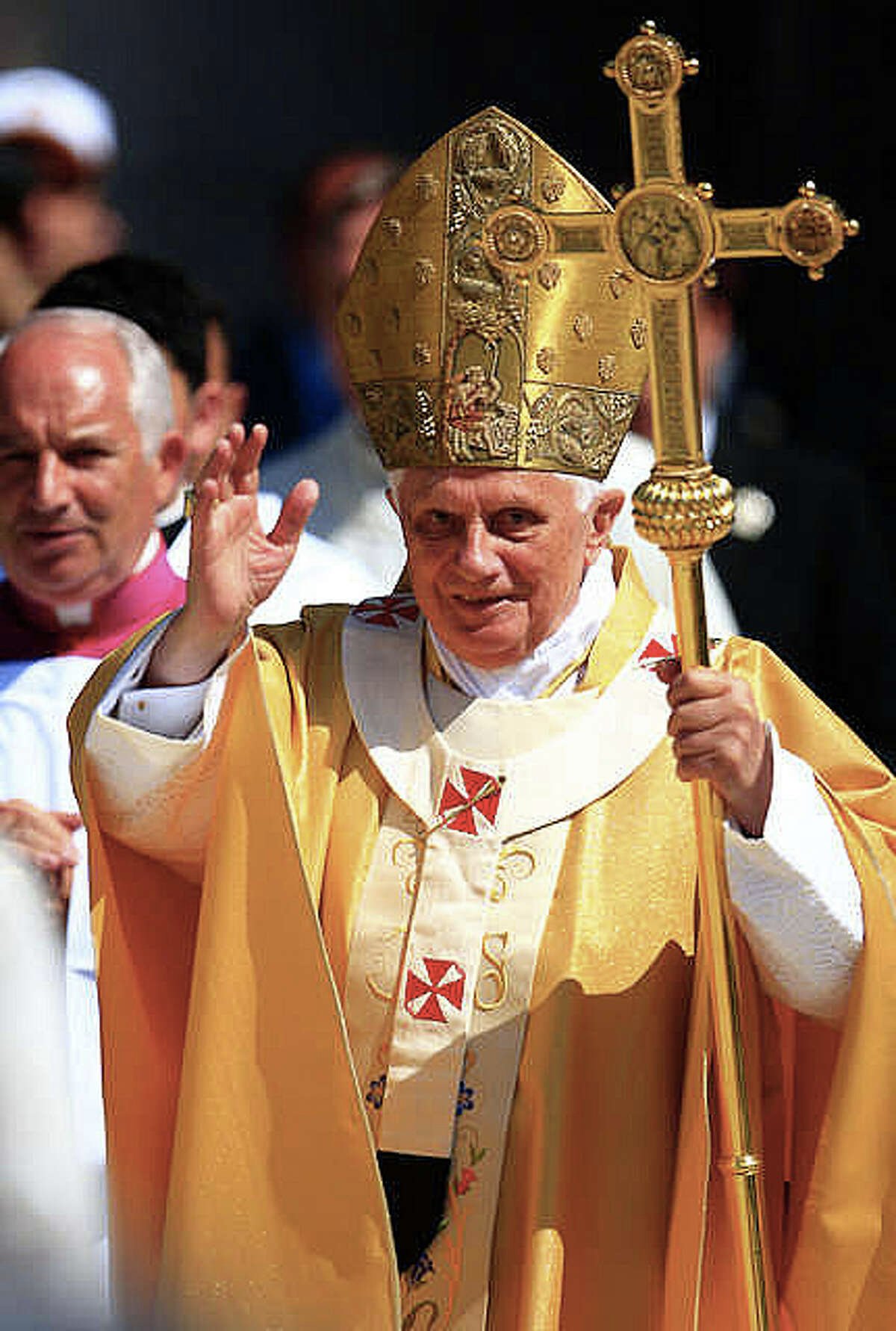
As we pray for the eternal repose of His Holiness Pope Benedict XVI, who died one year ago today, let us also remember with gratitude the gift of his papacy, his graciousness and good humor, his many wise and well-considered writings, his paternal love especially for priests and religious, but of course above all, his restoration to the Church of the incomparable treasure of the traditional Roman Rite, an act which will continue to bear great spiritual fruit and lead the way for much-needed reform. “What earlier generations held as sacred, remains sacred and great for us too, and it cannot be all of a sudden entirely forbidden or even considered harmful.”
Joseph Ratzinger serving an open-air solemn Mass in the town of Buchfelln in 1947, when he was 20. Tradition will always be for the young!

Saturday, December 30, 2023

The Life of Christ in a 5th Century Ivory Diptych

Among the many artistic treasures preserved in the cathedral museum of Milan, one of the most ancient is an ivory diptych produced in northern Italy, very likely at Ravenna, in the later 5th century. It is known as the Diptych of the Five Parts, since each of the two panels is assembled out of five separately carved pieces. The events of Our Lord’s life which are celebrated in the current liturgical season are particularly prominent on the large panels at the top and bottom of both sides; this is generally understood as an assertion, in the light of the Christological controversies of the 5th century, as an assertion of the fullness of Christ’s humanity united to the divinity in the Incarnation. Thanks to Nicola for sharing these pictures with us. Beneath the photos of the diptych, I have included two others of a very beautiful cover for a Gospel book, made in the early 11th century.

The upper panel of the front side: the Nativity of Christ, with two symbols of the Evangelists to either side, Matthew and Luke, who give the genealogies of Christ. St Joseph is dressed as a Roman shepherd, but holds a carpenter’s saw. 
The Massacre of the Holy Innocents, with the evangelists themselves to either side.
The upper part of the left panel shows an episode from an apocryphal Gospel, in which an angel comes to the Virgin Mary as she draws water at a well before the Annunciation: below it are depicted the three Magi, pointing to the star of the Nativity, and below that, the Baptism of Christ. 
It is not certain which episode is depicted on the upper section of the right panel, either the Presentation of the Virgin in the temple, or an episode from another apocryphal Gospel, in which She is subjected to an ordeal to prove Her innocence after She is found to be pregnant. Beneath it are shown the twelve-year-old Christ in the temple, and His entry into Jerusalem on Palm Sunday.

In the center is mounted an image of the Lamb of God made with the technique now known by the French name “cloisonné”, in which colored material of various kinds (here gemstones, but in many other examples, colored enamel) are set between metal wires (here gold.) This technique is very ancient, with examples dating back as far as the 12th century BC, but examples in early Christian art are extremely rare, much less ones as well preserved as this. 
The reverse of the diptych.
In the upper panel, the Adoration of the Magi, with the symbols of the Evangelists Ss Mark and John. 
At the bottom, the Wedding at Cana, an episode which the Church Fathers of the 5th century associated with the Epiphany, according to what they regarded as a tradition already ancient. It is the Gospel of the Sunday after the octave of the Epiphany in both the Roman and Ambrosian Rites. 
On the left side, the healing of a blind man, of the paralytic, and the Resurrection of Lazarus.

On the right side, Christ gives crowns to two martyrs, the Last Supper, and a rare depiction of the story of the Widow’s Mite (Luke 21, 1-4.)

The front side of this cover for a Gospel book is a gold plaque decorated with gold filigree, enamel, pearls, and a variety of precious stones. It is named for the archbishop of Milan during whose tenure it was produced, Aribert of Intimiano, who held the see from 1018 to 1045).

The chased silver back panel shows St John presenting the archbishop to Christ and the Virgin in the upper section, and in the lower section, St Ambrose with the martyrs Ss Protasius and Gervasius, who are buried along side him in the basilica named after him.


New Year’s Eve Customs

New Year’s Eve sketch, Marguerite Marty
Topsy-Turvy Twelve Days of Christmas, Part III

New Year’s Eve has been an occasion for merry-making (and worse) ever since the Roman festival of the Kalendae Januarii. The early Christian Church was opposed to the pagan proclivity for excess and instead kept January 1 as a day of fasting and penance. To this day, as far as the Church year is concerned, the start of the civic year is a non-event.

Nevertheless, because it is only natural to mark the end of an old year and the beginning of a new one, and because it is a good idea to ask God’s blessings on the future, Christians eventually incorporated aspects of the Roman new year, and added a few of their own.
Silvesterabend
St. Sylvester was Supreme Pontiff during the reign of Constantine, the Roman Emperor who ended the persecution of the Church. One legend even claims that Sylvester baptized Constantine after the latter was miraculously cured from leprosy. There is a simple reason why the saint’s feast falls on this day: after twenty-one years of service to God as Pope, Sylvester died and was buried on December 31, 335. That said, there is something appropriate about preparing for the new civic year with the first Bishop of Rome to assume the throne of Peter during a time of civic peace, since the time when our hearts are filled with hope for “peace on earth.”
Pope St. Sylvester and the Emperor Constantine
Sylvester’s feast is so closely tied to December 31 that in many countries New Year’s Eve is known as Sylvester Night (Silvesterabend or Silvesternacht in German).
In France and French Canada, it is traditional for the father to bless the members of his family and for the children to thank their parents for all of their love and care. In central Europe, a pre-Christian ritual of scaring away demons with loud noises was retained; from this is derived our custom of fireworks and artillery salutes in welcome of the new year. In Austria, December 31 was sometimes called Rauchnacht or “Incense night,” when the paterfamilias went through the house and barn purifying them with incense and holy water.
Superstitions
And speaking of luck, Sylvester Night was a favorite occasion for attempts to peer into the upcoming year. The reading of tea leaves was once popular, as was pouring spoonfuls of molten lead into water and interpreting the future from the shapes it took. Young maidens prayed to St. Sylvester in traditional rhymes, asking him for a good husband and hoping through his intercession to catch a glimpse of Mr. Right in their dreams or in the reflection of a mirror.
Religious Services
On the more pious side of things were vigil services of various kinds thanking God for the gifts of the year and seeking blessings for the new. To this day, the Catholic Church grants a plenary indulgence, under the usual conditions, for a public recitation of the great Latin hymn of thanksgiving, the Te Deum, on the last day of the year, and a partial indulgence “is granted to those who recite the Te Deum in thanksgiving.”
A century ago in England and Scotland, the night was marked by penitential “Watch Night” services, which could consist of testimonies from members of the congregation about God’s blessings during the year or the making of good resolutions. Several denominations have a tradition of Watch Night services, especially among black Americans. It is said that slaves gathered in their churches on the night of December 31, 1862 to wait for Abraham Lincoln’s Emancipation Proclamation to take effect the next day. Ever since then, Watch Night services have been popular in black churches.
Auld Lang Syne
The Scottish celebrate New Year’s Eve with zest. The (Presbyterian) Church of Scotland had suppressed Christmas in that land, and so all of the Scots’ pent-up desire for celebration was redirected to the New Year. Even after Christmas celebrations made a comeback in the mid-twentieth century, the so-called “Daft Days” – New Year’s Eve (“Hogmanay”) and New Year’s Day (“Ne’er Day”) – are considered the Scottish national holiday and the “chief of all festivals.”
One of the Scottish customs to catch on elsewhere is the signing of Auld Lang Syne at the beginning of the new year. In 1788 the great poet Robert Burns took an old Scottish folk song and adapted it, describing the poem as “an old song, of the olden times, and which has never been in print, nor even in manuscript until I took it down from an old man.” Some of the lines predate Burns, but the finished product is uniquely his. The standard English version is written as:
Should old acquaintance be forgot,
and never brought to mind?
Should old acquaintance be forgot,
and auld lang syne?
For auld lang syne, my dear,
for auld lang syne,
we'll take a cup of kindness yet,
for auld lang syne.
For those unfamiliar with Scots language, the meaning can be cryptic. “Auld lang syne” is the Scots spelling of “old long since,” and in the poem it functions as “for the sake of old times.” The song is popular not only on New Year’s Eve but also at funerals, graduations, and other farewell events.
Times Square, New Year’s Eve, 1999-2000
The Countdown
The Scottish also had a fondness for gathering before a public clock or bell tower and celebrating at the stroke of midnight. In Edinburgh all eyes were on the lighted clock-face of Auld and Faithful Tron (Church), while in London displaced Scots were attuned to the midnight chime of St. Paul’s Cathedral. 
The Scottish were not alone in taking advantage of modern time-keeping devices. In Spain and other Spanish-speaking areas it was considered good luck to eat twelve grapes at the twelve strokes of midnight. In Austria, krapfen, apricot-jam doughnuts, are traditionally eaten when the clock strikes twelve on New Year’s Eve. In Greece, the father steps outside at midnight and smashes a pomegranate for good luck. He then cuts the St. Basil cake or Vasilopita: the first piece is dedicated to Jesus Christ and the second to the Church, while additional pieces are for absent loved ones. Finally, those present each get a piece, beginning with the oldest. Even the baby must have some to ensure good luck for the new year. And the person who gets the piece with the coin in it is guaranteed good fortune. 
One custom familiar to most Americans is the ball drop in New York City’s Times Square. After The New York Times moved into the new building on One Times Square, the newspaper promoted its new headquarters with a fireworks display on December 31, 1904. The event attracted 20,000 spectators, and so the Times repeated the event in 1905 and 1906. For the 1907 celebration, Times owner Adolph Ochs decided to take advantage of the rather recently harnessed power of electricity with 100 incandescent light bulbs adorning a ball made out of wood and iron that was lowered down the building’s flagpole at 11:59 p.m. The ball drop has taken place every year since except 1942 and 1943 (wartime blackouts), even though the Times moved out of One Times Square in 1913. Today the ball is illuminated by a computerized LED lighting system and ceremonially lit by a special guest as the mayor of New York City stands nearby. The ball drop is accompanied by musical performances and attracts extensive TV coverage and over 1,000,000 spectators each year. It has also inspired copycats across the world.

Michael Foley is the author of Why We Kiss under the Mistletoe: Christmas Traditions Explained (Regnery, 2022).

Friday, December 29, 2023

The Sacristy of the Cathedral of Toledo

Our series on the cathedral of Toledo concludes with pictures of the sacristy, which is full of artworks and magnificent liturgical furnishings, including several paintings by El Greco, as well as Goya, Titian, Raphael, Velasquez, Caravaggio and Van Dijk among others. The first part of this series showed the cathedral itself, and the second part covered the cloister and chapter house.   

The sacristy was built in the later 17th century, and decorated by the Neapolitan artist Luca Giordano (1634-1705), who worked for ten years (1692-1702) as chief painter of the Spanish court. The enormous fresco on the ceiling depicts the clothing of St Ildephonsus with a chasuble which, according to an ancient legend, was given to him by the Virgin Mary as a reward for writing a treatise in defense of her perpetual virginity.

The altarpiece of the sacristy altar, the Despoliation of Christ, is one of a series of paintings made for the cathedral by El Greco (1541-1614), which also includes portraits of the Twelve Apostles, and an image of Our Lord as Pantocrator.

St Peter
St Paul
The Crucifixion
The Arrest of Christ, 1788, by Francisco Goya (1746-1828)
A copy of Titian’s portrait of Pope Paul III. Traditionally said to have been by Titian himself ca. 1545, two years after he painted the original, but now attributed by many scholars to a later hand, possibly the Flemish painter Anthony van Dijk.
St John the Baptist in the Wilderness, ca. 1598, attributed either to Caravaggio or one of his early followers, Bartolomeo Cavarozzi.

The Virgin of the Veil, a later work by Raphael (1487-1520)
The Holy Family, by Anthony van Dijk, ca. 1626.
The Presentation of Christ in the Temple, by Luis de Velasco, 1587

More recent articles:

For more articles, see the NLM archives: