Friday, September 30, 2022

The Gospel Book of St Henry II (Part 1)

St Henry II, the Holy Roman Emperor whose feast is kept in mid-July (973-1024), together with his wife St Cunegond of Luxembourg (975-1040), founded the Bavarian see of Bamberg in 1007. (Prior to his imperial coronation in 1014, he was the Duke of Bavaria.) For the consecration of the cathedral, he commissioned a Gospel book from the monastery of Reichenau, one of the most important Benedictine abbeys in the empire, and the center of an important contemporary school of painting and manuscript illumination. The manuscript (Bayerische Staatsbibliothek Clm 4452) has 28 full-page illustrations, and a great many decorated letters, although these latter are all quite similar to each other. This first article will show the illustrations up to Palm Sunday, and some other pages that exemplify the various kinds of decorations. The second part will include the illustrations from Holy Thursday to the end.

Henry was the last of the imperial dynasty which is called “Ottonian” from the name “Otto” shared by its first three emperors, a dynasty which ran from 919 to his death in 1024. The art of the Ottonian period moves strongly away from the naturalism of the classical world which the Carolingian era that preceded it sought to imitate. The human figures are stylized, mostly without expression or depth, and captured as they gesture without moving. The backgrounds are no more than bands of color, very often gold, since this is decidedly a luxury production. The contrast is immediately noticeable when one compares the late Carolingian ivory (ca. 870) on the front cover, looking at the highly naturalistic figure of Christ on the Cross, with the flatness of the figures in the image of Henry and Cunegonde being crowned by Christ.

The ivory plaque shows (from top to bottom; click to enlarge) the hand of God the Father coming down from heaven, with the sun and moon to either side, symbolically represented as figures driving chariots; three angels above the Cross; the Crucifixion, with the mourners and the soldiers, and Joseph of Arimathea speaking to Pilate (Joseph is shown as a nobleman of the early 11th century, carrying a war banner); the women at the tomb (a three-storied structure); the dead rising from their tombs, and symbolic figures of the sea, earth and underworld giving up the dead. At the corners of the gold frame are the symbols of the Four Evangelists in enamel medallions, and between them, slightly smaller enamels of Christ and the Twelve Apostles. Around the edge of the ivory runs an inscription written by someone anxious to show off his knowledge of Greek vocabulary.
“Grammata qui sophie querit cognoscere vere
Hoc mathesis plene quadratum plaudet habere.
En qui veraces sophie fulsere sequaces,
Ornat perfectam Rex Heinrih stemmate sectam.
He who seeks to know the letters of true wisdom / will rejoice in possessing this square (object) of the fullness of learning. / Behold those who shone forth as true followers of wisdom; King Henry adorns this perfect school with a crown.”

The dedicatory inscription, by which St Henry offers the Gospel book to the Apostles Peter and Paul, the titular Saints of Bamberg Cathedral.

“Rex Heinricus ovans, fidei splendore coruscans,
Maximus imperio fruitur quo prosper avito,
Inter opum varias prono de pectore gazas
Obtulit hunc librum, divina lege refertum,
Plenus amore Dei, pius in donaria templi;
Ut sit perpetuum decus illic omne per aevum.
Princeps aeclesiae, caelestis claviger aulae,
Petre, cum Paulo gentis doctore benigno
Hunc tibi devotum prece fac super astra beatum
Cum Cunigunda, sibi conregnante serena.
Hoc Pater, hoc Natus, nec non et Spiritus almus
Annuat, aeternus semper Deus omnibus unus.

King Henry, rejoicing, shining with the splendor of the Faith, / very great in the rule of his grandfather which he successfully holds, / among the varied treasures of his riches, from his heart inclined / offers this book, filled with the divine law, / being full of the love of God, dutiful in giving to the temple, / that it may be an everlasting glory there through every age. / Prince of the Church, key-bearer of the heavenly court, / Peter, with Paul, kindly teacher of the nations, / by your prayer, make this man devoted to you blessed above the stars, / with Cunigonde, his serene co-ruler. / May the Father, and the Son, and also the kindly Spirit / approve this, the one eternal God, ever above all.”

Christ crowning Ss Henry and Cunegonde, who are attended by Ss Peter and Paul. (The lack of depth characteristic of Ottonian art is particularly noticeable in the misplacement of St Paul’s arms.) Below are personifications of the provinces of the Empire; the three larger are probably meant to be Gaul, Italy and Germany, and the smaller, lower ones the German duchies of Bavaria, Swabia, Franconia, Saxony, Lower and Upper Lorraine. Over the upper scene is written,

“Tractando justum, discernite semper honestum.
Utile conveniat, consultum legis ut optat.

Doing what is just, always discern what is honorable; / may that which is useful fit with what the law requires.”

Below, “Solvimus ecce tibi, Rex, censum jure perenni.
Clemens esto tuis; nos reddimus ista quotannis.

Behold, we pay thee, o king, tribute by perennial law. / Be merciful to thine own; we render these things every year.”

The Four Evangelists, each accompanied by his traditional symbol and a poetic inscription. For St Matthew, “Res notat hic hominis Mathaeus, scriptor herilis. - This Matthew, the Master’s writer, notes the deeds of the man.”

St Mark: “Ut leo voce fremit, Marcus dum talia scribit. - As Mark writes such things, he roars like a lion.”

St Luke: “Ore canit vituli Lucas miracula Christi. - With the mouth (i.e. voice) of a bull, Luke sings of the miracles of Christ.”
St John: “Astra volando petens pandit secreta Joannes. - As he seeks the stars by flying, John lays bare the secrets.” (i.e. of Christ’s divinity.)

The beginning of the Gospel of Christmas Eve, Matthew 1, 18-21; the rest of the illuminated letters at the beginning of the Gospels look very much like this one throughout the book.

The first illustration of a Gospel, for the Midnight Mass of Christmas, Luke 2, 1-14, with the angel speaking to the shepherds.

The second image for Christmas is a highly stylized representation of the stable at Bethlehem, with Christ looking very much older than a newborn, and Bethlehem effectively floating in the featureless background. (I do not, of course, point these things out a criticism of the art or the period, but merely to note the differences in style from other periods.)

The text of the Gospel of the Midnight Mass.
The “rubric” introducing the Gospel of the Day Mass: “In die Natalis Domini. Initium Sancti Evangelii - On the day of the Lord’s Birth. The beginning of the Holy Gospel”
“Sec(undum) Johan(nem). In principio erat Verbum. - According to John. In the beginning was the Word.” (John 1, 1-14.)

The Three Kings present their gifts...
to the Virgin and Child on the Epiphany.
The Presentation of Christ in the temple, and Purification of the Virgin. (The altar of the temple looks very much like a modern Christmas present. Note how, with a total lack of concern for artistic realism, the toddler Jesus is effectively floating in front of His Mother’s hand, rather than supported by it.)
The Apostles fetch the donkey on Palm Sunday,
and the triumphal entry into Jerusalem. (In both of these images, the animals’ legs are comically misproportioned.)

St Jerome’s Lion

There are very few episodes of what we might call a legendary character attached to the figure of St Jerome, at least in part because we have so much authentic information about his life from his own incredibly prolific pen. The Golden Legend gives only one such story in its account of him, which explains why a lion became his most distinctive attribute in art.

“One evening, when Jerome was sitting with the brethren to listen a sacred reading, a lion came limping into the monastery; at the sight of it, as the other brothers fled, Jerome went to meet it as a guest. When the lion showed him its wounded foot, he commanded that its feet be washed and its wound carefully examined. This revealed that the sole of its paw was wounded by thorns; therefore, they took good care of it, and the lion recovered, and laying aside all its ferocity, lived among them like a domestic animal. Then Jerome, seeing that the Lord had sent the lion not so much for the healing of its foot as for their use, at the suggestion of the brothers imposed this duty upon it, that it should bring to pasture and watch over a donkey which they had, which carried wood from the forest.”
St Jerome Bringing the Lion into the Monastery, by Lazzaro Bastiani, second half of the 15th century. (Public domain image from Wikipedia.)

The story goes on to say that one day, the lion fell asleep while on duty, and the donkey was stolen by merchants passing by in a camel train. St Jerome therefore imposed the donkey’s job on the lion, which it faithfully did, until one day, it spied at a distance the same merchants, with their camels and the stolen donkey. By roaring and lashing its tail, the lion drove the whole camel train, including the thieves, back to the monastery; St Jerome received them as guests, while exhorting them not steal any more. As a token of their repentance, the merchants gave a certain quantity of oil as a gift to the monastery, and promised they would henceforth bring it every year in perpetuity, laying the same obligation on their heirs.

Right after the episode of the lion, the Golden Legend says that the behest of the Emperor Theodosius and Pope St Damasus I, he arranged the traditional division of the Psalter over the days of the week, prescribing the singing of the doxology at the end of the psalms, and that he also created the Roman Mass lectionary, “which he sent from Bethlehem to the Supreme Pontiff, and it was heartily approved by him and his cardinals, and deemed forever authentic.”

The Funeral of St Jerome, also by Bastiani. The lion attends in the lower left hand corner.

Thursday, September 29, 2022

Photos of the Marie Reine du Canada Pilgrimage

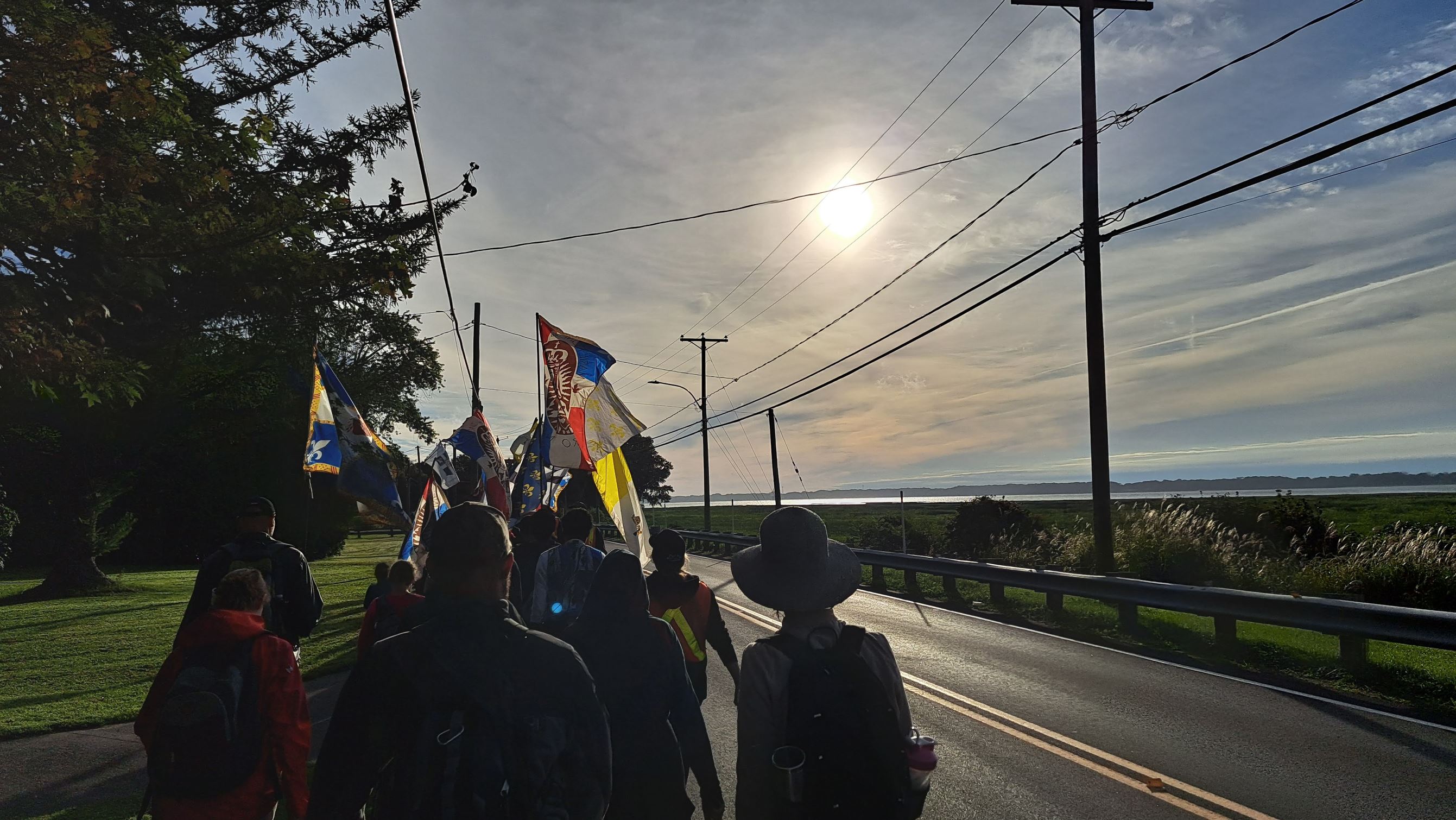
The Marie Reine du Canada pilgrimage to Canada’s national Marian shrine, Notre Dame du Cap, took place from September 3-5 this year. (Due to pandemic restrictions, the pilgrimage was a one-day event in 2020 and 2021). A lay-led endeavour based out of the FSSP’s apostolate in Ottawa, St Clement’s Parish, the pilgrimage is an annual, three-day 100 km (62 miles) trek in the footsteps of the North American Martyrs along Quebec’s north shore of the St Lawrence River. Much like the Pentecost pilgrimage to Chartres, pilgrims walk in chapters and carry banners while singing and praying, chaplains provide confession and spiritual direction en route, and all participants camp in tents. Priests celebrate Mass each day of the pilgrimage in parish churches along the route: in Berthierville, Yamachiche, and in the historic old shrine at Notre Dame du Cap, where upon the high altar stands the miraculous statue of Our Lady of the Cape, which opened its eyes on June 1888, in the presence of (later Blessed) Fr. Frederic Janssoone, Fr. Luc Desilets, and a layman, Pierre Lacroix. Next year will be the pilgrimage’s 20th anniversary.
Our thanks to Mr Ian Gallagher, and photographers Andrew Lessig, Philipp Winterstein, Virginie Soulard, and John Zwicker for sharing these pictures with us. The Mass photos are from the closing Mass after the arrival at the old shrine at Cap-de-la-Madeleine.

The Feast of St Michael and All Angels

The traditional title of today’s feast is “The Dedication of St Michael the Archangel”, a term already found ca. 650 A.D. in the lectionary of Wurzburg, the oldest of the Roman Rite that survives, and in the ancient sacramentaries. The Martyrology erroneously refers this feast to the dedication of the famous shrine of St Michael on Mt Gargano in the Italian region of Puglia, following a medieval tradition attested by William Durandus at the end of the 13th century. In reality, the title comes from the dedication of a church built sometime before the mid-6th century on the via Salaria, about seven miles from the gates of Rome, and remained in use long after the basilica itself fell completely to ruin. The traditional Ambrosian liturgy, which borrowed the feast from Rome, has in a certain sense preserved the memory of its origin better than the Roman Rite itself; not only does it use the Roman name, but it also takes several of the Mass chants, as well as the Epistle and Gospel, from the common Mass for the dedication of a church.
The central panel of The Last Judgment, by Rogier van der Weyden, 1446-52, showing Christ above, and below, St Michael weighing the souls of the dead.
Despite the fact that the feast’s title refers specifically only to St Michael, September 29th is really the feast of all the Angels, as stated repeatedly in the texts of both the Office and Mass. The Introit is taken from Psalm 102, “Bless the Lord, all ye his angels: you that are mighty in strength, and execute his word, hearkening to the voice of his orders.”

This text is repeated in part in the Gradual.


The Communion is taken from the Old Latin version of the canticle Benedicite, “Bless the Lord, ye angels of the Lord: sing a hymn, and exalt him above all forever.” (Daniel 3, 58)

The collect of the Mass makes no reference to St Michael at all: “O God, who in wondrous order assign the duties of Angels and of men: mercifully grant that our life on earth be guarded by those who continually stand in Thy presence and minister to Thee in heaven.”

The Lauds hymn of the Office speaks in its first stanza of all the Angels, and in the following three of Ss Michael, Gabriel and Raphael, the only Archangels specifically named in the Bible. In the Greek version of the book of Tobias (12, 15), however, St Raphael refers to himself as “one of the seven holy Angels, who present the prayers of the saints, and who go in before the glory of the Holy One.” This gave rise to a Byzantine custom of depicting seven Archangels standing together around the Lord; many icons of this motif give names to the remaining four from various apocryphal sources. One is called Uriel, who is mentioned several times in the Book of Enoch which St Jude quotes in his epistle (verses 14-15). The names of the remaining three are not the same in all sources; in the 19th century icon seen below, they are given as Jegudiel, Selaphiel and Barachiel.

The Byzantine feast of all the Angels is kept on November 8th, and like the Roman feast, originated with the dedication of a church; this was a basilica in Constantinople known as the Michaelion, traditionally said to have been built by Constantine himself. The formal title of the feast is “The Synaxis of the Great Commanders (ἀρχιστρατήγων) Michael and Gabriel, and the rest of the Bodiless Powers.” Curiously, the liturgical texts of the feast make no reference to St Raphael, nor to any of the other Angels, nor to the origin of the celebration.

In the Middle Ages, many places imitated the Roman custom of celebrating a second feast of St Michael, commemorating the famous apparition which led to the building of the shrine on Mt Gargano. In northern Europe, however, we find instead the feast of “St Michael on Mount Tumba”, the Latin name of the celebrated Mont-St-Michel, as for example in the Use of Sarum, which kept it on October 16th. A votive Mass of all the Angels was already in common use in the early ninth century, as attested by Alcuin of York, and is present among the votive Masses in every medieval missal. However, only very rarely does one find a feast of St Gabriel or of the Guardian Angels in the pre-Tridentine period; a Mass of St Raphael is sometimes found among the votive Masses especially to be said for the sick, but I have seen no no more than a handful of references to an actual feast day for him in the medieval period.

In the year 1670, Pope Clement X added to the general Calendar of the Roman Rite a feast of the Guardian Angels, which had been granted to the Austrian Empire by Paul V at the beginning of the century. The feast was kept in some places on the first Sunday of September, but the common date, October 2, was chosen as the first free day after the feast of St Michael.

The Three Archangels and Tobias, by Francesco Botticini, 1470
Pope Benedict XV, who reigned from 1914 to 1922, took a particular interest in devotion to the Angels. At the end of 1917, he raised the feast of St Michael to the highest grade, double of the first class, along with the March 19 feast of St Joseph. In 1921, he added the feasts of Ss Gabriel and Raphael to the general Calendar, the former on the day before the Annunciation, the latter on October 24 for no readily apparent reason. The feast of St Michael’s Apparition was removed from the General Calendar in 1960; in the post-Conciliar liturgical reform, Ss Gabriel and Raphael have been added to September 29th, and their proper feasts suppressed, along with the traditional reference in the title to the church dedication.

Wednesday, September 28, 2022

The 4th Annual Conference of the Catholic Art Institute, October 30 in Chicago

On October 30, the Catholic Art Institute, a Chicago-based Catholic Arts organization, will host another landmark conference bringing together today’s leading artists and scholars, to rediscover the power of Beauty in the modern world. This year, the Institute welcomes Scottish composer and conductor Sir James MacMillan as the keynote speaker; also presenting will be Alexander Stoddart, Sculptor in Ordinary to King Charles the III, as well as James McCrery, II AIA, NCARB award winning architect and Principal of McCrery Architects.
The theme of this year’s conference theme is “Art & Virtue,” and the event will take place at Chicago’s Athenaeum Theater. located at 2936 N. Southprt Avenue. The theater is a beautiful art deco building that seats 1100 attendees. Two basic ticket types will be available; ones for the presentations only, and another that include lunch, an elegant three course dinner and open bar, followed by a panel discussion with the conference presenters. Ticket prices start at $48 for tickets without catering and $275 for tickets that include lunch, dinner, and the panel discussion. VIP tickets are also available to include a thirty minute reception with the speakers. For details and to purchase tickets, please visit:
http://www.catholicartinstitute.org/conference2022 .
Sponsorship ads and tables are available for reservation. For details and to reserve your ad or table, please visit:
https://www.catholicartinstitute.org/sponsorships .
Additionally, the conference will begin with a Solemn High Mass featuring selections Sir James MacMillan, in Chicago’s historic St. John Cantius Church, a parish known for bringing beauty into Christian worship.

The Orations of Michaelmas

St Michael the Archangel, Castel Sant’ Angelo, Rome
Lost in Translation #78

The feast of St. Michael has a long and storied history in the Roman Rite. In the 1962 Missal it is known as the feast [of the anniversary of] the Dedication of St. Michael, a basilica that was dedicated to the Archangel on the Salarian Way about seven miles from Rome in A.D. 530 by Pope Boniface II. In the traditional rite, the feast maintains this title, even though the basilica it commemorates disappeared over a thousand years ago.

In the new Missal, the feast is that of “Saints Michael, Gabriel and Raphael, Archangels,” although it is indirectly extended to all Angels. The old rite has separate feasts for Gabriel and Raphael (March 24 and October 24, respectively), but is also shares a broader sensibility for all of God’s faithful heavenly spirts. Thus the Collect:
Deus, qui, miro órdine, Angelórum ministeria hominumque dispensas: concéde propítius; ut, a quibus tibi ministrántibus in cælo semper assístitur, ab his in terra vita nostra muniátur. Per Dóminum.
Which I translate as:
O God who, through a wonderful order, dost manage the ministries of Angels and men: graciously grant that as our life is forever assisted by those ministering to Thee in Heaven, may it also be defended by them on earth. Through our Lord.
The 2011 English translation of the new Missal (which retains this Collect) gets the gist of the prayer’s grammar where the old St. Andrew’s Missal does not, for the latter less clearly connects the ministry of the Angels in Heaven to our life on earth:
O God, who in a wonderful order hast established the ministry of angels and of men, mercifully grant that even as Thy holy angels ever do Thee service in heaven so at all times they may defend our lives on earth. Through our Lord.
The key is that when the Angels are ministering to God in Heaven, they are ministering to us, preparing us for heavenly rewards. We know this, for this is what these marvelous spirits do: they serve God, who wants them to serve us. Our only petition is that they do the same on earth as well. There is a nice contrast between “assistitur - assisted” (literally, to sit or stand by) and “muniatur - defended” (building a wall). Just as the Angels stand at the court of Heaven to help us, like soldiers on guard, so too do we hope that they will build a wall on earth to protect us against evils.
The subordinate clause for God, “He who dispenses ministries of Angels and men through a wonderful order,” is also noteworthy. God has delegated roles for His two intellectual creatures, the pure spirits known as Angels as well as human beings, a unique union of reason/intellect and animality. He allocates these roles through a “mirus ordo - wonderful order”, that is, an order that is not fully grasped by the human mind but elicits wonder and awe. We will never know, this side of the grave, all that the Angels do for us.
The Secret is:
Hostias tibi, Domine, laudis offérimus, supplíciter deprecantes: ut easdem, angélico pro nobis interveniente suffragio, et placátus accipias, et ad salútem nostram proveníre concédas. Per Dóminum.
Which I translate as:
O Lord, we offer up to Thee the sacrifice of praise, humbly praying that: by the angelic suffrage interceding for us, Thou wouldst graciously receive it and grant to attain our salvation. Through our Lord.
Unlike the fallen angels, who resent our inclusion in the economy of salvation, the good Angels, though superior beings, want us measly creatures to be saved! We offer up our Mass that God will accept their intercession and make it so. Suffragio, which I have translated as “suffrage,” can also mean “applause.” The Angels, these great spirits, are cheering for us in Heaven! Commenting on the Epistle to the Hebrews, Monsignor Ronald Knox writes: “If you are ever feeling rather down-hearted about your second-rate efforts to live a good Christian life, think of the Saints in heaven bending over the balconies in front of them and shouting out ‘Stick it it!’ as people do when they are watching a race. (The Creed in Slow Motion (Aeterna Press, 2014; repr. Sheed & Ward, 1949), p. 122.)
And thanks be to God, the nine choirs of Angels are doing the same.
The Postcommunion is:
Beáti Archángeli tui Michaélis intercessióne suffulti: súpplices te Dómine, deprecámur; ut, quod ore proséquimur, contingámus et mente. Per Dóminum nostrum.
Which I translate as:
Propped up by the intercession of Thy blessed Archangel Michael, we humbly beseech Thee, O Lord, that what we have pursued through our lips may also touch our souls. Through our Lord.
Ah, finally a reference to St. Michael on Michaelmas!
“Suffulti - Propped up” is rare in the Roman orations: it only appears one other time, in a Secret in a Votive Mass to Saint Joseph. If we are propped up by Saint Michael, the implication is that we need propping up, that we are constantly tottering without him in a world full of demons and other dangers. 
But here we make a more specific request: that St. Michael may help us have a more efficacious Holy Communion (which we have just received). Unlike the great Archangel, our heavenly aid is mediated through sacraments like the Eucharist, which we take through our carnal lips. But such a reception means nothing if it does not touch our souls, and so we ask God that through His faithful servant, Michael, our physical reception of the Eucharist may lead to a spiritual union with Him. Perhaps Michael is even guiding our souls to the divine target as he yells, “Stick it!”

Tuesday, September 27, 2022

The Legend of Ss Cosmas and Damian

Saints Cosmas and Damian are said to have been brothers from Arabia and physicians, who left their native place and settled in the Mediterranean port city of Aegea in Cilicia, modern south-east Turkey. They practiced medicine without taking any fee for their services, for which reason the Greek Church gives them the title “Unmercenary Saints”, (ἀνάργυροι, literally ‘un-moneyed’, Slavonic ‘безсребреники’), a title which they share with several others. During the persecution of Diocletian at the beginning of the fourth century, their Christian charity brought them to the attention of the local Roman governor, and they were martyred for the Faith, along with their brothers Anthimus, Leontius and Euprepius. By the 5th century there were two churches named for them in Constantinople, and in 527, Pope Felix IV converted a building in the Roman Forum into a church in their honor. This church is particularly important not only because the original apsidal mosaic is still preserved, although much restored, but also because it was the first “sanctuarium” in Rome, i.e., a church named for Saints, but with no material connection to them. (Churches of the Virgin Mary are an obvious exception.)

The apsidal mosaic of the Church of Ss Cosmas and Damian in Rome. On the far left, Pope Felix IV offers the church which he has built to Christ and His Saints. One of the two brothers is presented to Christ on the left by Saint Paul, the other by St Peter on the right. Peter and Paul, as the patron Saints of Rome, are closer to Christ, and dressed as Roman senators; Cosmas and Damian are wearing clothes that evidently would have look foreign to the eyes of a sixth-century Roman, and their faces are darker. On the far right, St Theodore, whose church is not far away on the other side of the Forum, balances the composition; as a Greek, he is also dressed as a foreigner. Above St Paul’s head, a phoenix, the symbol of the resurrection of the body, perches on a leaf of a palm tree.
They are among the Saints named in the Canon of the Roman Mass and the traditional form of the Litany of the Saints; along with four other Unmercenaries, (Cyrus and John, Panteleimon and Hermolaus), they are also named in the Preparation Rite of the Byzantine Divine Liturgy. The Emperor Justinian I (527-65) attributed to their intercession his recovery from a serious illness, and granted special privileges to the city of Cyrrhus in Syria, where their relics had been brought after their martyrdom. Many churches now claim to have their relics, among them the Jesuit church of St Michael the Archangel in Munich.

In the fifteenth century, they became particularly prominent in Florence as patron Saints of the de facto (and later de jure) ruling family, the Medici, whose name means “doctors.” In 1437, the Dominican convent of San Marco, newly established in an old Benedictine foundation, was completely renovated at the family’s expense. The painter Fra Angelico, one of the founders of the community, was commissioned to do a large altarpiece depicting the Madonna and Child surrounded by various Saints, with Cosmas and Damian kneeling before them in front of the group.

The main panel of the San Marco altarpiece, by Blessed Fra Angelico, 1438-40
The predella panels depict events from their story as given in the Golden Legend of Bl. Jacopo da Voragine. In the first, a woman named Palladia, who had spent all her money on doctors without being cured (like the woman with the issue of blood in the Gospels), is healed of an unspecified ailment by the brothers. She then compels Damian to accept a reward, at which Cosmas is so indignant that he states that he wishes to be buried apart from his brother, but the Lord Himself appears to Cosmas in a dream and excuses Damian.
The five brothers are hauled before a proconsul named Lysias, who orders them to worship an idol, shown on the far right. (Fra Angelico shares with his contemporary Piero della Francesca and other Tuscan artists of that era a predilection for depicting people in unusual hats; this comes from seeing Eastern clergymen during the great ecumenical council of reunion (1431-49), which was moved from Ferrara to Florence while he was working on this project.)
Since they refuse to worship the idol, the brothers are chained up and thrown into the sea, but are rescued from drowning by an angel. Lysias attributes their deliverance to sorcery, and asks them to teach him their magic, promising to become one of their followers. At this, he is immediately attacked by two demons, which depart at the brothers’ prayer.

Lysias, however, states that the demons attacked him because he thought to abandon the service of the pagan gods and follow the brothers, and therefore he will no longer permit the gods to be blasphemed. The Saints persist in the Faith, for which they are set on fire, but do not burn; arrows are then fired at them, but they turn back on the archers and kill them. (This is a persistent theme in the passions of the early martyrs, that nature itself will not cooperate with the persecutors, who are eventually forced to take the job in hand themselves.)

The series is interrupted by this classic Fra Angelico image of the deposition of Christ in the tomb.
Cosmas and Damian are crucified, and arrows are shot and stones thrown at them and their younger brothers, to no effect; they are therefore all beheaded.

The Christians take the bodies to bury them, knowing that Cosmas had previously expressed a wish to be buried separately; however, a camel approaches and speaks with a human voice, ordering them to be buried together. (The camel’s words are represented as a banderole with writing on it coming out of its mouth.)

A particularly bizarre miracle is reported of them in the Golden Legend, that shortly after Pope Felix built their church in Rome, the guardian was taken ill with a cancer that destroyed one of his legs. As he was sleeping one night, Cosmas and Damian came to him, and not only removed the diseased leg, but substituted it with a new leg taken from the body of an Ethiopian, who had died that very day and been buried in the cemetery of the nearby church of St Peter-in-Chains.

More recent articles:

For more articles, see the NLM archives: