Thursday, August 31, 2023

A Modern History of Gothic Vestments, 1838-1957 (Part 3): Guest Article by Nico Fassino

This is the third part of Mr Nico Fassino’s article on the history of the revival of Gothic vestments; the first part covered the period from 1841-1863, and the second part from 1863-1925. Mr Fassino is the founder of the Hand Missal History Project, an independent research initiative dedicated to exploring Catholic history through the untold and forgotten experiences of the laity across the centuries. Learn more at HandMissalHistory.com or @HandMissals. Once again, we are very grateful to him for sharing his interesting and thoroughly well-researched work with us.

A chasuble made for Cardinal Odoardo Farnese, ca. 1590-1610, designed by the painter Annibale Carracci. Image from Wikimedia Commons by Sailko, CC BY 3.0.
The Vatican “Ban” of 1925
The use of Gothic vestments continued to spread in England and elsewhere. For example: by 1925, it was reported that every single Catholic church and chapel except one (the Oratory of St. Philip Neri) in the Diocese of Birmingham used Gothic vestments. [38]
That year was a momentous one for the story of Gothic vestments. Pope Pius XI had proclaimed 1925 as a Holy Year, and Rome was chosen as the host city for an International Exhibition of Modern Christian Art. During the exhibition, “newly-made vestments, according to the Borromeon proportions, were shown in a special audience with Pius XI, who approved their use and blessed them.” [39]
Afterwards, there seems to have been a desire by some in Rome to walk back any idea of increased Gothic permissions. On December 9, 1925, the Sacred Congregation of Rites responded to a question regarding vestments. The rescript was exceedingly brief, did not formulate any new regulations or details, and simply referred the question back to the well-known letter of 1863, which was appended to the response:
[Question]: In the making and use of vestments for the sacrifice of the Mass and sacred functions, is it permissible to depart from the accepted usage of the Church and introduce another style and shape, even an old one?
[Response]: It is not permitted, without consulting the Holy See, in accordance with the Decree or circular letter of the S.R.C., given to Ordinaries on August 21, 1863. [40]
This was the very first time that the text of the 1863 letter had been published in any official collection of decrees of the Sacred Congregation of Rites. It is likely for this reason that the 1925 reply was commonly viewed as a ‘new’ or ‘updated’ Roman intervention on Gothic vestments, despite the fact that the reply merely pointed back to the original letter.
The Ecclesiastical Review, Dec, 1925, p. 626
The 1925 reply quickly raised questions around the world. It was reported in some quarters as an attempt to stop the widespread adoption of Gothic vestments. The editors of the Ecclesiastical Review answered several questions about it, discussed the original 1863 letter, and again did not interpret the decision to mean that ongoing use of Gothic vestments (or even the manufacture of new ones) was forbidden:
“Hence, while the use of the so-called Roman chasuble, in which the shoulder parts slightly overlap, is recognized as the prevailing approved custom, many churches in England, Germany, America, and even in Rome, adopt what is designated as the Gothic style to distinguish it from the purely Roman. It is certainly the more graceful of the two, and hence is commonly adopted in ecclesiastical art.” [41]
“The use of the Gothic chasuble in the modified form adopted by St. Charles and proposed by Bishop Gavanti, the Roman master of Pontifical ceremonies, is not forbidden. [...] The traditional right, which is not merely a privilege, of using Gothic vestments as described, was not abrogated by Pius IX or the S. Congregation, but continues wherever it has been regularly or accidentally adopted before that time.” [42]
As news of this reply from Rome spread in English-speaking lands, it produced a decent amount of confusion, and in some cases seems to have been met with barely a shrug. [43] Tongue-in-cheek commentary was offered in diocesan newspapers about the “battle of vestments” and the absurdity of attempting to define how ‘amply cut’ a vestment could be before it became forbidden.
The Catholic Transcript, April 15, 1926. p. 4
Gothic Vestments after the ‘ban’ of 1925
Given this reception and interpretation of the 1925 rescript, it will not be surprising that Gothic vestments continued to be used and continued to spread in the years which followed. In the decade following the 1925 document, they were discussed as normal and licit things by diocesan newspapers and the US Bishops’ news service; they were manufactured and advertised by church goods retailers, they were used in the presence of bishops and by bishops themselves; they were even used by papal legates and by the pope himself!
Gothic Chasuble commissioned in 1929 by Cardinal Francis Bourne. From Dom E.A. Roulin, Vestments and Vesture: A Manual of Liturgical Art (London: Sands & Co, 1933), page 94.
  • In 1926, Gothic vestments were used at the Solemn Midnight Mass at the Franciscan Monastery of the Holy Land in Washington, DC. [44]
  • In 1927, the US Bishops’ news service praised Sacred Heart church in Pittsburgh, Pennsylvania, for fostering a liturgical revival and specifically commented upon the exclusive use of Gothic vestments. [45]
  • In 1929, a special set of Gothic vestments was worn on the feast of St. Ignatius and Golden Jubilee of Rev. William Cunningham, SJ at the Church of the Gesù in Philadelphia, Pennsylvania. [46]
  • In 1929, Cardinal Francis Bourne commissioned Gothic vestments for Westminster Cathedral during the celebration of the centenary of Catholic Emancipation. [47]
On March 19, 1930, Pope Pius XI used Gothic vestments during mass at St. Peter’s, and allowed himself to be photographed while doing so. [48] Gothic vestments were widely used throughout Rome during these years, including by cardinals in the catacombs, at the Basilica of St. Sebastian, and in celebrations organized by the Pontifical Academy of Martyrs and presided over by the papal master of ceremonies. [49]
Pope Pius XI celebrating Mass in a Gothic chasuble made for him by the Poor Clares of Mazamet, France. Source: Raymund James, “The Origin and Development of Roman Liturgical Vestments” (Exeter: Catholic Records Press, 1934), page 2.
In 1934 the Catholic Church in Australia held a National Eucharistic Congress in Melbourne, celebrating the centenary of the church in that country and featuring “unprecedented” spectacular ceremonies and vast numbers of clergy and laity. On November 30, following the opening ceremonies for the congress, pontifical high mass was celebrated at St. Patrick’s Cathedral by papal legate Cardinal Joseph MacRory in the presence of 60 bishops and 450 priests from around Australia. The cardinal and celebrating ministers wore Gothic vestments. [50]
The Telegraph (Brisbane), Nov. 30, 1934, p. 7 
The following day Archbishop Filippo Bernardini, papal nuncio to Australia, celebrated another pontifical high mass in St. Patrick’s Cathedral for a crowd of more than 7,500 people, wearing Gothic vestments, which were frequently used throughout the Eucharistic Congress. [51]
Full approval of Gothic Vestments
In the years which followed, various members of the hierarchy of Australia continued to use Gothic vestments in high-profile settings, as in 1937, when Archbishop of Adelaide Andrew Killian used them during the consecration of Francis Henschke as Bishop of Wagga Wagga. [52]
They continued to receive official approval and use around the world during these years, for example, being authorized for the Archdiocese of Malines by Cardinal Jozef-Ernest van Roey in 1938, and by the Second Diocesan Synod of Quebec in 1940. [53]
Gothic vestments even reached the literal ends of the Earth during this period. During the US Navy’s Antarctic Expedition, on January 26, 1947, the first ever Catholic Mass offered in Antarctica was celebrated in extremely rustic conditions in the mess hall of camp ‘Little America IV’ on the Ross Ice Shelf. Rev. William Menster, chaplain of the flagship USS Mount Olympus, used green Gothic vestments. [54]
At left, Rev. William Menster; at right, the USS Mount Olympus (AGC-8) in Antartica, 1947. (Sources: left and right.)
Finally, on August 20, 1957, the Sacred Congregation of Rites issued a decree which gave bishops the right to permit the use of Gothic vestments in their own dioceses. From this point onward their use, which had been regular throughout the world by priests and bishops alike since 1925, only further increased.
NCWC News Service, Aug. 31, 1957, wire copy p. 8
Conclusions
This concludes our survey of the use of Gothic vestments between 1841 and 1957. It is a story far more complex and fascinating than that depicted by conventional narratives. What can we make of all this? I think there are several key points which are worthy of summary and further discussion.
First, it is abundantly clear that the ‘revival’ of Gothic vestments in the modern period was much more widespread throughout Europe–particularly in England, France, and German-speaking lands–much earlier than commonly thought. By 1849 it was authorized by multiple bishops (in some cases on a diocesan-wide basis) across the continent.
Second, it is also clear that from the very early days of the Gothic revival, there were some officials in Rome who were skeptical and disapproving of the use of these vestments. The number of those who disliked the Gothic, as well as their roles and the intensity of their opposition, varied over the years. On multiple occasions, the popes themselves directly gave approval for and/or approving remarks about Gothic vestments. But in general, there was consistently more opposition than support from various members of the curia.
Despite this, it is also evident that Rome did not ever unequivocally condemn or actually attempt to stamp out the practice, and that there was widespread toleration of Gothic vestments, which evolved into permission to the local bishops. [55] There were no formal restrictions against Gothic vestments until the circular letter of 1863, and even then it was not viewed by chanceries and clerical journals around the world as a strict ‘ban’. The text of the letter was not published for more than 60 years afterwards and not a single different or clarifying statement was ever issued by Vatican officials.
It’s obvious that there was a persistent lack of clarity on what Rome permitted, tolerated, or forbade, as is evident from the number of times the question was raised in clerical journals and Catholic periodicals). There was also a widespread interpretation that Gothic vestments could continue to be used with the permission of the bishop. Because of this, the situation varied from diocese to diocese and region to region. In some cities or dioceses, the use of Gothic vestments was fully approved; in others, it was forbidden or limited.
All of this demonstrates how difficult it would be to claim that there was a clear message from Rome or to assign the label of disobedience to those many priests, bishops, and laity who produced, purchased, and used Gothic vestments for decades even after the 1863 letter. They were discussed approvingly in diocesan newspapers, permitted and used by the bishops and cardinals of the region, and routinely sanctioned by canonical and clerical journals. If the use of these vestments was in fact disobedient or forbidden during these decades, could the common priest or member of the laity have been expected to discover that fact with any certainty? [56]
Even after the Vatican rescript of 1925–which merely pointed back to the 1863 letter, and again, was not interpreted as a ban–the use of Gothic vestments did not slow or diminish. Just 5 years after the rescript, the pope himself was photographed in Gothic vestments. Within less than a decade, multiple papal nuncios and legates were regularly using them in the most high-profile and public ceremonies possible.
Photograph of the Gothic vestments blessed by Pope Pius XI in 1925. Source: Dom E.A. Roulin, Vestments and Vesture: A Manual of Liturgical Art (London: Sands & Co, 1933), page 82.
Because the use of Gothic vestments was so widespread before 1900 (and was desired and encouraged by so many different priests and bishops in so many different countries for so many years) it seems clear that it would have been essentially impossible to avoid the trend even without the advent of the modern Liturgical Movement in the 1920s.
If Rome truly viewed the ongoing use of Gothic vestments as a clear abuse or explicitly forbidden, it must be said that they handled it in one of the worst and most ineffective ways possible. Furthermore, once papal representatives and the pope himself began to even occasionally use them for public masses, any remaining doubt about their permissibility was eliminated in the mind of Catholics around the world.
Following the decree of 1957, Gothic vestments came to dominate the ecclesiastical landscape and their use for the last several decades has been essentially universal. Contrary to the expectations of the writer in America in 1910, it seems that the vast majority of priests in the mid-20th century did not adopt the Gothic with “heavy hearts” after all. It is also interesting that the lighthearted commentary from 1926 now appears to be extraordinarily prescient:
“The question of amplitude or non-amplitude in vestments will never, let it be hoped, rise, or descend, to schismatical proportions. There was a long dispute over the date of Easter. The war of the Vestments ought to be settled within a generation or two at the utmost.” [57]
And indeed it was.
NOTES (numeration continued from previous article):
[38] The Advocate (Melbourne), June 4, 1925, page 15.
[39] Quote from Michael Sternbeck, “Styles and tradition in the chasubles of the Roman Rite” from Saint Bede Studio blog. For more on the exhibition, see Lucia Mannin, “Italian exhibitions of modern sacred art, from the early 20th century to the 1930,” pp 87-92.
[40] The original Latin of SRC rescript 4398 can be found in “May we use ‘Gothic’ Vestments?,” The American Ecclesiastical Review, June 1934, page 578. English translation adapted from The Celebration of Mass: A Study of the Rubrics of the Roman Missal, Vol I (Milwaukee: Bruce Publishing Company, 1941), pp 265-266.
[41] “Roman versus Gothic Vestments,” The Ecclesiastical Review, December 1925, page 630.
[42] “The Gothic Vestment Once More,” The Ecclesiastical Review, March 1926, page 309.
[43] “At once the rumor spread that ‘Gothic chasubles are forbidden’ and this was industriously circulated by many who disliked them. Discussions (not always temperate) ensued, consciences were troubled, [and] Catholic periodicals [...] were deluged with requests for enlightenment[.]” See Rev. Edwin Ryan, “May we use ‘Gothic’ Vestments?” The American Ecclesiastical Review, June 1934, page 579.
[44] NCWC News Service, December 1, 1926, first page of wire copy ‘Christmas Supplement #2’.
[45] NCWC News Service, February 7, 1927, wire copy page 5.
[46] The Catholic Standard and Times, August 10, 1929, front page. This mass was attended by Bishop Joseph Murphy, SJ, a former classmate of Cunningham.
[47] “The Form of Vestments,” The American Ecclesiastical Review, April 1942, page 252. For more on this set of vestments, which remains occasionally in use today, see “The Pentecost Pontifical High Mass Set of Westminster Cathedral” at the blog Liturgical Arts Journal.
[48] These vestments are described by Raymund James, “The Origin and Development of Roman Liturgical Vestments” (Exeter: Catholic Records Press, 1934), page 2. This chasuble seems to now be held by the Metropolitan Museum of Art’s Anna Wintour Costume Center (in the ‘Vatican Collection’).
[49] “The Form of Vestments,” The American Ecclesiastical Review, April 1942, page 252.
[50] The Telegraph (Brisbane), November 30, 1934, page 7. It was later recalled that “ there did not seem to be any shortage of Gothic vestments during the National Eucharistic Congress,” see The Advocate (Melbourne), July 18, 1935, page 24.
[51] The Herald (Melbourne), December 3, 1934, page 4.
[52] The Southern Cross (Adelaide), August 20, 1937, page 10. The co-consecrators were the Archbishop of Sydney and the Bishop of Wilcannia Forbes, and the ceremony was attended by three other bishops, fifty priests, and thousands of the faithful.
[53] “The Form of Vestments,” The American Ecclesiastical Review, April 1942, page 252.
[54] The Catholic Standard and Times, January 31, 1947, front page. Little America IV would also be the site of the first-ever ecclesiastical painting made on Antarctica, when in 1956 artist Robert Charles Haun would create a custom altar triptych for use at Catholic Mass in the mess hall.
[55] “The Gothic chasuble differs also in shape, and for this reason its use has been discouraged by the Roman authorities. There has been no public condemnation of it, as far as we are aware.” See The Irish Ecclesiastical Record, December 1918, page 512. The editors of the Record also discuss the 1863 letter in this same response, demonstrating that they do not view it as a condemnation of Gothic vestments as such.
[56] “It cannot be said that so many pious and God-fearing people–religious superiors, bishops, cardinals of the Holy Roman Church, the Pope himself, are infringing law” (see “The Form of Vestments,” The American Ecclesiastical Review, April 1942, page 253).
[57] The Catholic Transcript, April 15, 1926, page 4

The Feast of Bl. Ildephonse Schuster 2023

Normally, we would never let August 30th pass without remembering the Blessed Cardinal Alfredo Ildefonso Schuster, who went to his eternal reward on that day in 1954, after serving as Archbishop of Milan for just over a quarter of a century. Yesterday, however, my wifi router went on strike, and I was unable to post anything, so better a day late than never. We have written about him many times on NLM, partly in connection with our interest in the Ambrosian liturgy, of which he was a great promoter, but also as one of the most notable scholars of the original Liturgical Movement. His famous work Liber Sacramentorum, known in its English translation as The Sacramentary (republished in both paper and cloth by Arouca Press), was written while he was still a Benedictine monk of the Roman Rite, and although inevitably dated in some respects, it remains an invaluable reference point for liturgical scholarship.

Upon his transfer to Milan, he embraced the Ambrosian liturgy wholeheartedly, and as the ex-officio head of the Congregation for the Ambrosian Rite, strongly defended the authentic uses of the Milanese tradition. He also oversaw important new editions of the Ambrosian musical books, which are still used in both the Ordinary and Extraordinary Form of the Rite to this day. Our dear friend Monsignor Amodeo, a canon of the Duomo of Milan who was ordained a subdeacon by the Blessed Schuster, told us many stories about him over the years, among which one has always stood out in my mind in particular; in his lifetime, even the communist newspapers noted his continual presence in the Duomo at all of the most important functions of the liturgical year. Nicola de’ Grandi, our Ambrosian writer, once showed me a video of Cardinal Schuster giving Benediction from the façade of the Duomo, to a crowd that completely filled the huge piazza in front of the church. (Thanks to Nicola for these photos.)

Pontifical Mass on the feast of St Charles; the mitred canons sitting on the steps of the altar are the deacons and subdeacons who serve the Mass, apart from those at the throne.
Preaching from the great tribune pulpit of the Duomo.
Lighting the faro on the feast of St Sebastian.
During the difficult years of his episcopacy, the years of Italian Fascism and World War II, during which Milan was one of the hardest hit cities in Italy, the Bl. Schuster showed himself in every way a worthy successor of St Charles Borromeo, shepherding his flock in much the same way, visiting every parish of the diocese five times (occasionally riding on a donkey to some of the more remote locations), holding several diocesan synods, and writing innumerable pastoral letters.
Pastoral visit to the village of Valsolda.
Praying at the tomb of Card. Andrea Ferrari, archbishop of Milan from 1894-1921. Card. Ferrari was beatified on May 10, 1987; his relics are now in an altar in the right aisle of the Duomo, right next to that which contain the relics of Bl. Schuster. 
A diocesan synod.
Card. Schuster, accompanied by three mitred canons of the cathedral chapter, assists from the throne at the Pontifical Mass celebrated by the Archpriest of the same chapter, during the traditional presentation of candles in the “Tempio Civico” (civil temple) of St Sebastian on the patronal feast. The mayor of the city and other dignitaries are also present; the official banner of the city, with a famous image of St Ambrose, is seen on the right. The Tempio Civico was built by the city of Milan in 1576 as an ex voto for the end of a particular severe outbreak of the plague, one in which St Charles famously ministered to the sick and dying with his own hands. Candles are presented to the church by the city as part of the annual commemoration of the end of the plague; the devotional life of Italy is still to this day rich with such festivities.
His body lying in state.
The funeral procession.
When his tomb was opened in 1985, his mortal remains were found to be intact; he was beatified by Pope John Paul II in 1996, and his body was exposed for the veneration of the faithful in one of the side-altars of the Duomo.
My first experience of the Ambrosian liturgy was a votive Mass in the traditional rite held in his honor in 1998, at which Monsignor Amodeo and another canon sang the Ambrosian propers of a Confessor Bishop; after Mass, we processed from the altar of the left transept around the church to the altar, and sang the Ambrosian litany of the Saints at his tomb. The Ambrosian manner is for the cantors to sing the name of the Saint (“Sancte Ambrosi”) as in the Roman Rite; the choir responds by repeating it, and adding “pray for us.”

Beate Ildephonse. Beate Ildephonse, ora pro nobis!

Tuesday, August 29, 2023

The Beheading of St John the Baptist 2023

A righteous man is murdered by adulterers, and a death sentence is pronounced by the guilty upon their judge. Then the death of the prophet was the fee of a dancing girl. Last of all (something which even savages are wont to shun), the order to perpetrate this cruelty was given amid feasting and merriment, and the servants of this brutal crime run from banquet to prison, from prison to banquet. How many crimes within this one evil deed!

The Head of St John the Baptist Presented to Herod, by Donatello, 1427; one of six decorative panels on the baptismal font of Siena Cathedral.
Look, most grievous king, on these sights well worthy of thy banquet. Put out thy hand, that nothing may lack from thy savagery, and let the streams of sacred blood run between thy fingers. ... Look at the eyes, which even in death are witnesses of thy crime, even as they turn away from the sight of thy pleasures. Those eyes are closed, not from the necessity imposed by death, but from horror at thine excess. That golden mouth, now bloodless, whose sentence thou couldst not bear, groweth silent, and is still feared. (St Ambrose, On the Virgins, book 3; the sermon at Matins for the feast of the Beheading of St John the Baptist in the Breviary of St Pius V.)

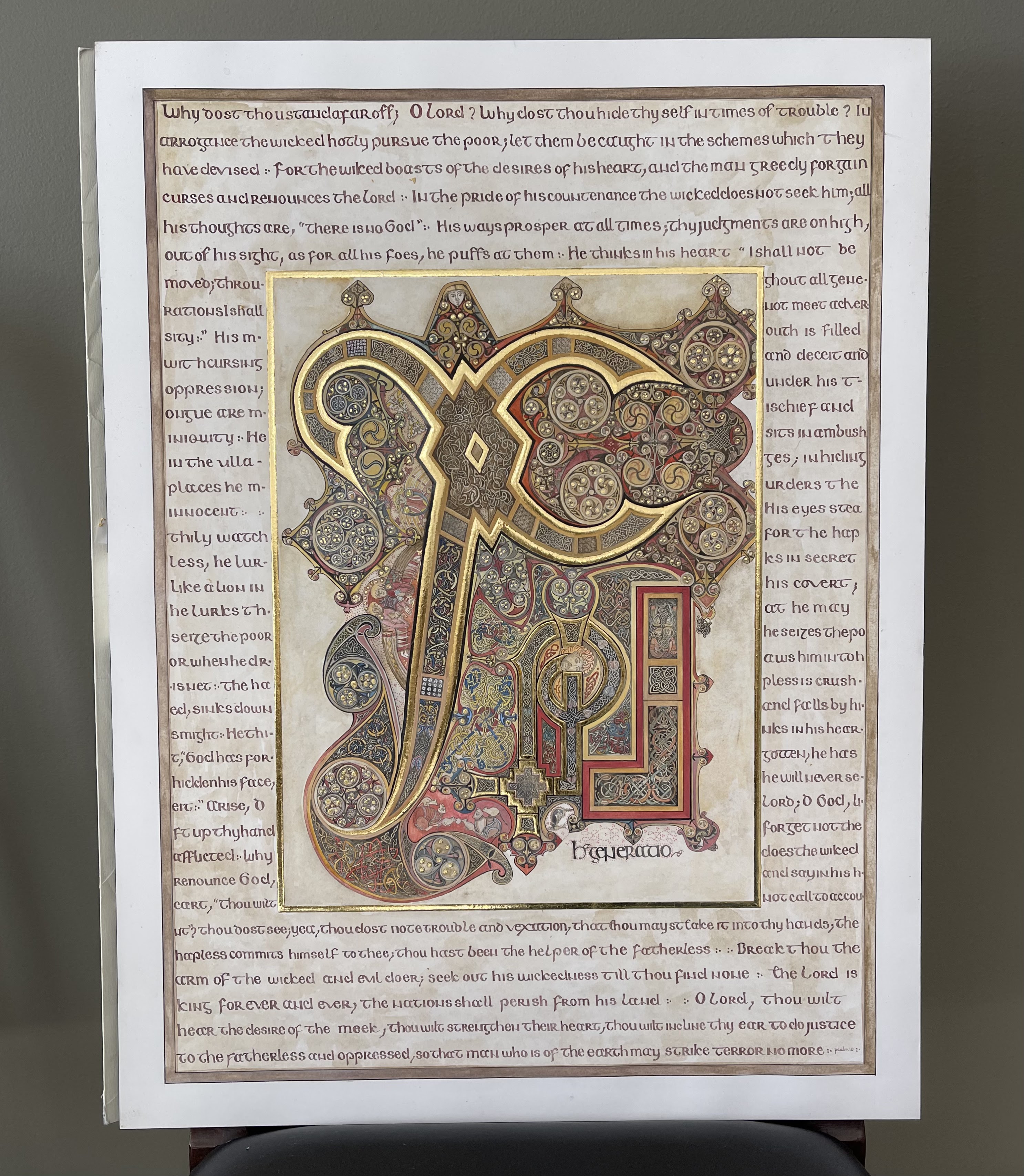
A Contemporary Hiberno-Saxon Style Illumination of the Chi-Rho

Work from a Graduating Student at the Pontifex University Master of Sacred Arts Program

I am excited to show you the work of one of our students, Daniela Diz, who submitted this for her capstone portfolio, the final stage of the Masters program. Daniela specializes in illumination and decorative and geometric patterns in the Christian tradition.

She based this work on the Chi-Rho of the Book of Kells, a manuscript which was created in the 7th century in what is referred to as the “Hiberno-Saxon” style. Chi and rho are the first two Greek letters of the word for Christ, ΧΡΙΣΤΟΣ (Christos).

The Master of Sacred Arts program capstone gives students a choice of either a research and writing option, or the submission of a portfolio of art work. The goal of the MSA overall is to offer to students the formation and Catholic inculturation that might have been offered to artists in the past. This is of interest, therefore, to artists in any creative discipline; to potential patrons of the arts who wish to understand Catholic tradition and how artists work; as well as the many people who have a deep interest in Catholic art and culture and want to know more. 
The practical content is not high. Aside from the option of submitting an art portfolio as part of the capstone, there other practical requirement is to create some geometric constructions as part of my Mathematics of Beauty course. As you can probably guess, Daniela came to us already equipped with a high level of skill, but enrolled with us because she wished to know more deeply how to direct her talents to the service of the Church. Some readers may remember, incidentally, that I featured the same student’s work for that Mathematics of Beauty course, a beautiful intricate floor designs in a Romanesque style.
Here are more photographs, showing the work in progress on the Chi-Rho. Note that she gilds the page as well as drawing and inking it.
The opening words of Psalm 10
The application of gold leaf
If you wish to commission her to do some work for you, please contact me through this site or www.Pontifex.University and I will put you in touch with her.

Monday, August 28, 2023

A Visit to St. Patrick’s Church in New Orleans, Home to the Latin Mass Since 1965

In terms of the history of the traditionalist movement, one of the most interesting places I had the opportunity to visit in Louisiana was St. Patrick’s in downtown New Orleans.

This church is a glorious artistic monument, built in 1833, and boasting an inspiring history. It is one of the few places anywhere on earth that kept the chanted Latin liturgy going from 1965 all the way to the present. There was a period (from ca. 1970 to 1984) when the Mass was the Novus Ordo in Latin, but before that period, and after it, the Roman Rite has held sway. All of the pastors from 1965 onward have been committed to keeping this tradition going; the archbishops have supported it, and the congregation is strong and healthy.

The parish is “bi-formal”; each day there is both the TLM and the NOM, and on Sunday the Novus Ordo is also celebrated ad orientem. The very sign announcing the Mass times is like a silent testament to Benedict XVI’s vision of paix liturgique, now shattered by his successor:

The Sunday 9:15am Solemn High Mass I attended filled the pews, with a high proportion of young adults and big families. The congregation sang the Ordinary and responses with gusto.


Some other photos of the church that I managed to get that day. The Tiffany stained glass is quite extraordinary, especially the orders of angels above the high altar, and the ornately carved wooden altar itself:

Saturday, August 26, 2023

A Modern History of Gothic Vestments, 1838-1957 (Part 2): Guest Article by Nico Fassino

This is the second part of Mr Nico Fassino’s article on the history of the revival of Gothic vestments; the first part was published on Wednesday. Mr Fassino is the founder of the Hand Missal History Project, an independent research initiative dedicated to exploring Catholic history through the untold and forgotten experiences of the laity across the centuries. Learn more at HandMissalHistory.com or @HandMissals. Once again, we are very grateful to him for sharing his interesting and thoroughly well-researched work with us.

Reception of the 1863 letter

Despite the 1863 letter from the Sacred Congregation of Rites, the use of Gothic vestments did not seem to be much changed in the years which followed. Records demonstrate the widespread and uncontroversial use of Gothic vestments around the globe during these years, including:

  • In 1870, a magnificent set of Gothic vestments worth approximately $50,000 in modern valuation was given to Bishop Richard Roskell of Nottingham for use in the cathedral. [15]
  • In 1873, Archbishop of Sydney John Polding wore “rich” Gothic vestments as he ordained Christopher Reynolds as Bishop of Adelaide in a large ceremony attended by at least four other Australian bishops. [16]
  • The 1867, 1879, 1883, and 1885 retail catalogs of Benziger Brothers, the premier Catholic publishing house and church goods retail in the United States, offered Gothic-style vestments. [17]
  • At his ordination by 1887, newly-consecrated Bishop of Wilcannia John Dunne wore “a superb and costly” set of white and gold Gothic vestments. [18]
  • By 1895, one account observed: “… there is a great diversity in this respect [of vestments] in the Roman Catholic Church. In England, the Gothic, French, and the Italian chasubles are all freely used by the Roman Catholic Clergy. [...] The Swiss Roman Catholic clergy and those in many parts of Germany use Gothic vestments, not those of Renaissance form”. [19]
Archbishop of Sydney John Bede Polding in Gothic vestments, 1866
Another summarized the situation thus: “[a]s in England, so also on the Continent, the advance of the ample chasuble was notable. By 1900 many dioceses in Western Europe could show churches where it was in use. Some of them had secured indults, some had simply accepted a growing custom, and all could cite the example of Rome itself, where several cardinals and at least two popes (Pius IX and X) encouraged the ample chasuble and used it themselves.” [20]
Helene Stummel, ca. 1890
Helene Stummel, wife of the famous artist Frederick Stummel, was a vestment maker, and a passionate advocate for the revival of Gothic vestments during these years. She was sought after by many bishops, taught regularly across Europe, and published books on recommendations for the design of vestments:

“Madam Stummel has lectured before cardinals, bishops, and the clergy in Rome, before the Congresses of Cologne and Dusseldorf. Recently a number of the Bishops of England have invited her to speak before the conferences of the clergy and in their seminaries to the students of theology. She possesses a singular mastery of the subject, and has the means to illustrate her clear and erudite expositions from a rare collection of paramentics gathered and disposed with artistic skill and a thorough realization of the dignity of the subject.” [21]

One may wonder how such a situation could exist following the circular letter of 1863. It seems exceedingly implausible that significant numbers of bishops and priests of multiple countries throughout the world were deliberately disobeying Roman directives. What then is the explanation?

Interpretation of the 1863 letter
First, it is interesting to note that the 1863 letter was not published or included in the official collection of decrees and decisions of the Sacred Congregation of Rites for more than sixty years after it was written. It is possible that, because of this, in some isolated cases the letter went unheeded due to lack of awareness, or because it was viewed as less authoritative than a formal decree. [22]

The letter was widely known in general, however, and regularly cited in clerical journals or similar interpretive authorities. These discussions demonstrate how the 1863 letter was understood and applied over decades and suggest an explanation for why the use of Gothic vestments continued: in short, the letter was not considered to be an unequivocal or totally restrictive ban.

Writing in 1884, the editors of the Irish Ecclesiastical Record explained that this letter permitted Gothic vestments to continue to be used but prevented any new vestments from being produced: “[i]n the face of this decree, it is not lawful to manufacture new vestments of this pattern. The bishop may allow the use of those already made, till they are worn out.” [23]
Painting of Rev. William Lockhart, from the cover of “William Lockhart: First Fruits of the Oxford Movement” (Herefordshire: Gracewing, 2011).
Rev. William Lockhart, a convert and friend of John Henry Newman, offered extensive commentary on the 1863 letter in the pages of the Irish Ecclesiastical Record in 1890, stating that, among other things, the manufacture of ‘Borromean’ chasubles (in the size and shape prescribed by St. Charles Borromeo) remained fully permitted without requiring any special permission, as did the ‘Galway’ chasuble in Ireland. [24]

Despite the continuing use of Gothic vestments and the prevailing interpretation that the 1863 letter permitted this (but not the manufacture of new ones), Rome did not issue any further instructions, clarifications, or restrictions. [25]
The hated modern ‘French’ style
It is also worth noting that there were a number of prominent clerical and lay figures during these years who regularly wrote about their preference for the Gothic style in clerical journals and Catholic periodicals. Ernest Gilliat-Smith, for example, wrote in 1890, “... to my mind, Gothic vestments are preferable to Roman, both from an artistic and symbolic point of view, and I hope and trust that one day their use may be universal.” [26]

There was also widespread and long running disdain for the cheap, mass-produced French (modern fiddleback-style) vestments. These had undergone rather significant changes in style – described by some as “cutting and clipping” and others as “mutilation” – both before and after the French Revolution. These new forms were not forbidden by Rome and had quickly spread throughout Italy and elsewhere. [27]
Example of French-style clerical dress, 1776
The trend was described by the editors of the American Ecclesiastical Review as “[t]he growing abuse of the viol- (fiddle-) shaped chasuble, forced on the ecclesiastical market by the French makers of paramentics and silk merchants.” [28] Commentary in the Irish Ecclesiastical Record in 1890 is at turns both comical and illustrative, and seems worth quoting at length:

“Who can describe the abortion of the chasuble that pervades France at the present day? Fiddle-shaped in front, not coming down to the knees, stiff with buckram, or paper pasted on the poverty-stricken half-cotton-half-silk material of Lyons manufacture. They are as stiff as tea-boards, and crack if they are bent.

“I was told a story lately in Belgium, of a priest who objected to the stiff paper pasted between the flimsy silk and cheap cotton lining. The manufacturer [...] misunderstanding the objection of the priest, replied: ‘Yes, M. l‘Abbe, we always use paper, in order that they may wear better, and to add to the substantial appearance of our vestments; but I assure you, on this point I have a delicate conscience, and I never put into vestments anything but des bons journaux Catholiques [good Catholic newspapers].”

“These Lyons vestments are going every day all over the world. They are cheap, and Les Dames pieuses can thus make their collections go a good way in providing vestments for Les Missions Etrangeres. [...] We need not wonder that Pius IX intimated in the letter of Cardinal Patrizi that there might be good reasons (rationes alicujus ponderis), in favour of a return to the more ancient form of the vestment.” [29]

Even the noted authority Bishop Josephus van der Stappen commented dismissively on the French corruption of the chasuble:

“Hence, when the ancient chasuble had, in the course of time, been cut down from its generous proportions of old, to the skimp reduction of modern times, and the evil had found its way from France into the neighboring countries, there arose in England, France itself, Germany, and Belgium men who, animated by a zeal for Christian art, sought on their own account to restore the ancient practice by adopting the more beautiful style of Gothic vestments...” [30]

American Gothic (Vestments)
In America, by the turn of the century, there was some regular use of Gothic vestments and clear clerical support for more. Even the editors of the Ecclesiastical Review, nobody’s idea of progressive innovators, routinely featured pieces and editorials supporting their adoption.
Excerpt from the Ecclesiastical Review, April 1910
Beyond mere support, the Review was considered to be a driving force behind a movement pushing for the change in vestments. A letter from 1910 begins: “To the Editor, The Ecclesiastical Review. My hearty congratulations upon the movement you have started for the very desirable reform in our church vestments. Enclosed is a typical letter showing that you have many well-wishers with you in this matter…” [31]  Multiple examples of proposed Gothic designs were published in the Review, along with example measurements of what was permissible.
Model of proposed Gothic chasuble in the Ecclesiastical Review, December 1909, page 687.
The use and permissibility of Gothic vestments were widely discussed in various Catholic publications of the time. Some discussions even considered the potential future of a Roman decree to abandon fiddlebacks and exclusively adopt the Gothic! A 1910 editorial in the Jesuit journal America commented on the matter in a rather cheeky fashion:

The proper form and colors of vestments is being discussed in the Ecclesiastical Review[…] they represent a school long in existence in Germany and England, and are strong in art and aesthetics. We fear the faithful are largely Philistines [regarding which style of vestments they prefer]. Moreover, the Latin races are not likely to submit gladly even in this matter to the Teuton. [...]

If the Holy See so ordains, priests will all exchange our aniline-dyed, fiddle-shaped vestments for modified Gothic of subdued, esthetic hue. But many will do so with heavy hearts and there will be heavy hearts, too, among their people. It is hard to part with old friends, and the modern form and the bright colors have many to love them. For, after all, as Andrew Lang, singing in ‘The Galleries’ the charms of the two schools of art, confesses: ‘You still must win the public vote, Philistia!’ ” [32]

Examples of a proposed three-tiered system of vestments, in the Ecclesiastical Review, March 1910, page 351. This system was devised by Bishop Wilhelm von Keppler of Rottenburg, Germany. [33]
Through the first decade of the twentieth century we find records of the use of Gothic vestments across America. In 1910, Gothic vestments were in use in St. Mary’s church in Portland, Oregon. The Tabernacle Societies of the cathedrals in Baltimore and Cincinnati, which funded supplies and furnishings for parishes too poor to afford them, regularly produced Gothic vestments during these years. [34]

In 1914, the general American situation was summarized as follows: “[d]uring the last few years there has been a steady advance, especially in our larger city churches, towards a more exact observance of the rubrics and the carrying out of the solemn services of the Church. One of the notable features has been a closer approach, in the matter of vestments, to the old Roman usage, and many churches have adopted altogether the use of the so-called Gothic (old Roman) chasuble in place of the violin-shaped garments introduced by Gallican enterprise.” [35]

Example of Gothic vestments being given to bishops as gifts. Source: NCWC News Service, May 28, 1923, wire copy page 15.
Parishes were proud to own fine Gothic vestments and hefty sums were paid out for the best sets from American and European retailers. They were also frequently given as gifts by various parish or diocesan groups to their priests and bishops. For example, in 1922 the St. Anne Married Ladies’ Sodality at St. Mary's parish in Dayton, Ohio paid $900 for an imported set as a Christmas gift to their pastor (equal to $16,345 in 2023 when adjusted for inflation). [36]

By 1924 they seem to be in widespread and regular use, at least in certain parts of the country. In Cincinnati alone there are multiple examples of Gothic vestments mentioned in less than 12 months: at the Student’s Crusade Castle chapel, at the parishes of St. Margaret of Cortona and St. Agnes, and even at the Cathedral. [37]

This concludes the second article in this series. The third and final article will explore the use of Gothic vestments between 1925 and 1957 and offer conclusions concerning the whole series.
NOTES (numeration continued from previous article):
[15] The Nottinghamshire Guardian, April 22, 1870, page 2. The set was donated by nuns of Cologne, Germany and was valued at between £400-500 in 1870, or £39,180 adjusted for inflation as of June 2023.
[16] The Express and Telegraph (Adelaide), November 3, 1873, page 2.
[17] See Sadliers’ Catholic Directory, Almanac and Ordo (1867), page 52; and Katherine Haas, The Fabric of Religion: Vestments and devotional Catholicism in nineteenth-century America, page 32.
[18] Freeman’s Journal (Sydney), August 20, 1887, page 17.
[19] The Daily Telegraph, January 26, 1894, page 5.
[20] Rev. Edwin Ryan, “May we use ‘Gothic’ Vestments?” in The American Ecclesiastical Review, June 1934, page 577. These comments are confirmed by other sources. Pius IX explicitly authorized Gothic vestments to be used by the French Dominicans and the Diocese of Moulins (see Raymund James, The Origin and Development of Roman liturgical vestments, page 28). Pius X, in comments made to Msgr. Heinrich Swoboda and later relayed to the 1912 Eucharistic Congress of Vienna, praised the Gothic vestments used by German parishes in Rome which he had authorized and said “the vestments of the Mass must once more be made according to this beautiful large form” (see Roman liturgical vestments, page 28). Pius X also, in responding to criticisms of the modern fiddleback chasuble by Msgr. Anton de Waal in 1906, said “Ha perfettamenta ragione, è il piu brutto possibile, questa forma” (see “The Reform in Church Vestments,” Ecclesiastical Review, March 1910, page 320). The widespread use of Gothic vestments is noted in many places during these years, including: “... the use of the Gothic vestment is recognized in some of the principal churches of Italy, not excluding Rome, and especially England, Germany, Belgium, and parts of France.” (see “The Pattern of the Chasuble for the Mass,” The Ecclesiastical Review, December 1909, page 686), and “In most of the churches of the archdiocese of Cologne hardly any other kind is used at present.” (see “The Reform in Church Vestments,”page 320).
[21] “The Pattern of the Chasuble for the Mass,” The Ecclesiastical Review, December 1909, page 688.
[22] It is even claimed in a handful of sources that the 1863 letter did not, in fact, actually have the approbation of the pope. This claim is made by Rev. John Laux, CSSp (writing under the pen name George Metlake, “The Reform in Church Vestments,” Ecclesiastical Review, March 1910, page 320) and for support he cites: “See Pruner, Pastoraltheologie, vol. I, p. 56; and Braun, Die priesterlichen Gewänder des Mittelalters, 174.” I have not been able to verify either citation and therefore cannot assess the credibility or details of the claim.
[23] See the Irish Ecclesiastical Record, Vol 5 (1884), page 56. The interpretation of the 1863 letter as permitting ongoing use of Gothic vestments but forbidding the manufacture of new ones appears to be fairly widespread and is attested to again in 1890: “But you will, perhaps, say, all this is very true, but we are not allowed to make new Gothic vestments. I am perfectly well aware that more than one diocese is restricted to the Roman shape, at least so far as concerns the manufacture of new vestments.” See Ernest Gilliat-Smith, “Ecclesiastical Vestments,” Irish Ecclesiastical Record, Vol 11 (1890), page 312.
[24] Lockhart’s commentary is fascinating. He argues that with the 1863 letter “no prohibition has been issued against a return, even to the largest form of the vestment in use previous to the Council of Trent”, and that what the letter actually forbids was a return to these vestments in a way which appears to be an innovation. He says that “the change in the size and form of the vestment, in the sixteenth century [to the fiddleback-style chasuble] can only claim for itself toleration on the part of the Holy See” and “that the Sacred Congregation admits that there may be reasons of some weight, “rationes alicujus ponderis,” in favour of a return to the usage of antiquity, and distinctly invites an inquiry.” See Rev. William Lockhart, “The Gothic Chasuble,” Irish Ecclesiastical Record, Vol 11 (1890), pp 1084 & 1091. Lockhart’s article was reprinted and in places edited and expanded as The Chasuble: It’s Genuine Form and Size (London: Burns & Oates, 1891).
[25] Lockhart, “The Gothic Chasuble,” page 1084; see also Rev. John Walsh, The Mass and Vestments of the Catholic Church (Troy: Troy Times & Art Press, 1909), page 475.
[26] Ernest Gilliat-Smith, “Ecclesiastical Vestments,” Irish Ecclesiastical Record, Vol 11 (1890), page 312. Other writers already cited and quoted above, like Rev. James Connelly and Rev. William Lockhart, also favored the Gothic.
[27] Rev. Claude de Vert, writing in the early 1700s, heavily criticized “[the French vestment makers] who are allowed the liberty of nibbling, clipping, cutting, slashing, shortening, just as the whim may take them, chasubles, dalmatics, tunicles, and other priestly garments or ornaments which serve for the ministry of the altar; in a word, they give these vestments what shape they would like, without consulting the bishop” (English translation from Raymund James, The Origin and Development of Roman liturgical vestments, page 27; James does not cite the source, but it seems to be from Explication simple, litterale et historique des cérémonies de l’Eglise Vol 2). For more description and commentary of the trend of “the mutilation and even destruction” of vestments during these centuries, see Roman liturgical vestments, pp 19-27; see also Rev. William Lockhart, The Chasuble: It’s Genuine Form and Size (London: Burns & Oates, 1891), pp 16-20.
[28] The Ecclesiastical Review, March 1926, page 309.
[29] Rev. William Lockhart, “The Gothic Chasuble,” Irish Ecclesiastical Record, Vol 11 (1890), page 1090.
[30] As quoted in “The Pattern of the Chasuble for the Mass,” The Ecclesiastical Review, December 1909, page 682. Other articles in the same journal cited additional comments from Van der Stappen on this topic: “Of our present-day chasuble, which is said to be a French contrivance and partly the outcome of commercial motives and industrial accommodation, Van der Stappen says: ‘[...] In place of the former flowing robe gracefully falling over the body they thus produced a sort of fiddle-shaped garment which had to be cut in front so as to permit the free movement of the arms.’ Subsequently this form degenerated still further and under the commercial influence of French vestment-makers the front part was often arbitrarily reduced so as to expose the arms and shoulders of the priest standing at the altar. ‘This new fashion of commercial chasuble,’ continues the author, who writes for seminarists [sic], ‘is lacking in both beauty and due reverence and should be censured and rejected.’ See “Roman versus Gothic Vestments,” The Ecclesiastical Review, December 1925, page 629.
[31] “Anent the Reform in Church Vestments” The Ecclesiastical Review, March 1910, pp 349-350.
[32] “What Vestments Shall We Wear?” America, February 19, 1910, page 509.
[33] See “The Introduction of the Old Roman (Gothic) Chasuble,” The Ecclesiastical Review, January 1910, page 86; and “The Reform in Church Vestments,” Ecclesiastical Review, March 1910, page 321.
[34] See: Our Sunday Visitor, October 21, 1910, page 5; The Baltimore Sun, May 31, 1913, page 6; and The Catholic Telegraph, June 8, 1916, page 5.
[35] “The ‘Color Rosaceus’ for Laetare Sunday” in The Ecclesiastical Review, March 1914, page 326.
[36] The Catholic Telegraph, December 28, 1922, page 5.
[37] See The Catholic Telegraph, October 11, 1923, page 9; The Catholic Telegraph, April 17, 1924, page 5; The Catholic Telegraph, June 26, 1924, page 8; and The Catholic Columbian, September 12, 1924, page 3.

Friday, August 25, 2023

The Vigil of St Augustine, According to the Order Formerly Known as the Hermits of St Augustine

St Augustine, attributed to Gerard Seghers, 1600-50
Lost in Translation #83

Saint Augustine of Hippo, whose feast day falls on August 28, left an indelible mark on the theology of Western Christianity, as well as on the priesthood and religious life. Augustine was one of the earliest bishop to establish what were later called Canons Regular, originally, priests that live with their bishop and share a common life, and his Rule led to the formation of several religious orders. The largest and most familiar of these is the Order of Saint Augustine (OSA), founded in 1244 and originally known as the Hermits of Saint Augustine (OESA).

In addition to the universal feast on August 28, the old Augustinians kept proper several feasts of their own, including a vigil on August 27 and an octave, which ended on September 4. Today, we look at the vigil and its orations.
The Collect is:
Da, quǽsumus, omnípotens, Deus: ut beáti Patris nostri Augustíni Confessóris tui Pontíficis, quam prævenímus, veneránda solémnitas; et devotiónem nobis áugeat et salútem. Per Dóminum.
Which I translate as:
Grant, we beseech Thee, Almighty God: that the solemnity about to be celebrated for our Blessed Father Augustine, Confessor and Bishop, which we anticipate, may increase in us devotion and salvation. Through Our Lord.
The one verb (besides “we beseech”) that runs throughout all three Orations is praevenimus. The Douay-Rheims translates this word as “prevent,” but English has attached new meanings to this word in the ensuing centuries. The safest way today to translate prae-venimus, or “come before,” is “anticipate.”
The Secret is:
Ut accépta tibi sint, Dómine, nostra jejúnia, præsta nobis, quǽsumus, beáti Patris nostri Augustíni suffrágiis, cujus natalítia prævénimus, purificátum tibi pectus offérre. Per Dóminum.
Which I translate as:
In order for our fasts to be accepted by Thee, O Lord, grant us, we beseech, to offer Thee a purified heart through the supplications of our blessed Father Augustine and whose birthday we anticipate. Through Our Lord.
The Secret draws attention to the fact that the Vigil was--as traditional vigils usually are--a day of fasting. The Augustinians kept this practice, and so did the Archconfraternity of Our Lady of Consolation, which was aggregated to the Hermits in 1575. But fasts mean little without a humbled and contrite heart behind them (a subject on which Augustine was a master), and so the Augustinian community asks for such a heart through the intercession of their patron saint. Curiously, no reference is made to the Eucharistic offering, which is the most common theme of a Secret.
St Augustine, by Sandro Botticelli, 1490 
As for the reference to Augustine’s “birthday,” we turn to the Postcommunion:
Sancti Patris nostri Augustíni Confessóris tui atque Pontíficis, cujus natalítia praevenímus, quǽsumus, Dómine, supplicatióne placátus; et véniam nobis tríbue, et remédia sempitérna concéde. Per Dóminum.
Which I translate as:
Being pleased, O Lord, we beseech, by the supplication of our Holy Father Augustine, Thy Confessor and Bishop, whose birthday we anticipate: that Thou wouldst grant us pardon, and concede to us sempiternal remedies. Through Our Lord.
The prayer relies, perhaps boldly, on Augustine’s intercession or supplication and not on the Sacrifice just offered. But we should not dismiss this petition as a lack of faith in the efficacity of Holy Mass; rather, it directs our attention to the Saint, who prayed, and who continues to pray, for his spiritual sons and daughters. On this vigil, we anticipate his birthday—not his earthly birthday, which is on November 13, but on his heavenly birthday, when he passed away on August 28 while the barbarians (the Vandals) were literally at the gate of his beloved city of Hippo and as he prayed (successfully) for their deliverance.
It is, still, a somewhat cheeky assumption. Normally, only the martyrs were granted the privilege of having their “birthday” on the day that they were martyred. But these sons of Augustine are confident that the same privilege applies to their Holy Father who, they believe, went from this life to the next without any stay in Purgatory.
In 1965, the Hermits of Saint Augustine eliminated the vigil of St. Augustine, and in 1969, the General Calendar moved the feast of St. Monica from May 4 to August 27, which further cemented the fate of this Vigil, since it is not easy to fast on the feast of St. Augustine’s mother.

More recent articles:

For more articles, see the NLM archives: