Tuesday, February 28, 2023

A Roman Pilgrim at the Station Churches 2023 (Part 1)

This year marks the tenth time we have run this series on the Lenten station churches in Rome! However, the professional circumstances of our dear friend Agnese, the original Roman pilgrim, have changed of late, such that she will likely be unable to attend many of them this time around. In past years, she has sometimes been joined in this series by other people; one of them, Mr Jacob Stein, whose work we have shared many times, will be providing most of the photos this year, as well as videos from his YouTube channel Crux Stationalis. We thank him for helping us to keep up one of our favorite Lenten traditions, and we are very pleased to begin this year’s series by wishing him a very happy birthday: ad multos annos, optime!

Thursday after Ash Wednesday – San Giorgio in Velabro
His Eminence Gianfranco Cardinal Ravasi, President of the Pontifical Council for Culture and the Pontifical Commission for Sacred Archeology, comes each year to personally celebrated the station in his title church, which he holds in the illustrious company of (among many others) Bl. John Henry Newman; his predecessor in the title was Alphonse Card. Stickler.
Friday after Ash Wednesday – Ss John and Paul
The building within which the lower part of the church’s medieval bell-tower is now partially enclosed is the generalate of the Passionist order. Their founder, St Paul of the Cross, had a brother named Giovanni Battista (John the Baptist), himself now a Venerable, to whom he was very close, and who was instrumental in helping him found the order. Many years after the latter’s death, Pope Clement XIV (1769-74) gave the basilica to St Paul to be the first “retreat”, as the order’s houses are called, in Rome, in remembrance of his beloved brother, since the martyrs John and Paul were also brothers.
“The entrance to Ss John and Paul, Crispus, Crispinian and Benedicta.” In 1887, a member of the Passionist community, Fr Germanus of St Stanislaus, began to dig under the church, hoping to identify the precise location of the martyrs’ burial. His excavation led to the discovery of a complex of twenty rooms from several different periods (late-1st to mid-5th centuries), which can now be visited by the public. (The relationship of the three other martyrs to John and Paul is not entirely clear.)
Saturday after Ash Wednesday – St Trypho
In the Roman Missal, the Station is listed at a church called St Trypho, which was demolished in 1595. The relics of Trypho and his companions, Respicius and Nympha, were transferred along with the Lenten Station to the nearby church of St Augustine, and now repose in the high altar. This church is particularly diligent in bringing out all of its relics for the station day.
The First Sunday of Lent – St John in the Lateran
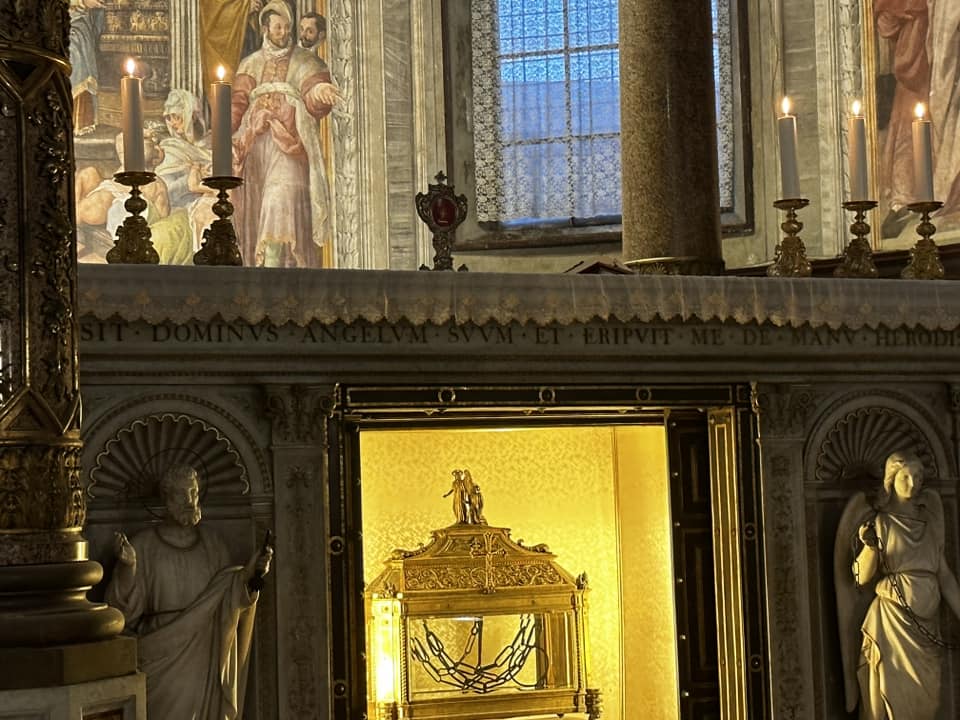
Monday of the First Week of Lent – St Peter in Chains

Does the Church Need Artists Who Are Humble Scribes? Or Original Geniuses?

Looking At Rabanus Maurus, St Dunstan, the anonymous painter of the San Damiano Crucifix, and Matthew Paris: how they are connected, and what they can teach us today.

Recently, I was put in touch with a small group of artists at the newly established sacred art studio at Ealing Abbey, the Benedictine house in West London. These artists are learning their craft under the guidance of the British iconographer Aidan Hart, and forming a group that learns together, and passes on what it learns to others, so as to encourage the spread of the iconographic tradition in the Roman Church.

I was interested in talking to them about their vision of past forms of iconography that might appeal to the modern eye, and so serve as a launch pad for what might in time be the development of a distinct contemporary, but nevertheless authentic, tradition of iconography in the Roman Church. I was very pleased to learn that they shared my enthusiasm for the line-based Romanesque and early Gothic styles of the English church. (Regular readers know that I tend to focus on the work of the 13th-century Gothic artist Matthew Paris.) The artists of the Ealing Abbey studio directed my attention to the work, previously unknown to me, of St Dunstan, who lived in the 10th century, a reformer of English monasticism who was based in Glastonbury for a large part of his life. He is less known as an artist: here is his drawing of Christ in which he has painted himself adoring the Saviour.

The inscription above him reads: Dunstanum memet clemens rogo, Christe, tuere. Tenarias me non sinas sorbsisse procellas (I ask you, merciful Christ, to watch over me, Dunstan, and not let the Taenarian storms swallow me.)

In their book The Image of St Dunstan, Nigel Ramsay and Margaret Sparks suggest that the idea for placing himself in the image came to St Dunstan from a 9th-century manuscript by another monk, Rabanus Maurus. Maurus wrote and illuminated “De laudibus sanctae crucis - On the praises of the Holy Cross”, a collection of poems presenting the sacred symbol in words, images, and numbers. One of the illuminated poems (in which every line has the same number of letters) can be seen here: as we can see, Rabanus Maurus portrayed himself adoring the cross.

When I looked at the St Dunstan image. It immediately brought to mind two others. The first was from the 13th-century England, by the monk Matthew Paris.
Here Paris has referred to himself as “Frat[er] Mathias Parisiensi[s] - Brother Matthew Paris.” It might be that he got the idea of including himself from Dunstan, who first got the idea from Maurus, I cannot say. But it occurs to me that it is just as likely that all three, Maurus, St Dunstan and Paris, were working within a tradition in which the scribe portrays himself in this manner, humbling himself before a holy patron. This being the case, it might be that none is aware of the work of any of their predecessors directly.

Another connection that occurred to me as I look at the St Dunstan image is that of the San Damiano crucifixion in the Basilica of St Claire in Assisi.

The facial features of each are striking, to me at least, as being similar to the other. I had always been under the impression that the San Damiano crucifixion had its origins in 9th century Syria, but most references I can find nowadays seem to have revised that idea, and suggest that it was painted by an Italian artist in the 12th century. So assuming the latter to be true, we might ask where the 12th century artists saw the St Dunstan image? Or are both following a established tradition for what the face of Christ looks like, with each being aware of a number of similar images? Again I do not know the answer to this question.

What does seem to be apparent, however, is that artists in the past were looking at each others’ work and happily replicating and adapting what they saw in order to create their own work. This is good practice, for it is the means by which tradition is passed on. 
Following traditional forms in art is almost antithetical to the modern mindset, in which everyone tries to be different from those who preceded them in order to demonstrate “originality.” However, as Christians, until we re-establish a mindset in which artists copy each other’s works with understanding, and deliberately seek to adapt or change only what is necessary to meet the needs of their commission, we cannot re-establish a tradition of sacred art in the Church today. A hermeneutic that dictates that artists do as little original work as possible, rather than as much as they can, is one that respects the past and, paradoxically, allows for the development of steadily better work in the future. In this sense, tradition has its hands on the tiller that guides present day artists as they develop new and inspired work. 
So whichever works from the past eventually do inspire the new tradition of the future, it will take a team of artists who view themselves as humble scribes, in the manner of Paris, Dunstan and Maurus, rather than celebrated original geniuses, for it to happen!

Monday, February 27, 2023

New Expanded Edition of Pre-55 Holy Week Congregational Book

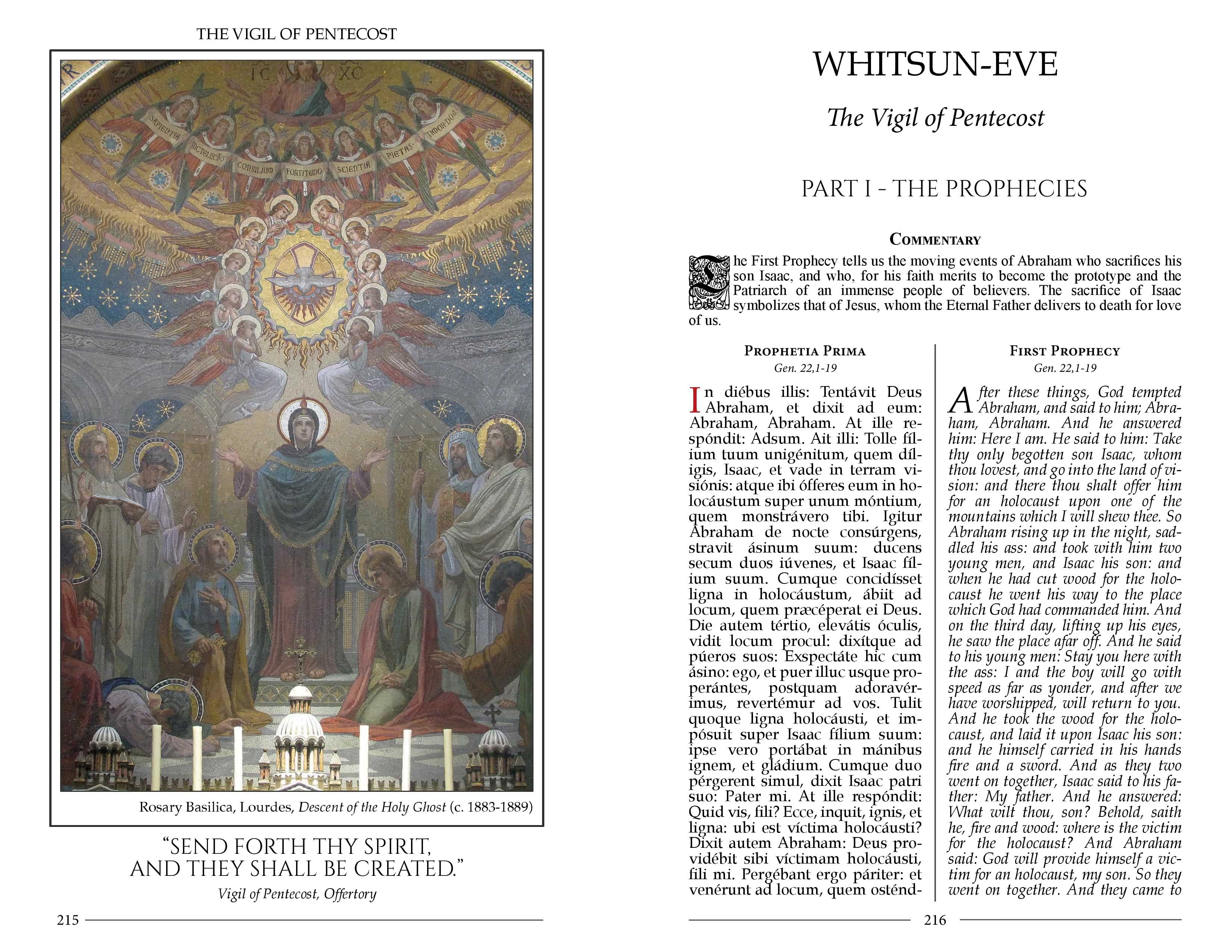
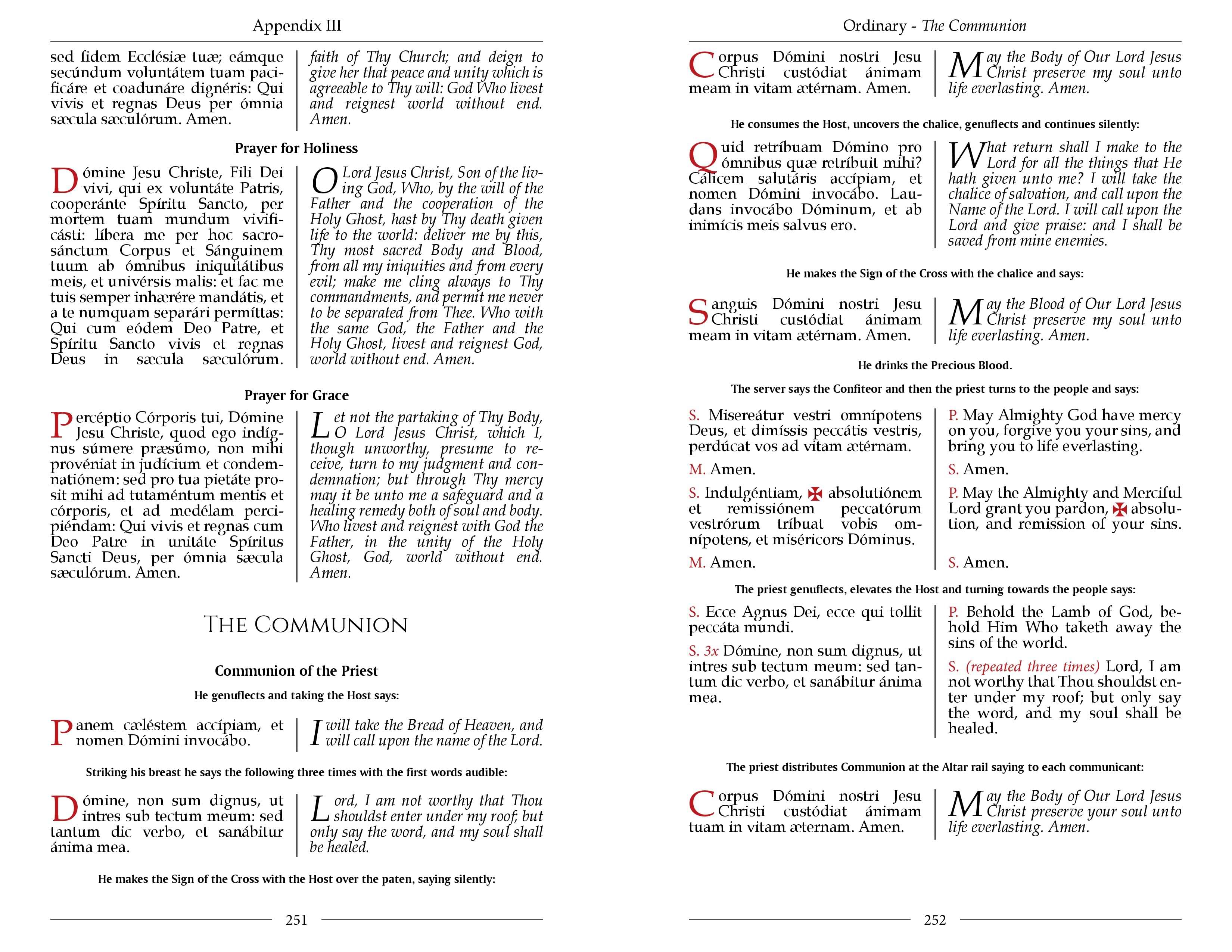
I’m pleased to announce the second revised and expanded edition of Roman-Seraphic Books’ Pre-1955 Hebdomada Sancta (Holy Week) congregational book, containing all the ceremonies and texts, in parallel Latin & English, with spiritual and historical commentary. The book also contains the pre-55 Vigil of Pentecost as well.

The Second Edition now including the full text of the offices of Tenebrae for the Sacred Triduum, alongside other appendices for Stations of the Cross, the Seven Sorrows, and more.

Nearly 400 pages and with full-color illustrations, the book is quite comprehensive yet printed in a font that is easy to read — truly a book that can be used by congregations year after year.

The Second Edition is available from Roman Seraphic Books (www.romanseraphicbooks.com) at a reduced price from last year, down to $24.97 (from $28.97). International shipping options and bulk orders available.

Roman-Seraphic Books aspires, over time, to preserve and spread the traditional (pre-55) liturgical books, as well as the books pertinent to the Franciscan spiritual patrimony.


Books may be obtained here.

The restoration of tradition continues!

Lectio Divina (2): What, Where, and When

Last week, we saw St. Gregory the Great speaking about the immense value of the practice of lectio divina or praying with the Scriptures, and I gave a simple sketch of how it works, recommending it as a practice to take up this Lent (and then to continue beyond Lent!) if you are not already doing it.

Naturally, questions arise. How do we decide, in practical terms, what to read each day—where to go in the Bible, how much, and for how long?

What we should bear in mind is that lectio divina is not meant to be an elaborate, burdensome obligation, but a childlike encounter with God in His Word, something that will refresh us and give us light for our journey. It will stretch us and challenge us, to be sure, but in such a way that we are still led to the peace of Christ. It’s not an academic study or a rote recitation. A personally fruitful lectio divina can be done by everybody.

I


First, as to quantity. Usually several verses, up to about half a chapter, is the right amount for people living in the world. A person could read an entire chapter, but that’s a lot to read slowly and meditatively, and it’s far more important to be able to ponder what we're reading and pray about it than to “get through” a certain book. Even one verse can furnish enough material for lectio divina, if the verse really hits one in the gut. The Gospels are ideally suited to lectio for many reasons, one of which is the way they are divided into small chunks or pericopes (e.g., a parable, miracle, or conversation) that can be taken by themselves.

It is important to read slowly, really thinking about what we are reading, and if something strikes us in a new way, or if we have a sense that this particular “word” (phrase or sentence) is what we need to take to heart, we should stop and ponder that word. There is no requirement to “finish” a section of the text; one can always resume there next time. On the whole, it will do us more good to meditate and pray than to continue reading. Indeed, our powers of concentration are limited, so even if we had all day at our disposal, we would do better with several shorter times of reading mixed with a variety of other activities.

The great Thomist Fr. Reginald Garrigou-Lagrange once stated:
One single sentence from Sacred Scripture can nourish the soul, illuminate it, strengthen it in adversity. Sacred Scripture is something far superior to a simple exposition of dogma, subdivided into special tracts: it is an ocean of revealed truth in which we can taste in advance the joys of eternal life.


II


Second, as to choice of text: there are 73 books in the Bible. They fall into groupings that are extremely different from one another, not only in genre—historical or narrative, prophetic, poetic, epistolary, legislative, apocalyptic—but also in their immediate accessibility or usefulness for personal prayer. The Fathers, Doctors, and mystics of the Church reached a level of spiritual maturity that enabled them to reap a harvest from any verse in Scripture, but since we are not their equals, we need to be more humble and more realistic. Some books clearly lend themselves to lectio divina for beginners, and indeed these books are the ones that all the saints keep going back to. They are: the Psalms (and the Wisdom literature in general); the prophets, both major and minor; and every book in the New Testament, with the Gospels holding pride of place. Simply put, if we choose one of the Gospels or a psalm, it is almost impossible not to profit from meditating on that reading.

Still, there will be dry moments when we can’t make heads or tails of a reading, and that’s also a healthy experience for us: we need to realize that we are not in charge. Any fruit we reap is God’s gift to us, and when we don’t seem to be reaping fruit, it’s because He’s preparing a larger harvest for us that demands a greater faith and trust in him before it can happen. The more experienced we become with lectio, the more freely we can launch out into the deep of other parts of Scripture and find nourishment there, as well.

III


Third, as to when and where: one need not do lectio divina in a church; what is necessary is to choose a time and place of quiet, where we can let our mind and heart go into the Word of God. For some people, this could be a conveniently situated church or chapel—it is one of the few places in our noisy world that is (usually) still recognized and respected as a haven of silence. But if there is a quiet place in one’s home early in the morning, that, too, would be well suited for lectio. Indeed, so great is the dignity of the Word of God that the Church has granted a plenary indulgence, with the usual conditions, to the devout reading of Scripture for one half-hour, anywhere.

The timing is also important: we need to find a time of day that is not so busy that we will be utterly distracted. For most people, this is early in the morning; once we get started with the work day, there’s too much going on. The morning has a special quality to it that strongly recommends it as a time for lectio.

We may conclude with the rousing words of the Benedictine monk Smaragdus of Saint-Mihiel (c. 760–c. 840):
For those who practice it, the experience of sacred reading sharpens perception, enriches understanding, rouses from sloth, banishes idleness, orders life, corrects bad habits, produces salutary weeping, and draws tears from contrite hearts . . . curbs idle speech and vanity, awakens longing for Christ and the heavenly fatherland.
          It must always be accompanied by prayer and intimately joined with it, for we are cleansed by prayer and taught by reading. Therefore, whoever wishes to be with God at all times must prayer often and read often, for when we pray it is we who speak with God, but when we read it is God who speaks with us.
          Every seeker of perfection advances in reading, prayer, and meditation. Reading enables us to learn what we do not know, meditation enables us to retain what we have learned, and prayer enables us to live what we have retained. Reading Sacred Scripture confers on us two gifts: it makes the soul’s understanding keener, and after snatching us from the world’s vanities, it leads us to the love of God.
(Part II of a five-part series. Here is Part I.)

More recent articles:

For more articles, see the NLM archives: